


When Kevin Warsh was sworn in as chairman of the Federal Reserve, he touted a planned policy regime change for America’s central bank and pledged not to repeat past mistakes. Four months-plus into his tenure, Warsh finds himself in the same boat as his predecessor: sticky inflation and the need for higher interest rates.
Warsh promised to be an independent leader, with high ethical standards, whom markets and the public could trust. That included a willingness to resist persistent calls for lower interest rates by the president who appointed him, Donald Trump.
“The president never asked me to predetermine, commit, fix, decide on any interest rate decision in any of our discussions,” testified Warsh before the Senate banking committee in April.
Beyond interest rates, Warsh has already changed Fed business somewhat. He is not participating in the Fed’s Summary of Economic Projections, in which participants predict future economic growth, unemployment, inflation, and policy rate paths. Warsh wants public speeches cut down so governors can do “more thinking, less talking.”
So far into Warsh’s tenure, though, he’s facing similar problems as his predecessor as Fed chairman, Jerome Powell.
</p>
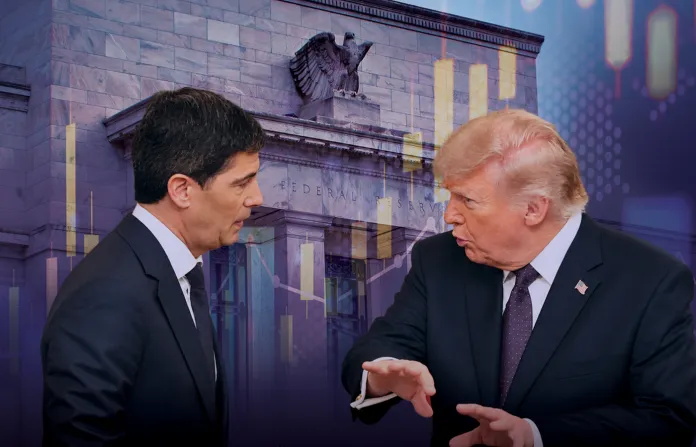
<p> ” data-large-file=”https://conservativemodern.com/wp-content/uploads/2026/10/fed-expected-to-raise-interest-rates-again-against-trumps-wishes.webp” height=”658″ width=”1024″ src=”https://conservativemodern.com/wp-content/uploads/2026/10/fed-expected-to-raise-interest-rates-again-against-trumps-wishes.webp” alt=”Federal Reserve Chair Kevin Warsh and President Donald Trump. (Washington Examiner Illustration/Getty Images/Alex Brandon/AP)” class=”wp-image-4752851″ style=”width:888px;height:auto” srcset=”https://conservativemodern.com/wp-content/uploads/2026/10/fed-expected-to-raise-interest-rates-again-against-trumps-wishes-1.webp 1400w, https://conservativemodern.com/wp-content/uploads/2026/10/fed-expected-to-raise-interest-rates-again-against-trumps-wishes-1.webp?resize=300,193 300w, https://conservativemodern.com/wp-content/uploads/2026/10/fed-expected-to-raise-interest-rates-again-against-trumps-wishes-1.webp?resize=768,494 768w, https://conservativemodern.com/wp-content/uploads/2026/10/fed-expected-to-raise-interest-rates-again-against-trumps-wishes-1.webp?resize=1024,658 1024w, https://conservativemodern.com/wp-content/uploads/2026/10/fed-expected-to-raise-interest-rates-again-against-trumps-wishes-1.webp?resize=150,96 150w, https://conservativemodern.com/wp-content/uploads/2026/10/fed-expected-to-raise-interest-rates-again-against-trumps-wishes-1.webp?resize=696,447 696w, https://conservativemodern.com/wp-content/uploads/2026/10/fed-expected-to-raise-interest-rates-again-against-trumps-wishes-1.webp?resize=1068,687 1068w” sizes=”auto, (max-width: 1024px) 100vw, 1024px”><figcaption class=) Federal Reserve Chair Kevin Warsh and President Donald Trump. (Washington Examiner Illustration/Getty Images/Alex Brandon/AP)
Federal Reserve Chair Kevin Warsh and President Donald Trump. (Washington Examiner Illustration/Getty Images/Alex Brandon/AP)Inflation remains above the Fed’s 2% target. Consumer prices were 3.4% higher in August than a year earlier.
Warsh at the start of the summer declined to say whether rates should rise.
After the Federal Open Market Committee voted to keep interest rates steady in July, Warsh promised to keep an eye on the markets and address price shocks when necessary. He was encouraged by job gains and the lower unemployment rate — despite higher inflation.
In August, Warsh said the Fed’s focus should be on prices but did not endorse a rate hike. He indicated it was important to wait for more information before anything else.
The Bureau of Labor Statistics reported Sept. 11 that core inflation, all items minus food and energy, rose 2.4% from this time last year. Food prices rose 2.7%, and energy prices rose 16.3%.
One week later, the FOMC raised interest rates by a quarter of a percentage point to 3.75%-4%.
“It’s defensible but late,” said Jai Kedia, an economist at the Cato Institute.
Kedia wasn’t surprised by the unanimous interest rate decision because the FOMC had been debating higher interest rates for months. He was curious why committee members waited so long to address inflation.
“It was much higher earlier this year when the Fed chose to do nothing,” he told the Washington Examiner.
Iran war complicates interest rate debate
Earlier this year, the FOMC wrestled with lowering rates versus holding them steady despite higher prices. As the Iran war continued — and central banks worldwide began raising rates — members began favoring a hike, with three members wanting a quarter-point hike.
David Beckworth, a senior research fellow at the Mercatus Center at George Mason University, said the upward pressure is coming from persistent budget deficits and AI investment.
“As we run these larger deficits, how do we finance them?” Beckworth asked the Washington Examiner. “At some point, the Fed’s going to have to accommodate it.”
He said artificial intelligence is helping the economy grow, but all that investment is also competing for workers, electricity, equipment, and capital, potentially pushing prices upward.
That makes it easier for politicians to avoid discussing deficits, Beckworth said.
“You can always point to something else because the world’s a complicated place with all these moving parts that affect interest rates,” he said. “It’s challenging to kind of parse out everything.”
Beckworth said he supports the FOMC’s decision to raise rates to communicate credibility to the market and tackle inflation. That would allow the market to self-correct by cutting back on spending.
That self-correction may not be the best decision for the U.S. economy, said Mark Zandi, chief economist at Moody’s Analytics.
Zandi worried that raising rates too quickly would push growth down.
“That is hard to do without layoffs, rising unemployment, and igniting a self-reinforcing negative cycle,” he wrote on LinkedIn. “To hit its inflation objective, the Fed either needs to rein in the AI boom or put even more pressure on the rest of the economy.”
Trump still focused on slashing rates
Zandi argued it would be better to hold interest rates steady, blaming inflation on supply shocks from higher energy prices and tariffs.
President Donald Trump agrees.
Shortly after the Fed raised interest rates, Trump said it was unnecessary — citing investment coming into the United States.
“If we stopped Trading with every country that we have a Deficit with, which is most of them, we would make, at least 1.5 Trillion Dollars a year,” he wrote on Truth Social. “The word “Deficit” is nothing more than a fancy word for LOSS.”
Trump wants interest rates at 1% or less.
“Where do you even start with that?” said Michael Brown, an independent market strategist in the United Kingdom. “The real estate developer view of monetary policy … not at all how it works in reality, of course.”
Brown said the Fed was placing greater emphasis on the inflation side of its dual mandate over maximum employment. He pointed out that Warsh wants investors to consider the breadth of price increases, and seemed willing to think price stability could be achieved without an economic slowdown.
“This lack of a trade-off, if indeed it remains the case, should mean that the equity bull case continues to hold water even with this tighter policy backdrop, provided that there is no meaningful slowdown in consumer spending, or in AI Capex,” he told Washington Examiner.
Brown predicted the FOMC would raise rates again in December, and possibly early next year, depending on inflation progress and geopolitical backdrop.
Trump has blamed the Fed board for the interest rate decision. He told reporters that Warsh was dealing with a board that didn’t want his policies to succeed.
“The board is very hostile,” Trump said. “They’re very political. They’re doing the wrong thing.”
Trump remains confident in Warsh and said he needed to be independent — regardless of what the president wants.
RATE HIKES CAN’T STOP DRONE STRIKES: WHY IS THE FED PUNISHING AMERICANS FOR THE HORMUZ BLOCKADE?
Most Fed officials expect rates to rise further. Warsh, however, has declined to say exactly where rates are headed.
“We will deliver on the price-stability objective,” he said after announcing the rate hike. “And as the statement said, we’ll do it on a timelier basis.”
Taylor Millard is a freelance journalist who lives in Virginia. Follow him on X @TaylorMillard.


