






Republicans are increasingly worried they failed to address voters’ economic concerns while they had full control of Washington, fueling fears that the party could pay a steep price in November.
The anxieties offer an early preview of the Monday-morning quarterbacking to come after the Nov. 3 midterm elections, in which Republicans increasingly acknowledge they could lose both chambers to Democrats.
Sen. Jim Justice (R-WV), a conservative ally of President Donald Trump, described the GOP as having “glossed over” everyday voters “out here really hurting.” The first-term senator is a millionaire coal tycoon who’s weighing a bid to return to the West Virginia governor’s mansion.
“We, as Republicans, can become tone deaf,” Justice told the Washington Examiner, citing Trump’s desire to acquire Greenland as an example. “I think we, as Republicans, should own it. This is not to say, ‘Well, our president screwed up, or Congress screwed up,’ or whatever it may be. We ought to own it. Period.”
Senate GOP leadership kept the chamber in session this week after Republicans lobbied for attempts at last-minute policy wins that battleground members can tout on the campaign trail ahead of November. The House departed Washington Sept. 16 and won’t return until after the elections. The Senate’s last pre-election day in session is likely to be Thursday.
Among the messaging bills being considered this week is a proposal from Sen. Jon Husted (R-OH), one of the GOP’s most vulnerable incumbents, to shield households from rising energy costs caused by data centers. Husted’s bill is expected to fail Wednesday due to opposition from Democrats, who say that it lacks enforcement mechanisms.
Likewise, a measure from Sen. Pete Ricketts (R-NE) to ban lawmakers from stock trading and implement portions of a separate Republican voter ID bill will also be shot down by Democrats. Ricketts faces a surprisingly competitive reelection in deep-red Nebraska.
Sen. John Kennedy (R-LA), a popular campaign surrogate for battleground Senate candidates, said that Republicans should have “tried to work something out with the Democrats” for Husted’s legislation to pass the upper chamber. The bill passed the House by a whopping 417-to-3 vote before the chamber left for its recess.
</p>
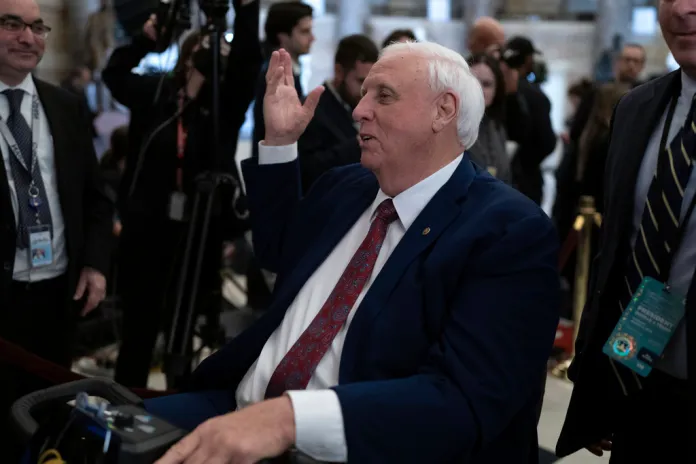
<p> ” data-large-file=”https://conservativemodern.com/wp-content/uploads/2026/09/republicans-worry-theyve-glossed-over-voters-affordability-concerns.webp” src=”https://conservativemodern.com/wp-content/uploads/2026/09/republicans-worry-theyve-glossed-over-voters-affordability-concerns.webp” alt=”Sen. Jim Justice, R-W.Va., arrives with a smile and clean white hair to the House Chamber before President Donald Trump addresses a joint session of Congress at the Capitol in Washington.” class=”wp-image-4747722″ srcset=”https://conservativemodern.com/wp-content/uploads/2026/09/republicans-worry-theyve-glossed-over-voters-affordability-concerns-1.webp 1024w, https://conservativemodern.com/wp-content/uploads/2026/09/republicans-worry-theyve-glossed-over-voters-affordability-concerns-1.webp?resize=300,200 300w, https://conservativemodern.com/wp-content/uploads/2026/09/republicans-worry-theyve-glossed-over-voters-affordability-concerns-1.webp?resize=768,512 768w, https://conservativemodern.com/wp-content/uploads/2026/09/republicans-worry-theyve-glossed-over-voters-affordability-concerns-1.webp?resize=150,100 150w, https://conservativemodern.com/wp-content/uploads/2026/09/republicans-worry-theyve-glossed-over-voters-affordability-concerns-1.webp?resize=696,464 696w” sizes=”(max-width: 1024px) 100vw, 1024px”><figcaption class=) Sen. Jim Justice, R-W.Va., arrives to the House Chamber before President Donald Trump addresses a joint session of Congress at the Capitol in Washington, Tuesday, March 4, 2025. (AP Photo/Jose Luis Magana)
Sen. Jim Justice, R-W.Va., arrives to the House Chamber before President Donald Trump addresses a joint session of Congress at the Capitol in Washington, Tuesday, March 4, 2025. (AP Photo/Jose Luis Magana)“Instead, we’re doing it at the last minute,” Kennedy lamented. “And the reason we’re doing it is because a lot of us raised fresh hell.”
GOP frustration over the legislative agenda and schedule foreshadows the likely blame game that is to take place if a Democratic wave materializes in November, which nonpartisan election forecasters say is a real possibility.
A lot could also be riding on the results for Thune and his Democratic counterpart, Minority Leader Chuck Schumer (D-NY), when their respective parties hold secret-ballot leadership elections in the days and weeks after Nov. 3.
Thune is not facing a concrete threat or even talk of a real challenger, but the calculus could shift depending on Democrats’ ability to flip seats. The White House has cited achievements such as a bipartisan college sports bill, its immigration agenda, and extending expiring tax cuts as important election factors.
But Republicans say higher gas prices from the Iran war and a lack of continued focus on pocketbook issues, such as distractions with Trump’s yet-to-be-constructed White House ballroom, undermine successes. Trump has also irked GOP lawmakers this week with taxpayer-funded, campaign-style ads, and by canceling nearly $1 billion in federal spending passed by Congress.
REPUBLICANS FEAR THEY HAVE LITTLE TO OFFER VOTERS AS CONGRESS LEAVES TOWN
Some Republicans have advocated that Trump focus his executive action on the economy where possible, such as a diesel export ban in an attempt to bring down fuel costs.
“We’re flying into some serious headwind on the issues because the president does not believe that we should address affordability issues,” said Sen. John Cornyn (R-TX), who lost his primary to Trump-backed Texas Attorney General Ken Paxton. “I think [Thune’s] done the best he can, and I would look to the White House if you want to look for who’s responsible for the outcome.”
David Sivak contributed to this report.


