







President Donald Trump is planning to visit at least 10 states during the final month before the midterm elections, embarking on an aggressive blitz as Republicans fight to maintain control of Congress.
Trump’s planned travel will take him to nearly every major battleground except for Maine, where Sen. Susan Collins (R-ME) is defending her seat against Democratic challenger Troy Jackson. The president is expected to make stops across a mix of traditional swing states and Republican strongholds that have become competitive this year, according to Politico.
The itinerary includes traditional battlegrounds Michigan, North Carolina, and Georgia, along with trips to Republican-leaning Texas, Iowa, Alaska, Ohio, and Kansas. Trump is also expected to visit Montana and Pennsylvania, where competitive House races are underway.
Trump is expected to visit Texas, Ohio, and Georgia twice, while one of his largest campaign swings will reportedly last two weeks, taking him from Washington to Montana, Alaska, Las Vegas, Arizona, and Texas before returning to the White House. The White House did not return a request for comment.
The absence of Maine from Trump’s itinerary is notable as Collins faces one of the closest races of her nearly three decades in the Senate. Collins is also the only Republican senator seeking reelection this year in a state former Vice President Kamala Harris carried in 2024. Such is Trump’s relationship with Collins, however, that it would make sense she would want to keep him at arm’s length.
The three states Trump is expected to visit twice — Texas, Ohio, and Georgia — also feature closely watched Senate contests, although the political dynamics differ considerably.
</p>
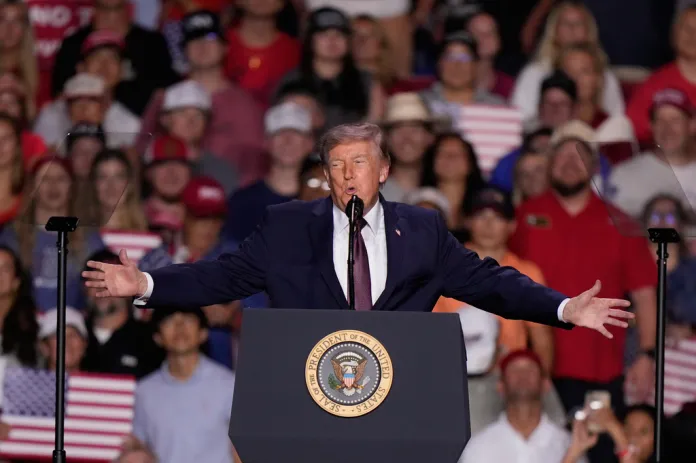
<p> ” data-large-file=”https://conservativemodern.com/wp-content/uploads/2026/10/trump-planning-a-10-state-travel-blitz-in-the-midterms-closing-stages-visiting-all-but-one-battleground.webp” src=”https://conservativemodern.com/wp-content/uploads/2026/10/trump-planning-a-10-state-travel-blitz-in-the-midterms-closing-stages-visiting-all-but-one-battleground.webp” alt=”President Donald Trump speaks at a campaign rally at The Mitchell Center in Mobile, Ala., Friday, Oct. 2, 2026.” class=”wp-image-4752911″ srcset=”https://conservativemodern.com/wp-content/uploads/2026/10/trump-planning-a-10-state-travel-blitz-in-the-midterms-closing-stages-visiting-all-but-one-battleground-1.webp 1024w, https://conservativemodern.com/wp-content/uploads/2026/10/trump-planning-a-10-state-travel-blitz-in-the-midterms-closing-stages-visiting-all-but-one-battleground-1.webp?resize=300,200 300w, https://conservativemodern.com/wp-content/uploads/2026/10/trump-planning-a-10-state-travel-blitz-in-the-midterms-closing-stages-visiting-all-but-one-battleground-1.webp?resize=768,512 768w, https://conservativemodern.com/wp-content/uploads/2026/10/trump-planning-a-10-state-travel-blitz-in-the-midterms-closing-stages-visiting-all-but-one-battleground-1.webp?resize=150,100 150w, https://conservativemodern.com/wp-content/uploads/2026/10/trump-planning-a-10-state-travel-blitz-in-the-midterms-closing-stages-visiting-all-but-one-battleground-1.webp?resize=696,464 696w” sizes=”(max-width: 1024px) 100vw, 1024px”><figcaption class=) President Donald Trump speaks at a campaign rally at The Mitchell Center in Mobile, Alabama, Friday, Oct. 2, 2026. (AP Photo/Gerald Herbert)
President Donald Trump speaks at a campaign rally at The Mitchell Center in Mobile, Alabama, Friday, Oct. 2, 2026. (AP Photo/Gerald Herbert)Texas has emerged as one of the most competitive fights as Attorney General Ken Paxton and Democratic nominee James Talarico face off. Trump, who carried Texas by 14 percentage points in 2024, is scheduled to return on Wednesday for a San Antonio rally for Paxton. Recent polling has shown a close race, prompting a surge in outside spending as Republicans seek to hold a Senate seat the party has controlled for years.
In Ohio, Sen. Jon Husted (R-OH) is facing a challenge from former Democratic Sen. Sherrod Brown, who is looking to return to the upper chamber after losing to Sen. Bernie Moreno (R-OH) in 2024. Ohio is also looking at a competitive governor race between Republican Vivek Ramaswamy and Democrat Amy Acton.
In Georgia, Sen. Jon Ossoff (D-GA) is seeking a second term against Rep. Mike Collins (R-GA), who has recently lagged in the polls. A visit from Trump could help drive his voter base to turn out in a state he carried in 2024.
The president has already ramped up his campaign travel as Election Day approaches. Trump rallied supporters in Mobile, Alabama, on Friday night and is set to travel to Ohio on Saturday before heading to Nebraska on Monday.
In Alabama on Friday, Trump made clear that his strategy is aimed at translating his personal support into votes for Republican candidates even though he is not on the ballot.
“I’m asking you to pretend that I’m on the ballot,” Trump told supporters, noting Republican turnout suffers when he is not running himself. “Just close your eyes and pretend I’m on the ballot.”
Trump acknowledged that Alabama and some of his other stops are in states he carried comfortably, saying he traveled there both to help Republican candidates and to recognize voters who have consistently supported him.
TRUMP REVEALS HE WILL RETURN TO ALABAMA IN A WEEK TO WATCH CRIMSON TIDE FACE GEORGIA
“Sometimes even though you don’t have to come here, you got to pay respect to the people that have loved you from the beginning,” Trump said.
Going on the road also gives Trump the opportunity to hammer home his accomplishments while in office, a strategy he has leaned on throughout the week. Trump has promoted billions of dollars in proposed investments in Alaska and Iowa, redirected $20 million in Department of Homeland Security funding toward government-paid television advertising, and begun sending $500 checks to roughly 1 million people the administration says were overcharged for Obamacare coverage under former President Joe Biden.


