







DONETSK OBLAST, Ukraine — “Myrik,” as his callsign goes, looks about as good as one can expect in his situation. Tired but intact, the Ukrainian commander puffs intently on a cigarette as he takes in his first break in nearly three months.
“We were on the zero line almost the entire time,” he says. “Ninety days. Just to be alive is good enough.”
Given their location, “alive” is almost a miracle. Myrik and his team were in the small village of Novoekonomichne, at the very eastern edge of the Pokrovsk-Myrnohrad salient, the twin cities whose capture has been Russia’s primary goal this year.
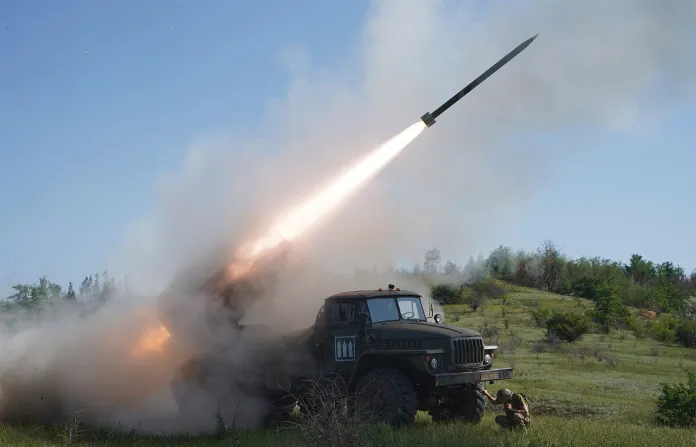
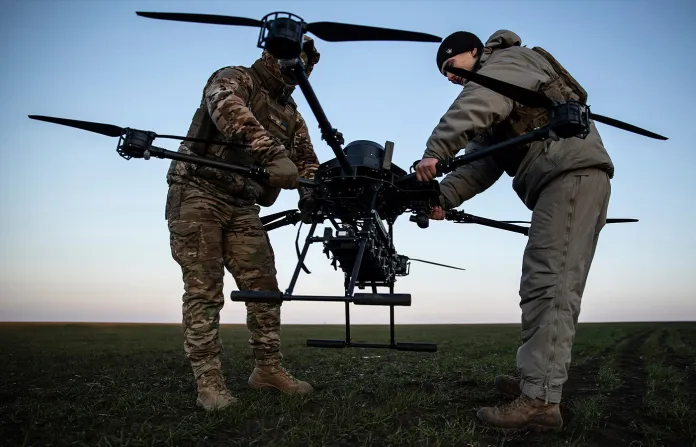
More than four full years into the Russian invasion of Ukraine, the headlines have become dominated by drones. Both on the front lines and far behind them, unmanned aerial vehicles are used in the tens of thousands every month. On the front line, swarms of first-person view drones hunt their targets incessantly, whether armored vehicles (now a rarity) or individual soldiers. Far behind them, long-range strikes on Ukrainian cities and Russian refineries have brought the war to every corner of each country.
Yet for all their dominance, drones cannot accomplish what men can. Only soldiers can take, hold, and defend territory. And while they are an increasingly scarce resource for Ukraine, as desertion rates soar, the experiences of Myrik and his team show just how crucial their role is, and why man is still more important than machine on the corpse-strewn fields of Donbas.
Myrik is a commander with Ukraine’s 14th National Guard Brigade, one of the country’s most experienced infantry formations. While it, in theory, performs functions more akin to those of a national gendarmerie and internal security force, the National Guard has become a key source of manpower since the full-scale invasion began in February 2022. Its brigades have deployed across the country, filling in key sections of the roughly 750-mile frontline and helping to plug gaps in the most critical areas of the front.
A 32-year-old from Vinnytsia, a sleepy provincial city in central Ukraine, Myrik worked as a mechanic prior to the war. While not a member of the army until 2022, he had provided support to Ukraine’s armed forces as a civilian during the 2014-15 Russian intervention in Donbas.
“I was always good with vehicles,” Myrik said. “I was already working as a mechanic when the Russians first attacked us in 2014, so I decided to use my skills to help the army as best I could. I was repairing military equipment — AFVs, infantry fighting vehicles, and the like — from the middle of 2014, helping our boys at the front.”
Once the full-scale invasion began, he decided to up his participation.
“After the Russians attacked us in force [in 2022], I decided I could no longer sit in Vinnytsia,” Myrik said. “They were already in Kyiv. How could I sit at home and wait for them to reach my city and my family? I talked with a childhood friend of mine, and we both decided to join [the army].”
He’s had little rest since. Myrik first served in Ukraine’s 59th Brigade, where he learned the basic fighting skills he’s employed to this day, becoming a machine gun operator in a small squad. At the start of this year, he transferred to the 14th National Guard Brigade, one of many such cases inspired by lackluster leadership amongst the officers above him.
“Our commanding officer in that unit [the 59th] was incompetent, to put it lightly,” Myrik said. “We were losing so many men in avoidable situations, and there is no punishment for officers that perform poorly. If you don’t want to die, your only option is to transfer.”
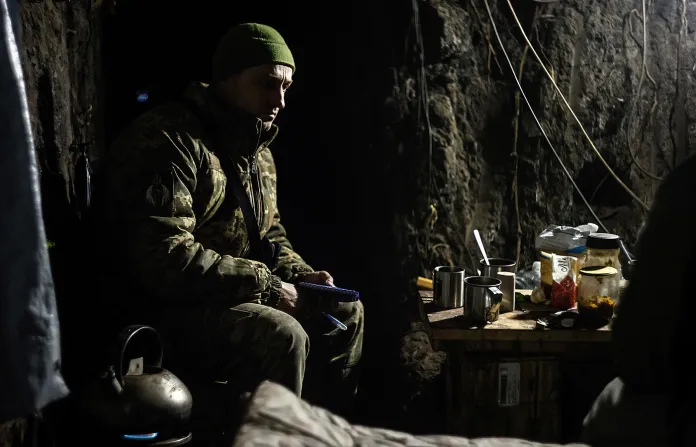
Myrik sits perched on a wooden stool in the dilapidated courtyard of the abandoned village house his team is resting in. To his left is another colleague, who goes by “Pavlik.” They were deployed to Novoekonomichne together for the past three months.
Pavlik reveals that one of the reasons for their extended deployment was the difficulty of even reaching their positions in the first place.
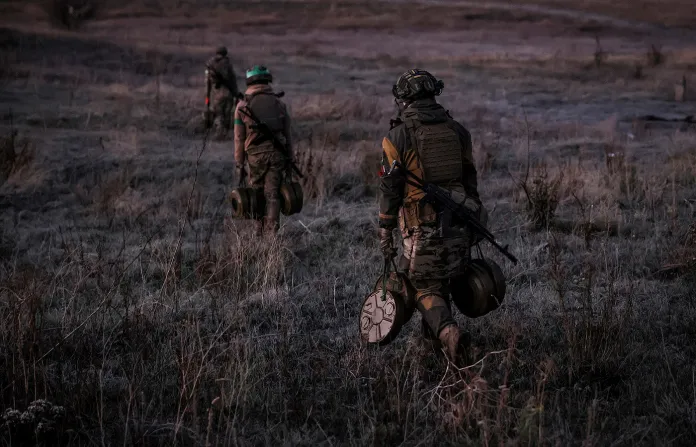
“It is almost impossible to drive near the front line anymore,” said Pavlik. “You are lucky if you can drive within 5 or 10 kilometers of where you need to be. After that, you move on foot. Sometimes you can walk, assuming that the sky is relatively clear above you. Otherwise, if you don’t want to eat a drone [strike], you have to crawl.”
Like Myrik, Pavlik has been fighting since nearly the start of the full-scale invasion. Many of the other men in their team are the same, with almost no breaks in the fighting. The sheer amount of experience they have gained as a result makes it clear why their unit is so valuable.
Not all of the earlier experience is still relevant, however. What began as a conventional war of tanks, armored vehicles, and artillery has broken down into a diffuse collection of pairs of soldiers flanked overhead by hundreds of drones, both theirs and the enemy’s. Heavy equipment like the BMP-2 infantry fighting vehicle, a once-ubiquitous piece of Russian armor — Moscow’s forces have lost more than 2,000 of these in Ukraine, according to open-source verification — are now nearly absent.
“In 90 days, we saw enemy [tanks or armored vehicles] literally three times,” Myrik said. “I had almost forgotten what they looked like.”
In their place are men. Russian troops now surge forward in human wave attacks, the goal of which is not to engage and destroy Ukrainian positions, but to bypass. Often employing motorbikes and relying on speed and sheer numbers, these attacks are incredibly costly.
“The Russians almost do not attack us head-on anymore,” Myrik said. “They are looking to move past us, barely engaging us at all as they come [toward us]. They are almost suicidal in their determination.”
In the rare event they reach their destination, the Russians then look to entrench. They dig in and await reinforcements, resupplied by drone-dropped packages of food, water, and ammunition all the while. Essentially behind enemy lines, they look to slowly leapfrog Russian positions forward across the battlefield.
While such assaults are constant, some can reach enormous proportions. Myrik tells of one enemy attack that featured over 200 combatants, almost all of whom were killed.
“The largest assault we faced was in April,” he said. “The Russians sent 112 motorbikes on it, each with two soldiers [on it]. They came forward again and again, for around six hours. I think maybe 10 [Russian soldiers] survived. They don’t care about their losses, only land.”
Despite the overwhelming casualties, the sheer number of men involved means that some do inevitably make it to their destination, outflanking the Ukrainian troops they have just bypassed. That tactic allowed Russia, albeit slowly and at great cost, to continue its advance throughout 2025. A growing rate of desertions among Ukraine’s rank and file, meanwhile, has meant an ever-thinner reserve of manpower to plug the gaps and fend off the endless assaults.
Wild charges forward are not the only page in the Russian playbook. Myrik tells that Russian soldiers are increasingly wearing civilian clothing in an attempt to sneak past Ukrainian positions — a war crime, but far from the first one to be committed by Moscow’s forces in this war.
“We see more and more Russians without uniforms, in civilian dress,” Myrik said. “Usually, we can spot that they are soldiers, but not always, especially when they are acting strangely. There was one event when a guy came up to us, looking like a civilian, and started making small talk, just saying hello. I turned my head for half a second and looked back to see him suddenly grabbing a rifle. We eliminated him before he could shoot, but this is the kind of thing they try.”
Pokrovsk, Myrnohrad, and their surrounding villages are all bombed-out wrecks, nearly devoid of civilians after a year of direct fighting. The vast majority of locals evacuated long ago, heading to safer places further behind the front line.
The towns are not completely empty, however. Of those who remain, the vast majority are pro-Russian — called zhduny, or “those who wait [for Russia],” by Ukrainian soldiers.
“There are many, many instances where these zhduny have endangered us,” Pavlik said. “At one point, we were in a position near a few large apartment buildings. Our position had been mostly secure, when suddenly we were fired on from one of those buildings behind us. It turns out a family living there had guided the Russian [soldiers] to their apartment, welcomed them in, and allowed them to use it to shoot at us. I wish this had been the only such case, but it is far from alone.”
If even reaching the forward fighting position is that dangerous, rescuing wounded soldiers from them is nearly impossible. That’s the task set out for “Kucha,” a boyish-faced 40-year-old medic working with Myrik and the 14th National Guard Brigade.
“Evacuating the wounded is very difficult, both physically and psychologically,” Kucha said. “You have to wait until the sky is mostly clear, relying on our own guys and their drones to spot the enemy [drones]. It’s better when it’s cloudy or rainy, but this is not a guarantee.”
The real test of nerves comes when an enemy drone becomes audible. At that moment, silence and stillness is crucial — and often a matter of life and death.
“When an enemy drone is above you, the sound of it makes you want to start running [away],” Kucha says. “But that is exactly when you need to be still. If you can hold yourself and wait a couple of minutes, then there is a higher chance that they will not notice you and fly further [away].”
That may work for the drones, but not for the other main weapon in Russia’s aerial arsenal: glide bombs. Weighing anywhere from 550 to 6,600 pounds, the massive explosives are lobbed from Russian aircraft far behind the lines, striking Ukrainian forces on the front line with impunity. A drone may damage a building — a glide bomb will simply annihilate it.
“There is not much we can do against [the glide bombs],” Myrik admits. “We are getting hit with 20 or 30 of them per day in our sector. All you can do is keep your head down and hope you will not be unlucky.”
The mental stress of nearly three years on the front line is hard to imagine. Pavlik explains that it’s easier to act on instincts and training and avoid letting one’s mind wander as much as possible.
“There is fear in everyone,” he said. “But there is no time to dwell on it. When you are going to the position, all you think about is not losing your coordinates and making it to where you need to go. Once you are there, you have to be constantly alert for enemy attacks. Our drones are watching for us, too, but you cannot get distracted, or you can easily die.”
On their short breaks, the soldiers visit their families. This visit was a mere five days.
“The only thing that truly gives me anxiety now is not hearing my family’s voices,” Myrik says. “I know I have to do my job as well as possible, because I have to get back and see them.”
While Myrik, Pavlik, and the rest of the 14th National Guard Brigade have fought bravely and effectively, they have not been able to halt Russia’s slow advance. Late last year, Russian troops entered Pokrovsk in force, taking over much of the city and engaging in running gun battles with Ukrainian troops in what remains.
UKRAINE PLAYS PUTIN ON DISINGENUOUS VICTORY DAY TRUCE
Ukraine’s top general, Oleksandr Syrsky, has said that Ukraine “will continue to hold” Pokrovsk, even as continued Russian offensives north of the pocket threaten the remaining soldiers there with encirclement.
Myrik, Pavlik, and the 14th National Guard Brigade have long since finished their short break and rotated back to the front. They are prepared. But for Ukraine, winter does not come easy.
Neil Hauer (@neilphauer) is a journalist who has reported on the Caucasus, Russia, Ukraine, and Syria.


