





Uncategorized

Appeals court considers creating separate transgender cell blocks within women’s prisons

A federal appeals court is weighing how to house a group of transgender inmates, all biological men currently residing in women’s prisons across the country, who are suing to prevent the Trump administration from sending them back to male-designated facilities. The trans litigants allege under the “cruel and unusual punishment” clause of the Eighth Amendment […]

A federal appeals court is weighing how to house a group of transgender inmates, all biological men currently residing in women’s prisons across the country, who are suing to prevent the Trump administration from sending them back to male-designated facilities.

The trans litigants allege under the “cruel and unusual punishment” clause of the Eighth Amendment that imprisoning them with fellow biological men would place them at a heightened risk of rape.

A three-judge panel on the U.S. Court of Appeals for the D.C. Circuit heard oral arguments on Friday in the case, Jane Doe v. Blanche, laying out creative alternatives to resolve the fear-of-rape claims.


In a rare move, the appellate panel, composed of two Trump appointees and one Obama-nominated judge, also granted speaking time to female inmates from a separate but related transgender prison separation lawsuit out of Texas.

The incarcerated women in that case, Fleming v. Warden T. Rule, succeeded in separating the biological men from the female prisoners housed there through the creation of a specialized unit inside Federal Medical Center-Carswell, a women’s prison in Fort Worth. Their case centered on witness testimony from female inmates reporting they have experienced sexual abuse at the hands of the biological men housed with them.

DOJ’S CREATIVE SOLUTION TO TRANSGENDER PRISON CASE WOULD MOVE MALE INMATES INTO SPECIALIZED UNIT

Judge Gregory Katsas, an appointee of President Donald Trump, noted during oral arguments that the Federal Bureau of Prisons was able to keep the biological men as well as the women safe at FMC-Carswell by placing the trans inmates in the specially-designed cell block.

See also  FN4220H8 title

“BOP has basically built within a women’s facility a jail within a jail for these gender dysphoric men, and they have managed to both protect these individuals from the risk [of rape] in the more violent male prisons and — just as important — protect the female inmates from the gender dysphoric man,” Katsas said.

Katsas drilled the Justice Department on why the federal government cannot create similar segregated living quarters at other women’s prisons. Government attorneys, however, remained adamant about moving the trans inmates to men’s facilities in accordance with Trump’s January 2025 directive to separate federal prisons by biological sex.

“You acknowledge they need a lot of protections there,” Katsas said. “You say that you will ramp up protections if things don’t work in the two facilities you’ve chosen, and that might push you, as you said, to something like you put them in the SHU.”

A special housing unit is a secure area used by BOP for de-escalation purposes that separates inmates from the general prison population, either placing them alone in solitary confinement or with a cellmate.

“You have arrangements that look like a prison within a prison in the male facility. So what’s the difference?” Katsas questioned. “What’s the constitutional difference? What do you care about whether the prison within the prison is at Carswell or in Rochester?”

Eric McArthur, an attorney in the DOJ’s civil division, had suggested transferring the trans complainants to an “extraordinarily safe” men’s prison in Rochester, Minnesota, for inmates with medical or mental health issues.

See also  United Airlines says technology issue resolved after ‘widespread system outage’

McArthur told Katsas he suspects the inmates in the Doe case will protest the idea of a miniature transgender prison, wherever the location. “You’re not going to hear from the plaintiffs that that’s a viable option,” McArthur replied. “They have filed a motion saying that even that violates [their rights].”

“I’m going to ask them about that,” Katsas said, “but I want to ask you: What’s wrong with the Fleming-Carswell arrangement from your perspective? The women are protected, and so are these plaintiffs.”

McArthur acknowledged that the FMC Carswell set-up “largely serves the government’s interest in protecting the well-being of the women,” but he argued it’s “still intruding” on BOP’s administrative authority and discretion to assign housing as it sees fit, taking into account the competing interests of all parties.

“It’s not at all clear to me that these plaintiffs, for example, are better off in a segregated unit in Carswell than in one of these extraordinarily safe men’s facilities, where they would have more freedom to move about, a wider circle of inmates with whom to socialize, and at the end of the day, if it’s necessary to protect them in the men’s facilities by putting them in a segregated unit there that’s similar to the segregated unit in the women’s facility in Carswell,” said McArthur. “I don’t see a great deal of difference between that, and I don’t think the Eighth Amendment dictates that choice and requires that they be kept in the women’s facility, segregated unit, as opposed to the men’s facility.”

See also  Jensen Huang will testify before House Foreign Affairs Committee, Intelligence Committee on affair with suspected Chinese spy

” data-large-file=”https://conservativemodern.com/wp-content/uploads/2026/11/appeals-court-considers-creating-separate-transgender-cell-blocks-within-womens-prisons.webp” src=”https://conservativemodern.com/wp-content/uploads/2026/11/appeals-court-considers-creating-separate-transgender-cell-blocks-within-womens-prisons.webp” alt=”A Federal Bureau of Federal Prisons truck drives past barbed wire fences at the Federal Medical Center prison in Fort Worth, Texas.” class=”wp-image-3829868″ srcset=”https://conservativemodern.com/wp-content/uploads/2026/11/appeals-court-considers-creating-separate-transgender-cell-blocks-within-womens-prisons.webp 1024w, https://conservativemodern.com/wp-content/uploads/2026/11/appeals-court-considers-creating-separate-transgender-cell-blocks-within-womens-prisons.webp?resize=300,174 300w, https://conservativemodern.com/wp-content/uploads/2026/11/appeals-court-considers-creating-separate-transgender-cell-blocks-within-womens-prisons.webp?resize=768,446 768w” sizes=”(max-width: 1024px) 100vw, 1024px”>

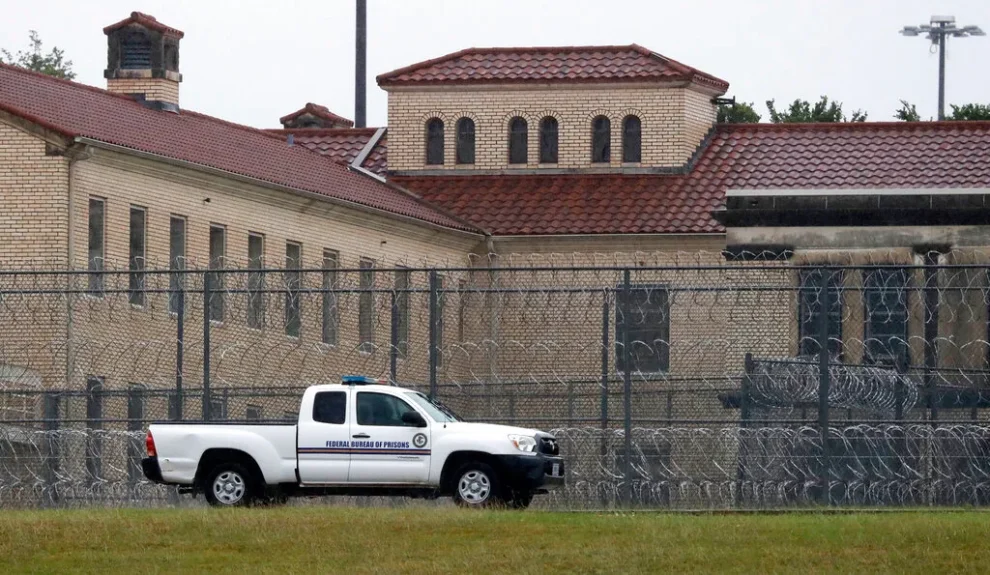
A Federal Bureau of Prisons truck drives past barbed wire fences at the Federal Medical Center prison in Fort Worth, Texas, Saturday, May 16, 2020. (LM Otero/AP Photo)

Katsas later pressed Doe attorney Jennifer Levi, of the GLBTQ Advocates & Defenders, on the plaintiffs’ position on establishing Carswell-like wings dedicated to housing the trans inmates.

Levi cited “suicide risks that would be realized” upon their transfers to men’s facilities and gender dysphoria being exacerbated by the transfers themselves.

“If you think that no accommodation in a male facility is possible, your case has a lot of force, but then the only way to reconcile the competing interests is the Carswell solution,” Katsas said.

Levi said “the only thing” plaintiffs were asking of the court was to keep in place “a very narrow” injunction that blocks the transfer of the 11 trans plaintiffs.

The current preliminary injunction expires soon, and the trans appellees are asking for a new injunction, including a new requirement ordering BOP to move the eligible Doe co-plaintiffs out of the separate unit at FMC Carswell and into the general female population at another women’s prison.

Levi urged the court to at least affirm the existing injunction. “The injunction preserves the status quo that has been in place for years,” she said, referring to transgender housing accommodations implemented under the Obama administration.

“How many findings does one need to make the point that when you put men in the general female prison population, we are going to have serious issues, privacy issues, safety issues?” Katsas said.

Lawyers for the Fleming plaintiffs, who were denied their request to intervene in Doe but permitted to deliver oral arguments as amicus curiae, explained at Friday’s hearing how housing biological men in women’s general population harms women.

“It subjects women to voyeurism. It subjects women to forced exposure to male genitalia. It subjects them to sexualized threats and sexualized harassment,” attorney John Greil told the court. “The declarations that my clients submitted in the Fleming litigation are illustrative of these points, and the Constitution protects them from these harms.”

Following the hearing, Greil expressed hope that his clients’ appearance in the Doe case helped move the needle.

“In this case, the government has not submitted evidence of how female inmates are harmed by the presence of men,” Greil told the Washington Examiner. “The Fleming plaintiffs have bravely shared their stories, and brought those facts to light.”

Greil noted that the judges were interested in the workable alternative offered by the Fleming case and hearing the harms to women articulated.

MORE FEMALE INMATES ALLEGE SEXUAL ABUSE IN TRANSGENDER SEPARATION CASE

“I was glad to hear that the judges wanted to know about the impact on female inmates,” Greil said. “I’m thankful that they took the rare step of allowing my clients to be heard at oral argument — too often in these cases, the voices of affected women are not heard.”

The female plaintiffs in Fleming are now seeking to vacate the Obama-era regulations that allow BOP to place biological men in women’s prisons.

Share this article:
Share on facebook
Facebook
Share on twitter
Twitter