Zelensky sacks Ukrainian Commander in Chief Syrsky in major military shake-up
Ukrainian President Volodymyr Zelensky fired Ukrainian Armed Forces Commander-in-Chief Oleksandr Syrsky, the second man in the position since Russia’s invasion of the country. Syrsky was appointed to the position on Feb. 8, 2024, after the sacking of Valery Zaluzhny, his more publicly visible predecessor. He soon made a name for himself as one of the […]
Syrsky was appointed to the position on Feb. 8, 2024, after the sacking of Valery Zaluzhny, his more publicly visible predecessor. He soon made a name for himself as one of the most polarizing figures in Ukraine, seen by detractors as an archaic figure responsible for thousands of unnecessary deaths through his holding to outdated Soviet ways of thinking, and by defenders as a skilled defender willing to make unpopular but realistic decisions required for the kind of war being fought, while resisting unrealistic calls for transitioning the military to a more drone-centered force.
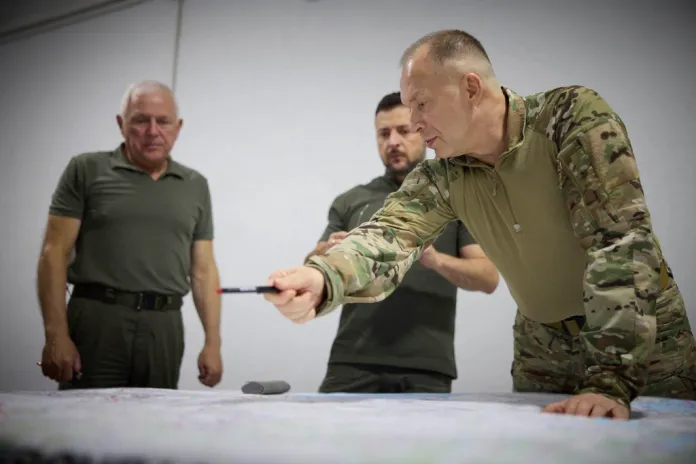
” data-large-file=”https://conservativemodern.com/wp-content/uploads/2026/07/zelensky-sacks-ukrainian-commander-in-chief-syrsky-in-major-military-shake-up.webp” src=”https://conservativemodern.com/wp-content/uploads/2026/07/zelensky-sacks-ukrainian-commander-in-chief-syrsky-in-major-military-shake-up.webp” alt=”Syrsky” class=”wp-image-4657940″ srcset=”https://conservativemodern.com/wp-content/uploads/2026/07/zelensky-sacks-ukrainian-commander-in-chief-syrsky-in-major-military-shake-up-1.webp 1024w, https://conservativemodern.com/wp-content/uploads/2026/07/zelensky-sacks-ukrainian-commander-in-chief-syrsky-in-major-military-shake-up-1.webp?resize=300,200 300w, https://conservativemodern.com/wp-content/uploads/2026/07/zelensky-sacks-ukrainian-commander-in-chief-syrsky-in-major-military-shake-up-1.webp?resize=768,512 768w, https://conservativemodern.com/wp-content/uploads/2026/07/zelensky-sacks-ukrainian-commander-in-chief-syrsky-in-major-military-shake-up-1.webp?resize=150,100 150w, https://conservativemodern.com/wp-content/uploads/2026/07/zelensky-sacks-ukrainian-commander-in-chief-syrsky-in-major-military-shake-up-1.webp?resize=696,464 696w” sizes=”(max-width: 1024px) 100vw, 1024px”>In this photo provided by the Ukrainian Presidential Press Office, Ukrainian President Volodymyr Zelenskyy, center, Commander-in-Chief Oleksandr Syrsky, right, look at a map during their visit to Sumy, Ukraine, Thursday, Aug. 22, 2024. (Ukrainian Presidential Press Office via AP)
Syrsky was insulated from most criticisms since taking his position, protected by Zelensky, who likely appreciated his lack of political ambition, an issue he faced with Zaluzhny. This changed last week after Zelensky fired popular former Defense Minister Mykhailo Fedorov, who, rather than going quietly, decided to go public with his criticisms of Syrsky, blaming him for the military’s failures.
Zelensky finally caved to pressure to fire Syrsky on Tuesday, announcing that Commander of the Joint Forces of the Armed Forces of Ukraine Mykhailo Drapaty would take his place. However, he couched the firing with liberal praise for Syrsky, listing off his accomplishments.
“It is a fact that Oleksandr Syrsky ensured Ukraine’s success in defending Kyiv, in the Kharkiv offensive operation, and in the Kursk operation,” Zelensky said in a post on Telegram. “Significant progress has been made, the defense of Ukraine continues, and it is essential to treat every soldier with respect. I am grateful to Oleksandr Syrsky and every one of our soldiers for their strong positions on the front lines. I am grateful to Mykhailo Drapatii for his vision. Today, Oleksandr Syrsky and I, along with Andriy Gnativ, discussed future service arrangements and the proper transfer of responsibilities.”
The moves would be finalized tomorrow, the Ukrainian president added.
The firing of Syrsky came as a surprise to many, especially as the protests that followed Fedorov’s firing were relatively small in number. The key push likely came from within the military or political elite. As with the firing of his longtime closest ally Andriy Yermak as his chief of staff last year, the saga illustrates Zelensky’s political fragility, as he had long resisted pushback against Syrsky.
The crisis triggered last week by Fedorov’s firing was made increasingly public by unfavorable media coverage, and the episode served as a lightning rod for the critics of Syrsky’s conduct to push forward for his firing. Zelensky appeared to begin preparing for Syrsky’s replacement over the past few days by holding publicly telegraphed meetings with nearly a dozen leading military commanders, including the man who would ultimately be chosen as Syrsky’s replacement. Notably, he was accompanied by his new defense minister in the published photos, indicating he has no intention of rehiring Fedorov.
It became dire enough this week that Syrsky published a rare column under his own name, apologizing to Fedorov for their feud and urging the public not to personalize the war.
“For me, it was a surprise to learn that the minister and I had a conflict,” Syrsky wrote. “I saw our relationship as a working one, with difficult questions and different positions. That is how it should be between two institutions during a great war.”
“If I offended someone with something: Mykhailo Albertovych [Fedorov], I’m sorry. I can be tough,” he said. “But I ask you, and everyone following this story with such enthusiasm, to focus not on the personal but on the global one. On victory.”
Despite the apology, he devoted extensive space to explaining the chain of command, the division of labor, and who is actually responsible for military strategy, all of which seemed veiled swipes at Fedorov, with the implication that he didn’t understand these matters. He also took credit for things that were publicly credited to Fedorov, including the long-range drone campaign and drone strikes to try to isolate Crimea.
“War strategy, planning of operations, the situation on the front — by law, I am responsible to the Supreme Commander-in-Chief,” Syrsky wrote. “Long-range strikes, isolation of Crimea — this is done by the Armed Forces of Ukraine, the Security Service of Ukraine, the State Security Service of Ukraine, and is coordinated by the Supreme Commander-in-Chief and me. Not because I ‘don’t let’ anyone succeed, but because that is how institutional processes are built in all armies of the world.”
His most significant not-so-subtle criticism of Fedorov was about the technocrat’s focus on shifting the UAF to a drone-focused force, something he dismissed as unrealistic and out of touch with reality.
“We are not at war with a conventionally small country. Against us is an enemy that is superior in everything, who fights, in particular, with artillery, aviation, and infantry,” Syrsky wrote. “I cannot transfer a million-strong army ‘to drones’ in two months and say: now we are fighting like this. In addition to the fact that this is an obvious adventure, any experiment of this scale is paid for by our lands and our people.”
His column ended up being in vain, as he was fired the next day.
Fedorov had aired all these grievances and more shortly after he was fired, holding a press conference in his favored Steve Jobs-style presentation, presenting his vision of modern warfare, drone technology, and trashing army leadership and bureaucracy. After being removed, he’d increasingly targeted Syrsky with his criticisms.
The choice of Drapaty signals a major victory for two major cadres in the Ukrainian political establishment — the western-aligned liberals and the more radical right-wing elements, simultaneously. However, he’s in the middle of the two poles who were held up as two of the other most likely candidates: the former neo-Nazi politician known as the “White Fuhrer,” Big. Gen. Andriy Biletsky, and one of Syrsky’s acolytes, Brig. Gen. Oleg Apostol. Both had met with Zelensky in his public casting campaign.
The Syrsky-Fedorov dispute culminated in both of their firings, primarily over military strategy, but quickly took on a political character. Fedorov was beloved by Ukraine’s Western-aligned liberals, and liberal media outlets spent days after his firing railing against the perceived injustice and calling for Syrsky’s removal.
Syrsky, though entirely apolitical, came to be treated as a proxy for nonliberal and non-Western thinking and forces in Ukraine, being seen by the more liberal political class as a relic from Soviet times.
The more radical right-wing elements, exemplified by Biletsky, were more of a wild card, having generally good relations with both sides.
Zelensky was caught in the middle, but as with the Yermak saga, he found the liberal pressure was too much to bear.
As for whether Syrsky’s removal will coincide with a major overhaul in strategy may be unlikely. One of the foremost issues that triggered the Fedorov firing was issues around mobilization, especially after a riot in Lviv, the heartland of Ukrainian nationalists, against the press ganging of locals. While some blame has been placed on Syrsky for the forced conscription detachments, Fedorov also holds blame in his position. No viable alternatives have been offered by rivals to solve the country’s manpower issues.
The primary strategic clash behind the leadership shake-ups was the competing visions of Fedorov and Syrsky. Syrsky is known as a more traditional commander, and his reforms have focused on forming new infantry assault groups and procuring traditional weapons. Fedorov has pushed for the opposite, aiming to replace much of the military with drones to make up for casualties.
With limited resources to contend with, the differing philosophies inevitably clashed and created a situation where Zelensky had to choose between the two.
Fedorov and Syrsky’s leadership styles also clashed. Syrsky, who began his career in the Soviet military and graduated from the Moscow Higher Military Command School, subscribed to the Soviet centralized command-and-control system, favoring a top-down approach to command. Fedorov, just 35 years old, has spent his career idolizing the startup, entrepreneurial culture of Silicon Valley and sought to recreate it in Ukraine. His data-centric approach and favoring of empowering lower commanders has annoyed much of the traditional military establishment.
Though the Western and Ukrainian public largely side with Fedorov in the dispute with Syrsky, the fight can’t be fairly characterized by Western technology and innovation versus old Soviet-style bureaucracy and backwardness. Syrsky was a leading figure behind many of Ukraine’s biggest wartime successes, including the defense of Kyiv in 2022 and the Kharkiv counteroffensive of September 2022. Ukraine’s relative successes on parts of the front line this year, such as successful localized counteroffensives in Kharkiv and Zaporizhzhia, can be credited in part to Syrsky’s focus on cultivating manpower and forming assault groups.
Many within the military, outside the high command, also spoke against Fedorov, voicing skepticism about the efficacy of his reforms. Roman Ponomarenko, an analyst in the prestigious 1st Azov Corps, called the reforms a “sham.”