



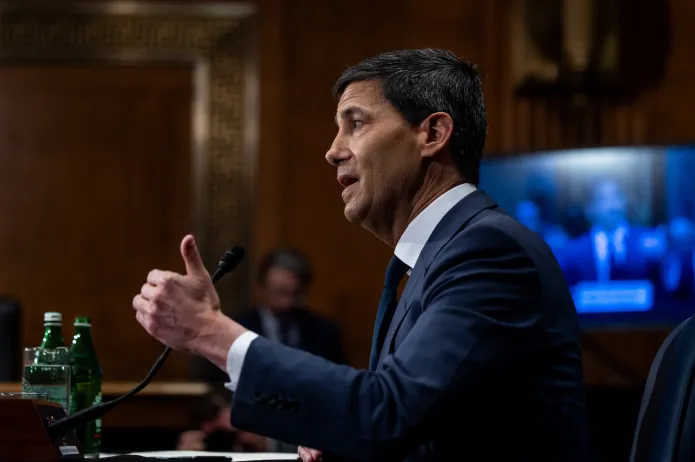
President Donald Trump’s nominee Kevin Warsh gained Senate confirmation Wednesday to be chairman of the Federal Reserve, where he is set to immediately face a dilemma between trying to curb inflation and fulfilling Trump’s wishes by lowering interest rates.
The Senate confirmed Warsh, 56, on Wednesday in a 54-45 vote, with only Sen. John Fetterman (D-PA) joining Republicans in voting for him to lead the central bank. Warsh will enter the Fed at a time where inflation is rising, thanks in part to energy market disruptions from the war in Iran, and investors see interest rate hikes as more likely than cuts.
FED HOLDS INTEREST RATES STEADY IN WHAT WILL LIKELY BE LAST MEETING UNDER POWELL
On Tuesday, the Senate also voted 51-45 to confirm Warsh to a 14-year term on the Fed’s Board of Governors.
Inflation is running well above the central bank’s 2% target.
An update to the consumer price index this week showed that annual inflation spiked five-tenths of a percentage point to 3.8% for the year ending in April. And on Wednesday, the producer price index showed that wholesale inflation shot up to a blistering 6%, the biggest increase since 2022.
All of this presents a major headache for Warsh, who is now tasked with leading the 12-member Federal Open Market Committee, which is in charge of interest rate decisions, as Fed Chairman Jerome Powell’s chairmanship term expires.
Notably, Powell has opted to break longstanding tradition and remain on the Fed board. Traditionally, Fed chairs retire from the board after their terms are up, allowing the president to fill the vacancy. While Powell’s term as chairman ends on May 15, his term as a board member runs until 2028.
Powell, who for months has faced withering criticism from Trump for failing to cut rates faster, faced an investigation by the Justice Department, which has since been dropped, that he asserted was politically motivated. He has also said that Trump’s effort to fire Fed Governor Lisa Cook has factored into his decision to stay at the Fed as a form of helping the central bank resist political pressure.
Powell’s plan to stay on the board will deprive Trump of a majority of seats on the Fed’s Board of Governors. Powell himself was initially nominated by Trump to be chairman, but he was renominated by former President Joe Biden and has since diverged from Trump on monetary policy.
And while Powell might take a backseat once Warsh comes on, the dynamic could still be an interesting one for Warsh to navigate, especially because Powell is well respected on the board and has been on the panel since 2012.
Also adding to the challenges for Warsh, markets are signaling that they do not believe that he will be able to implement rate cuts. In fact, investors are betting that an interest rate increase is more likely than a cut by the end of the year.
As of Wednesday, the implied odds of a rate cut before the end of the year are just 1%, according to CME Group’s FedWatch tool, which calculates the probability of rate changes using futures contract prices for rates in the short-term market targeted by the Fed.
But the odds of a rate increase in 2026 have now risen to just over 34%.
It is worth noting that Warsh alone cannot cut interest rates, even as chairman. That is because while the chairman leads the Fed board and messaging, interest rate decisions are up to the FOMC.
WARSH SET TO TEST LIMITS OF FED REFORM
Warsh was previously a Fed governor, but he hasn’t been a public policymaker for over a decade. The Stanford and Harvard Law School graduate was a member of the Federal Reserve Board of Governors from 2006 to 2011, including during a big chunk of the Great Recession. He has long been a prominent figure in finance and economics.
After leaving the central bank, Warsh worked as a distinguished visiting fellow at Stanford University’s Hoover Institution. Warsh was also a partner at billionaire Stanley Druckenmiller’s Duquesne Family Office.


