







Brian Patrick stood outside of an abandoned office building in Welch, West Virginia, surveying its decaying interior. The flooring had mostly collapsed, but the beams held. A filing cabinet stood against a back wall.
On top of the cabinet was some sort of trinket, but through the inky inner sanctum, Brian couldn’t make out its size or shape.
Wanting a closer look, he shimmied out onto one of the beams, reached up, and snatched the ornament. Back out in the light, he examined its jagged edges. Strange. Eerie almost. A plaster dental cast with missing front teeth. Brian tucked the cast into a jacket pocket and kept exploring.
He held onto the half smile for years. Now, it’s displayed behind a cigar case inside the Norfolk, Virginia, store he owns with his wife, Brandy Collins. “It’s my strangest pick by far,” he says.
The space feels built for it.
Union Overall Company, which formally launched in 2024, specializes in intentionally made and curated vintage apparel that dates back to the early 20th century. The glass case and the set of teeth, the shelves made from old hen nesting boxes, the stacks of vintage radios that draw the eye toward mannequins in Ivy League prep, they give the place a stylish but lived-in sensibility.
At the center of the room, Brian sits on a faded leather sofa. “There’s a risk, when you’re first starting out, of thinking that you have to be like everybody else,” he says. “But, for me, a big part of this is about finding pieces that don’t look like what’s already out there.”
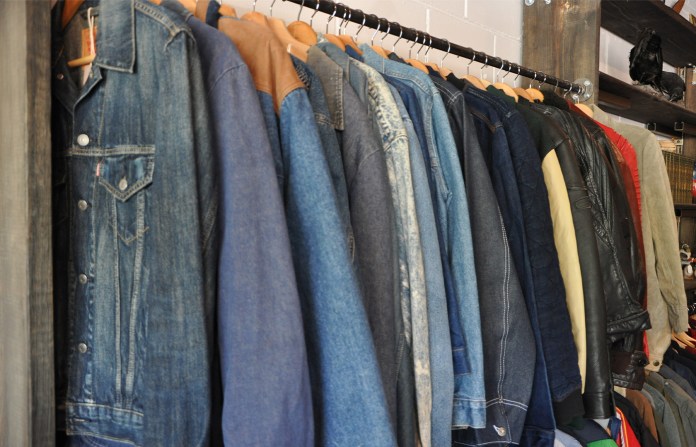
A customer comes in looking for a good leather wallet, and Brian steps away for a moment to help. I wander the shop floor. There’s a collection of worn-in denim against a wall. Nearby, there are military uniforms from World War II, the Korean War, and Vietnam. A standout item is a roughly 70-year-old wool jacket in royal blue that has the words “Merchants & Farmers” chain-stitched in block letters across the back.
To some, these vintage workwear and military issue pieces might feel too far afield from the constantly rotating styles sold in online shops and at local department stores. To others, they represent some physical connection to a deeper American mythos.
Workwear emerged alongside industrialization in the late 19th century. Workers needed clothing that could withstand grueling and repetitive tasks, and regional manufacturers began producing “overalls,” the broad name for garments meant to be worn over everyday clothes, a protective second skin.
With the evolution of youth culture in the 1950s and 1960s, workwear went mainstream, inspiring (and, in turn, being inspired by) Hollywood blockbusters like A Streetcar Named Desire and Rebel Without a Cause. Decades later, the look is still synonymous with an American kind of cool, still embraced by musicians and artists like Andre 3000 and Ethan Hawke.
“If you could give anybody a styling tip, what would it be?” the People Gallery asked Hawke in a September 2025 Instagram video.
“To not be afraid to think of people that you admire,” Hawke responded, “not from a magazine, but from your life.”
Spend some time walking around the Smithsonian Museum of American History, and Hawke’s advice starts to make sense. Across the exhibits, there are photos of sailors, mechanics, factory workers and farmers in work-worn bibs and jackets. There are no runways or boutiques. There’s just life itself.
Brian Patrick’s relationship with style is grounded in his own personal history. Growing up in Norfolk left him with an unshakable sense of the relationship between work and what we choose to wear.
“This has always been a sort of hub for work,” he says. “There’s the Navy. And then there are the shipyards, the railyards, the docks. The trains used to carry goods to and from mining towns inland in Appalachia.”
A few years back, when he was still looking for a name for the brand, Brian started researching historic Norfolk manufacturers.
“I thought, ‘There had to be people here making garments for these workers,’” he explains.
Eventually, he discovered the original Union Overall Company, a workwear maker that operated in the city from 1901 until 1922.
“The original warehouse is just three blocks from here,” Brian says. “It’s been turned into apartments, but it’s still there.”
The company served Norfolk, but it also served Southwest Virginia’s farming and mining towns, where Brian also has roots.
“It all just felt so serendipitous,” he says. “We were like, ‘OK, cool, we’re going to revive Union Overall Company.’”
When he talks about revival, Brian is talking about more than the name.
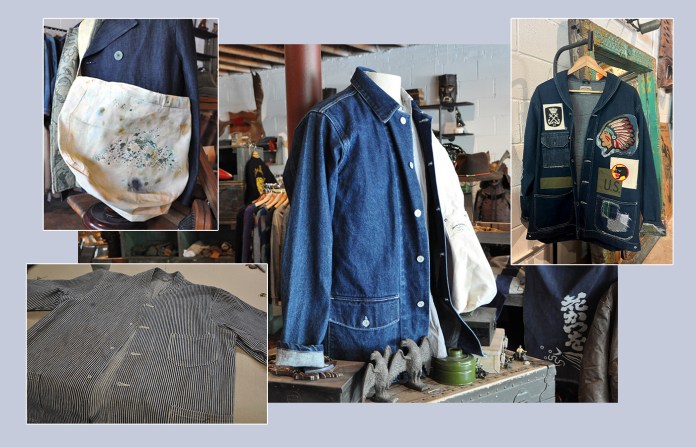
In addition to collecting and selling vintage, the brand designs and makes clothing. The shop’s centerpiece is a carefully constructed denim jacket released under the Union Overall Company label. A mannequin next to a vintage chopper is wearing a shawl collar denim jacket embellished by the artist and designer Kimbro Edwards with patches featuring military and other insignia. It’s reminiscent of the “cuts” worn by members of motorcycle clubs beginning in the late 1940s and early 1950s.
Before opening the store, Brian worked in marketing and creative strategy for global brands in the Pacific Northwest. He is obsessive about quality. Among his latest designs are two garments inspired by a work shirt from the original Union Overall Company. The first is a kind of reimagining of the shirt, and the second is a chore coat influenced by it. Mount Vernon Mills supplied the material for the original, and Brian managed to get his hands on fabric from the same mill. There’s something almost surreal about the changelessness of the stuff over time.
“We’ll do a limited run of the shirt,” Brian says, “because it’s sort of a strange piece.”
He walks over and takes a prototype for the chore coat off a rack. “You’ve got this outside here,” he says, “and then you’ve got this phone pocket here.”
He smooths the front of the garment. “So, the idea is to take cues from old designs, but then to modernize it in a way that makes sense for today.”
The thought that animates Brian’s efforts is that time has not stopped. History has not ended. We are still growing and changing with the world around us. I ask him whether what he’s doing ever feels like a conversation.
“Yeah, it does in a way,” he reflects. “With everything we make, we go into it thinking that… whoever buys it… we want their grandchildren to find it in their closet 50 years down the road and think, ‘Damn, this is cool. Grandpa or Grandma wore some really cool s***.’ I feel that connection through what I’m doing here.”
KEEP ON TRUCKING: SELF-DRIVING VEHICLES AND A WAY OF LIFE
Some of Brian’s favorite items came together by accident — a cut-to-measure Horween leather belt smudged with black edge paint, a canvas messenger bag splattered with blues and greens after a spill.
“When you actually start studying some of these vintage garments,” he says, “they can be pretty archaic. There might be stitching that’s not perfect, for instance, because they were just getting it done. I love the Japanese idea of wabi-sabi, of finding beauty in imperfect things.”
The door swings open, and another customer comes in, this time to browse the racks of vintage denim. I meander back over to the cigar case to examine the dental cast, the broken teeth replicated to inform a fuller set. There’s something unexpectedly optimistic about them. It’s like they belong here.
Farahn Morgan is a contributing writer at Country Highway and a freelance writer living and working in the American South.


