






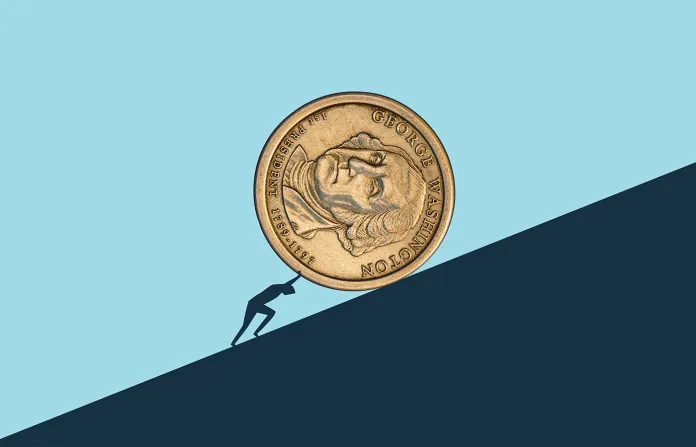
Wages in the United States have been growing below the level of inflation, meaning that the purchasing power for many workers has gone down at a time when affordability concerns are front and center ahead of the midterm elections.
Workers’ hourly earnings, as measured by the Bureau of Labor Statistics, have not kept up with inflation over the past year, a source of economic discontent among workers.
FEDERAL RESERVE WON’T DISCLOSE IF TRUMP COLD-CALLS WARSH
Average hourly earnings grew at a 3% year-over-year rate in September, which is a slowdown from the 3.1% growth rate in August and the 3.2% rate in July. Crucially, inflation tracked by the consumer price index was higher than that, rising to 3.4% for the year ending in August, and outstripping wage increases.
“Overall, if you look over the last year for all employees, people can buy less with a sort of average hour of work than they could a year before,” Aaron Sojourner, a labor economist and senior researcher at the W.E. Upjohn Institute for Employment Research, told the Washington Examiner.
</p>
<p> ” data-large-file=”https://conservativemodern.com/wp-content/uploads/2026/10/wage-growth-lags-inflation-making-the-affordability-crisis-feel-even-more-acute.webp” height=”658″ width=”1024″ src=”https://conservativemodern.com/wp-content/uploads/2026/10/wage-growth-lags-inflation-making-the-affordability-crisis-feel-even-more-acute.webp” alt=”wealth economy finance” class=”wp-image-4762462″ style=”width:759px;height:auto” srcset=”https://conservativemodern.com/wp-content/uploads/2026/10/wage-growth-lags-inflation-making-the-affordability-crisis-feel-even-more-acute-1.webp 1400w, https://conservativemodern.com/wp-content/uploads/2026/10/wage-growth-lags-inflation-making-the-affordability-crisis-feel-even-more-acute-1.webp?resize=300,193 300w, https://conservativemodern.com/wp-content/uploads/2026/10/wage-growth-lags-inflation-making-the-affordability-crisis-feel-even-more-acute-1.webp?resize=768,494 768w, https://conservativemodern.com/wp-content/uploads/2026/10/wage-growth-lags-inflation-making-the-affordability-crisis-feel-even-more-acute-1.webp?resize=1024,658 1024w, https://conservativemodern.com/wp-content/uploads/2026/10/wage-growth-lags-inflation-making-the-affordability-crisis-feel-even-more-acute-1.webp?resize=150,96 150w, https://conservativemodern.com/wp-content/uploads/2026/10/wage-growth-lags-inflation-making-the-affordability-crisis-feel-even-more-acute-1.webp?resize=696,447 696w, https://conservativemodern.com/wp-content/uploads/2026/10/wage-growth-lags-inflation-making-the-affordability-crisis-feel-even-more-acute-1.webp?resize=1068,687 1068w” sizes=”(max-width: 1024px) 100vw, 1024px”><figcaption class=) (Washington Examiner Illustration/Getty Images)
(Washington Examiner Illustration/Getty Images)The switch to negative inflation-adjusted earnings really happened earlier in the year. Experts say one of the driving factors behind that change has been the uptick in inflation that came, in large part, because of the war with Iran and resulting energy price increases.
The result of the higher inflation, coupled with the weaker wage gains, has been high dissatisfaction among consumers. At some points recently, consumer sentiment has been lower than even the depths of the Great Recession, showing just how much affordability is the key economic issue for consumers right now.
Also, the most recent employment report showed further slowing in the labor market — a bad combination when coupled with years of too-high inflation.
The economy added just 29,000 new payroll jobs in September, the Bureau of Labor Statistics recently reported. Forecasters had expected payroll job growth to be 89,000. The employment reports for both July and August were also revised down, and a combined 60,000 lower than previously reported.
“I think the trend lines right now are still with inflation growing faster than wages, particularly given the fact that we don’t see employment changing that much,” G. William Hoagland, senior vice president at the Bipartisan Policy Center, said. “Meaning that, from my perspective … employers are not hiring, they’re not firing, they’re holding steady.”
“Therefore, the individuals’ wages are remaining somewhat stagnant at this particular point — wages stagnant combined with the fact that I see no letup in inflation, then I see real wage growth continuing to decline, at least in the near term,” Hoagland added during an interview with the Washington Examiner.
Fall in real wages
Sneha Puri, an economist with Indeed Hiring Lab, told the Washington Examiner that the most recent employment cost index for the second quarter of 2026, which came out a few months ago, showed that real wages fell for the first time since 2022.
Puri said that Indeed also internally analyzes posted wages — so not necessarily what people are actually earning, but rather the salaries listed in job postings, which she said have “stagnated” in recent years.
“It’s been under 3% for … almost two years now, and currently it sits at 2.5%,” Puri said, “whereas inflation, as you know, is like 3.4%. So there is this gap, which basically suggests that the purchasing power of job seekers is on the decline.”
She also said that Indeed has found some discrepancies when it comes to wage data for salaried workers and consumers who have an hourly wage. Puri said posted hourly wages are growing at a slower year-over-year rate than those of salaried workers.
“And the type of workers who tend to be hourly workers are also the ones who might be more vulnerable in society, for example, entry-level workers,” Puri added.
Another factor at play, which economists will be looking at closely regarding wages and the overall labor market, is the rise of artificial intelligence. Hoagland said that the verdict is still out on how AI could affect wages, inflation, and employment.
“While there will be some segments that will benefit from AI, and demand for AI workers is clearly very high, at the same time … some people without those skills will fall behind,” he said.
And the elephant in the room when it comes to inflation right now, at least the latest wave that kicked off earlier in the year, is the war with Iran.
Matthew Nestler, senior economist at KPMG, acknowledged that a big part of this wage issue is the recent uptick in inflation, although he also pointed to the continued slowdown in average hourly earnings.
“So the gap is widening from both parts,” Nestler told the Washington Examiner.
And there isn’t a one-shot solution to causing wages to grow faster than inflation again. Gasoline prices, which have caused inflation to rise, coming down with the war ending could be helpful, though.
“What’s even a bit more concerning for us is diesel prices because of the second- and third-order effects, and how they feed into inflation, that has that larger spillover effect,” Nestler said. “And diesel prices recently hit an all-time high, and so that could take some unwinding.”
Inflation became a problem for the first time in generations following the pandemic. But taking a longer view of the situation with real wage growth, Sojourner said that there was strong growth in the late 1990s and also decent wage growth in the latter half of the 2010s, from about 2014 until about 2019 or 2020.
All of this is unwelcome news for President Donald Trump and Republicans seeking to hold on to the House and the Senate in November. Voter discontent with the economy is high, and Trump’s economic approval ratings are low.
Trump ran in big part on the economic discontent that surged during the first post-pandemic wave under then-President Joe Biden, channeling that anger into a winning 2024 campaign that saw Republicans sweep the White House, Senate, and House.
Now, with inflation remaining high and real wages down, voters are increasingly blaming the president.
THE DETAILS OF SEPTEMBER’S JOBS REPORT ARE MORE ENCOURAGING
And just overall, politics aside, consumers are frustrated at their inability to afford things due to higher inflation and less purchasing power.
“They are able to afford fewer things because the rate at which the products that they purchase is growing is higher than their salaries,” Puri said.
Zach Halaschak (@zhalaschak) is the economics reporter for the Washington Examiner.


