Ukraine drone strikes and Iran war split blame on skyrocketing diesel prices
Following President Donald Trump’s deal with Russia to export diesel fuel into the global market, the administration and its critics have fought over what impact Ukrainian drone and missile strikes on Russian refineries have had on global diesel prices. On Friday, American Enterprise Institute senior fellow Marc Thiessen published a graph provided to him by […]
Following President Donald Trump’s deal with Russia to export diesel fuel into the global market, the administration and its critics have fought over what impact Ukrainian drone and missile strikes on Russian refineries have had on global diesel prices.
On Friday, American Enterprise Institute senior fellow Marc Thiessen published a graph provided to him by the Institute for the Study of War, which tracked the price of diesel fuel since August 2025, when Ukraine first began its strikes on Russian refineries in earnest. The graph showed the climb in price over time, with annotations showing major events in Iran and Ukraine that could have had an effect. By his account, the graph conclusively showed that the war with Iran was behind the rise in diesel prices, not Ukraine’s refinery strikes.
” data-image-caption=”
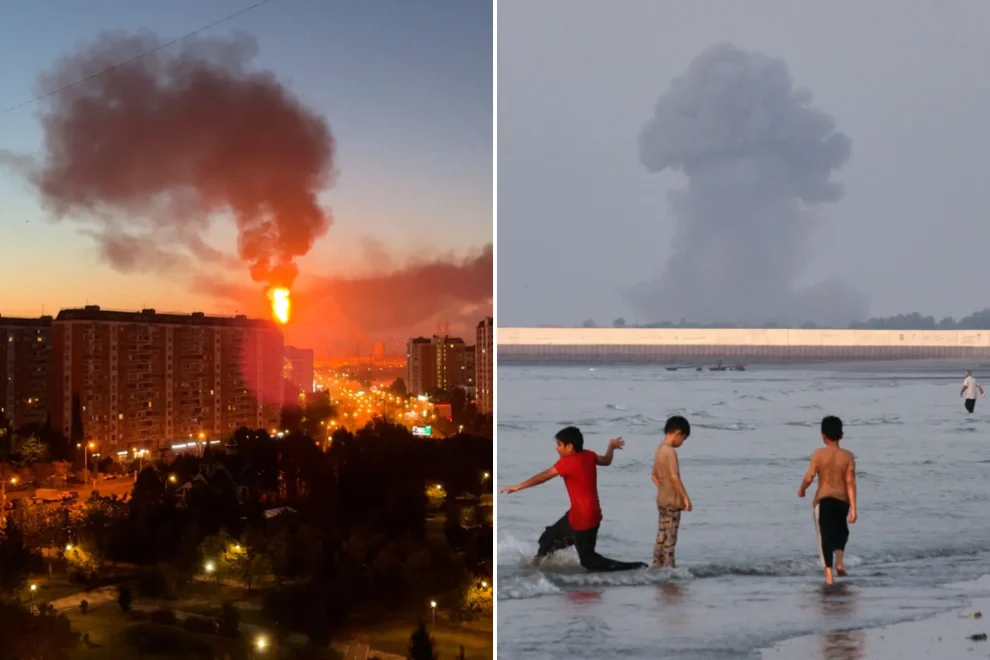
A fire rises over a Russian oil refinery and smoke rises above the horizon of Bandar Abbas, Iran. (AP)
” data-large-file=”https://www.washingtonexaminer.com/wp-content/uploads/2026/10/image-collage-p22wzwfaw-1792183729171-e1792186238441.jpg?1792171851&w=696″ src=”https://conservativemodern.com/wp-content/uploads/2026/10/ukraine-drone-strikes-and-iran-war-split-blame-on-skyrocketing-diesel-prices.webp” alt=”Moscow Iran” class=”wp-image-4769378″>A fire rises over a Russian oil refinery and smoke rises above the horizon of Bandar Abbas, Iran. (AP)
“This new chart from @TheStudyofWar overlays Ukraine’s strikes on Russian refineries with the price of diesel fuel. There is NO CORRELATION between strikes on Russian refineries and spikes in the price of diesel here in the U.S. They are not driving up prices here,” Thiessen said.
Many analysts agree that the war with Iran has had a bigger impact on diesel prices. Before the war, Russia exported around an equal amount of diesel products that passed through the Strait of Hormuz. Bloomberg, citing estimates from energy analytics companies Energy Aspects, Kpler, and Vortexa, implied an average loss of 770,000 barrels of diesel fuel per day from the Middle East from March to August, compared to 350,000 barrels of diesel fuel lost per day from Russia over the same time period.
“In pure volumetric terms Iran is bigger,” Eugene Lindell, head of refined products at consultancy FGE NexantECA, told the outlet about the war-driven loss.
“But, of course, prices are set at the margin,” he continued, adding that Ukraine’s erasure of hundreds of thousands more barrels of diesel off the market “turned a super tight market into a historically tight one.”
In 2025, Russia provided around 11% of the world’s diesel fuel, Bloomberg reported.
Many analysts would also take issue with finding no correlation between Ukrainian strikes on Russian refineries and global diesel prices.
Other analysts view the impact of the war in Iran and the Russia-Ukraine war as having almost equal impact. Oil market researcher Rory Johnston said he believes the rise in diesel prices can be credited 50/50 between the two conflicts. He clarified that he dislikes Trump’s “scapegoat-y” claim that the rise is entirely due to Ukraine, but took issue with Thiessen’s characterization.
“This comparison is a bit silly. Ukrainian strikes have absolutely hammered Russian refining capacity (which is exactly their purpose, to bring the war home to Russia) and collapsed Russian diesel exports. It’s not the strikes themselves in some kind of ‘risk premium’ in diesel; it’s the cumulative impact on Russian refining capacity,” he wrote in a post on X responding to Thiessen’s graph.
“Russia is normally the world’s second largest diesel exporter shipping ~1 million barrels per day. Today they’re barely above 100,000 bpd. That loss of Russian diesel has absolutely helped drive diesel prices to their current near-all-time-highs,” Johnston added.
The graph itself also only gives part of the picture. It only counts refineries struck, without clarifying the actual damage done, whether the refineries were knocked offline, and for how long. The graph lists the number of weekly strikes, but doesn’t specify which refineries were hit. A series of mid-June strikes on Moscow’s Kapotnya refinery and Tatneft’s TANECO refinery, for example, knocked out 600,000 barrels per day in throughput. Other refineries don’t have nearly as much throughput.
The graph also fails to account for bigger developments in Russia’s diesel industry related to the strikes.
The biggest oversight of the graph is a critical date placed at July 8. The graph correctly labels the resumption of large-scale strikes on that date, followed by a continuous rise in diesel prices to the record heights experienced over the past month. However, it fails to account for another major development that occurred on the same day — Russia’s ban on diesel exports. Aside from the change in volume, the mere announcement of the ban had an immediate impact on diesel prices among European traders, as noted by the Moscow Times at the time.
Patrick De Haan, head of petroleum analysis at GasBuddy, argued last month that the wars in Ukraine and the Middle East stacked to create the current crisis, rather than just one.
“Two things stacked,” he explained in a post on X. “Ukraine spent months tightening global supply even while prices held flat, so when Iran responded & shut the Strait there was no Middle East cushion left to absorb it. That combo broke it higher at the same time demand peaks- in the summer.”
“The producer ban of diesel exports from Russia started I believe July 2026, which was an escalation from the trader export ban that started last year. Complete bans of diesel exports when Russia producers >10% of global diesel is quite substantial,” De Haan added.