






As former President Barack Obama remains one of the Democratic Party’s most popular figures, a growing number of insurgent progressive candidates are increasingly willing to criticize his presidency and the politics of the Obama era, signaling a broader reassessment taking shape on parts of the Democratic Left.
The tension has surfaced across several 2026 races, where candidates aligned with the Democratic Socialists of America or broader populist movements have argued Obama’s presidency failed to deliver the transformational economic change many voters expected after the 2008 financial crisis.
Michigan Senate candidate Abdul el Sayed has emerged as one of the clearest examples of a progressive Democrat openly revisiting and criticizing the Obama era while running for federal office. El Sayed spent years criticizing Obama, at various points writing that the country was “not better off than we were before him,” that the 44th president “had a list of failures,” and that he “was not the right choice.”
Now, as he campaigns for Senate in Michigan, el Sayed has continued making versions of that argument publicly. During a June 20 campaign stop in Saginaw, he said Obama’s presidency “wasn’t quite what we had wanted” and argued many Americans remained frustrated by the economic fallout of the Great Recession.
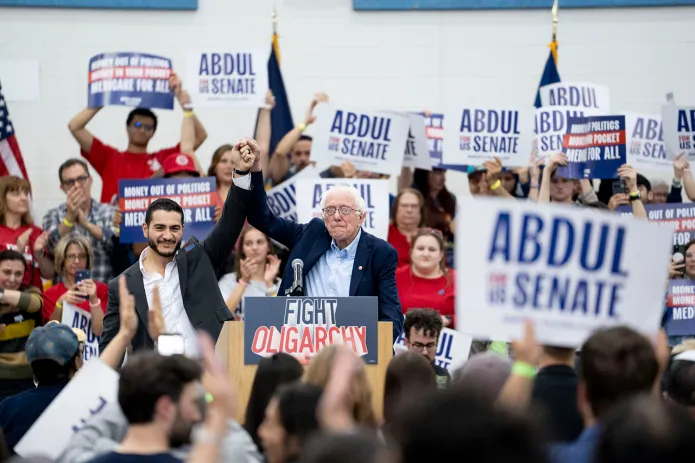
 stands with Senate candidate Abdul El-Sayed after speaking at Mumford High School on May 3, 2026 in Detroit, Michigan. Sanders is visiting the mid-west on his ‘Fighting Oligarchy: Where We Go From Here’ tour. (Photo by Sarah Rice/Getty Images)</p>
<p> ” data-large-file=”https://conservativemodern.com/wp-content/uploads/2026/07/the-democratic-partys-progressive-insurgents-are-turning-on-obama.webp” height=”683″ width=”1024″ src=”https://conservativemodern.com/wp-content/uploads/2026/07/the-democratic-partys-progressive-insurgents-are-turning-on-obama.webp” alt=”Sen. Bernie Sanders (I-VT) stands with Senate candidate Abdul El-Sayed after speaking at Mumford High School on May 3, 2026 in Detroit, Michigan. Sanders is visiting the mid-west on his ‘Fighting Oligarchy: Where We Go From Here’ tour. (Photo by Sarah Rice/Getty Images)” class=”wp-image-4637038″ style=”aspect-ratio:1.5011497777096428;width:352px;height:auto” srcset=”https://conservativemodern.com/wp-content/uploads/2026/07/the-democratic-partys-progressive-insurgents-are-turning-on-obama-3.webp 1500w, https://conservativemodern.com/wp-content/uploads/2026/07/the-democratic-partys-progressive-insurgents-are-turning-on-obama-3.webp?resize=300,200 300w, https://conservativemodern.com/wp-content/uploads/2026/07/the-democratic-partys-progressive-insurgents-are-turning-on-obama-3.webp?resize=768,512 768w, https://conservativemodern.com/wp-content/uploads/2026/07/the-democratic-partys-progressive-insurgents-are-turning-on-obama-3.webp?resize=1024,683 1024w, https://conservativemodern.com/wp-content/uploads/2026/07/the-democratic-partys-progressive-insurgents-are-turning-on-obama-3.webp?resize=150,100 150w, https://conservativemodern.com/wp-content/uploads/2026/07/the-democratic-partys-progressive-insurgents-are-turning-on-obama-3.webp?resize=696,464 696w, https://conservativemodern.com/wp-content/uploads/2026/07/the-democratic-partys-progressive-insurgents-are-turning-on-obama-3.webp?resize=1068,712 1068w” sizes=”(max-width: 1024px) 100vw, 1024px”><figcaption class=) Sen. Bernie Sanders (I-VT) stands with Senate candidate Abdul El-Sayed after speaking at Mumford High School on May 3, 2026 in Detroit, Michigan. (Sarah Rice/Getty Images)
Sen. Bernie Sanders (I-VT) stands with Senate candidate Abdul El-Sayed after speaking at Mumford High School on May 3, 2026 in Detroit, Michigan. (Sarah Rice/Getty Images)“A lot of the 2008 campaign that Obama ran was pushing back on that, but in some respects some of what we got wasn’t quite what we had wanted,” el Sayed said. “I think the [Affordable Care Act] was one small step in that direction, but also, you look at the fallout of the financial crisis, and a lot of folks are frustrated.”
El Sayed has also argued that Obama governed too incrementally. In his 2020 book, he described the Affordable Care Act as an “important if tepid healthcare reform” and criticized the administration for abandoning more aggressive structural changes to healthcare during negotiations with Republicans. He also wrote that Obama’s policies to bail out the auto industry “largely failed” to address the structural economic problems facing many working-class communities. El Sayed’s campaign did not respond to a request for comment.
Democratic strategist Michael Ceraso said many younger voters who did not directly experience the Obama presidency are evaluating it through a different lens than older Democratic voters who remember the Great Recession and the legislative battles surrounding the Affordable Care Act.
“When you’re younger and you didn’t experience it, you’re going to look at things in the critiques and you’re just going to want to say, ‘Wait, under Obama, the wealth gap expanded,’” Ceraso said. “Living through it and then evaluating it through history are just two completely different things.”
The criticism extends beyond el Sayed. During an appearance on the “Lever Time” podcast earlier this year, Maine Democratic Senate candidate Graham Platner argued Democrats paved the way for President Donald Trump’s rise by continuing “neoliberal” economic policies under Obama after voters expected sweeping change following the financial crisis.
“We did not stop the neoliberal project, that’s why,” Platner said. “When Obama comes in and so many people are looking for this significant change, and then materially we kind of just continue with the same neoliberal policies, trickle-down economics, bailing out the banks and not bailing out the homeowners. That engenders an intense amount of anger and frustration and total disillusionment with the system itself.”
</p>
<p> ” data-large-file=”https://conservativemodern.com/wp-content/uploads/2026/07/the-democratic-partys-progressive-insurgents-are-turning-on-obama-1.webp” src=”https://conservativemodern.com/wp-content/uploads/2026/07/the-democratic-partys-progressive-insurgents-are-turning-on-obama-1.webp” alt=”Democratic U.S. Senate candidate Graham Platner speaks during a primary election night watch party after winning the Democratic nomination Tuesday, June 9, 2026, in Blue Hill, Maine. (AP Photo/Robert F. Bukaty)” class=”wp-image-4637041″ style=”width:330px;height:auto” srcset=”https://conservativemodern.com/wp-content/uploads/2026/07/the-democratic-partys-progressive-insurgents-are-turning-on-obama-5.webp 1024w, https://conservativemodern.com/wp-content/uploads/2026/07/the-democratic-partys-progressive-insurgents-are-turning-on-obama-5.webp?resize=300,200 300w, https://conservativemodern.com/wp-content/uploads/2026/07/the-democratic-partys-progressive-insurgents-are-turning-on-obama-5.webp?resize=768,512 768w, https://conservativemodern.com/wp-content/uploads/2026/07/the-democratic-partys-progressive-insurgents-are-turning-on-obama-5.webp?resize=150,100 150w, https://conservativemodern.com/wp-content/uploads/2026/07/the-democratic-partys-progressive-insurgents-are-turning-on-obama-5.webp?resize=696,464 696w” sizes=”auto, (max-width: 1024px) 100vw, 1024px”><figcaption class=) Democratic U.S. Senate candidate Graham Platner speaks during a primary election night watch party after winning the Democratic nomination Tuesday, June 9, 2026, in Blue Hill, Maine. (AP Photo/Robert F. Bukaty)
Democratic U.S. Senate candidate Graham Platner speaks during a primary election night watch party after winning the Democratic nomination Tuesday, June 9, 2026, in Blue Hill, Maine. (AP Photo/Robert F. Bukaty)In New York, resurfaced social media posts from Democratic congressional candidate Darializa Avila Chevalier, who went on to win her primary in the state’s 13th Congressional District, included attacks on Obama and other Democrats alongside calls to abolish police and borders.
Even New York City Mayor Zohran Mamdani, now one of the country’s highest-profile socialists, previously blasted Obama in tweets posted between 2012 and 2014, at one point calling the former president “pretty damn evil” and accusing him of misleading the public after Edward Snowden’s NSA revelations.
Still, strategists caution that criticizing Obama remains politically risky in a Democratic primary electorate where the former president remains broadly admired.
“Obama is very popular. He is especially popular with people who vote for Democrats. He is universally popular among African American voters, which are a key part of the Democratic coalition,” Democratic strategist and pollster Brad Bannon said. “If you’re going to criticize Barack Obama in the Democratic primary, it’s going to come back and bite you.”
A Democratic national strategist, speaking on the condition of anonymity to discuss intraparty politics candidly, said Obama’s popularity still extends well beyond the Democratic base.
“President Obama is still extremely popular amongst all parts of the Democratic coalition, besides potentially some folks on the very far left, but not only that, the former president remains popular with folks in the middle,” the strategist said. “There are folks who voted for him who may not vote for Republicans. He is a very popular figure, and it does not make a lot of electoral sense to distance yourself from someone that popular.”
</p>
<p> ” data-large-file=”https://conservativemodern.com/wp-content/uploads/2026/07/the-democratic-partys-progressive-insurgents-are-turning-on-obama-2.webp” src=”https://conservativemodern.com/wp-content/uploads/2026/07/the-democratic-partys-progressive-insurgents-are-turning-on-obama-2.webp” alt=”Former President Barack Obama speaks during the dedication ceremony for the Obama Presidential Center, Thursday, June 18, 2026, in Chicago. (AP Photo/Alex Brandon)” class=”wp-image-4637047″ style=”width:309px;height:auto” srcset=”https://conservativemodern.com/wp-content/uploads/2026/07/the-democratic-partys-progressive-insurgents-are-turning-on-obama-6.webp 1024w, https://conservativemodern.com/wp-content/uploads/2026/07/the-democratic-partys-progressive-insurgents-are-turning-on-obama-6.webp?resize=300,200 300w, https://conservativemodern.com/wp-content/uploads/2026/07/the-democratic-partys-progressive-insurgents-are-turning-on-obama-6.webp?resize=768,512 768w, https://conservativemodern.com/wp-content/uploads/2026/07/the-democratic-partys-progressive-insurgents-are-turning-on-obama-6.webp?resize=150,100 150w, https://conservativemodern.com/wp-content/uploads/2026/07/the-democratic-partys-progressive-insurgents-are-turning-on-obama-6.webp?resize=696,464 696w” sizes=”auto, (max-width: 1024px) 100vw, 1024px”><figcaption class=) Former President Barack Obama speaks during the dedication ceremony for the Obama Presidential Center, Thursday, June 18, 2026, in Chicago. (AP Photo/Alex Brandon)
Former President Barack Obama speaks during the dedication ceremony for the Obama Presidential Center, Thursday, June 18, 2026, in Chicago. (AP Photo/Alex Brandon)The warning from Democratic strategists underscores the central tension facing many of these insurgent candidates: While criticism of Obama-era politics may resonate with portions of the progressive left, Obama himself remains one of the most broadly popular figures in Democratic politics.
A recent CNN poll conducted by SSRS found Obama held a 57% favorability rating nationally, far ahead of both Trump and former President Joe Biden. Obama also continues to dominate among independents and remains deeply popular among Democratic voters, particularly Black voters.
Another recent Strength In Numbers/Verasight survey found Obama was the only political figure tested with an overall positive warmth rating among Americans, outperforming figures ranging from Sen. Bernie Sanders (I-VT) and Rep. Alexandria Ocasio-Cortez (D-NY) to Trump and Vice President JD Vance.
Even some Democrats sympathetic to progressive critiques caution against judging Obama’s presidency without considering the political environment he inherited.
“It’s very hard to sit 10, 20 years later and cast judgment,” Sen. Cory Booker (D-NJ) told CNN. “Barack Obama was a hero and saved our economy and advanced our nation along really specific indices that are lasting and still are making a difference.”
Ceraso argued many progressive candidates are less interested in launching a full ideological rejection of Obama than in channeling frustration from younger voters struggling with housing costs, childcare expenses, and broader economic anxiety.
“I think it’s a turnout shift,” Ceraso said. “You want to get people worked up to turn out, and frustration is something people see all around them.”
OBAMA’S $850 MILLION PRESIDENTIAL CENTER OPENS WITHOUT AN INVITATION FOR TRUMP
Still, he argued, there is a difference between criticizing Obama-era politics and diminishing Obama’s standing within the Democratic Party itself.
“Obama will always be beloved, because the party is the party,” Ceraso said. “Many Democratic voters grew up looking at Obama as their political leader.”


