






A private equity-owned autism therapy chain that receives Medicaid payments is facing scrutiny over allegations of improper billing and child abuse, according to a new watchdog report.
The American Accountability Foundation’s 33-page investigation, provided exclusively to the Washington Examiner, focuses on Hopebridge, an Indianapolis-based company operating more than 100 autism therapy centers across the country. The report brings together lawsuits, a federal billing settlement, employee accounts, and property records associated with the company’s investors.
AAF argues the records expose a business model that prioritizes investor returns over patient care. The company was acquired by Arsenal Capital Partners in 2019 — a time when private equity was pouring into autism services — and promotes its services as personalized treatment designed around each child’s needs, but alleges that in several severe instances, it failed to live up to that promise.
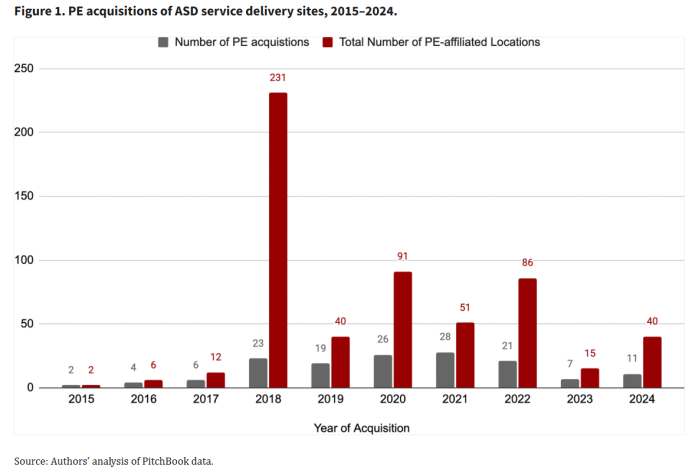
 100vw, 695px”><figcaption class=) Private-equity acquisitions and locations in the autism-services industry from 2015 through 2024, as presented in the AAF report. Source: AAF analysis of PitchBook data, report p. 10.
Private-equity acquisitions and locations in the autism-services industry from 2015 through 2024, as presented in the AAF report. Source: AAF analysis of PitchBook data, report p. 10.“Hopebridge presents a unique case study on the failures of private equity owned ABA providers,” the AAF report states, arguing it has a “staffing model that puts underpaid and underqualified individuals in crucial positions of patient care.”
The report arrives amid the Trump administration‘s crackdown on Medicaid fraud, in addition to scrutiny on abuse of autism services.
On May 21, the Justice Department announced Minnesota charges that included an alleged $46.6 million autism-services scheme and funding for 15 additional prosecutors to pursue Medicaid fraud nationwide.
While those federal prosecutions concerned a different set of providers, they also only scratch the surface of the potential autism-services fraud taking place across the country. Hopebridge’s billing matter, as outlined by AAF, exhibited similar characteristics but notably differed in that Hopebridge has so far resolved its disputes via civil settlements. Hopebridge has not been accused of healthcare fraud.
In one instance, Hopebridge agreed to pay $25,336.48 to resolve allegations under the Civil Monetary Penalties Law. The Department of Health and Human Services inspector general listed the enforcement action on Oct. 31, 2025.
OIG alleged the company submitted claims for plans of care that were “not individualized to the patient,” according to the agency announcement.
That allegation resembles a central complaint in an earlier Indiana lawsuit, in which a family accused Hopebridge of charging approximately $37,000 over roughly five months while failing to complete assessments and provide the clinical supervision necessary for applied behavior analysis, or ABA, therapy.
The family alleged its four-year-old autistic son was left alone in a closed, windowless room with the lights off for at least 24 minutes at the company’s Bloomington center in May 2019.
 100vw, 622px”><figcaption class=) Photographs attached to the family’s complaint and reproduced in the AAF report. The complaint alleged that the pictured room was used for an “exclusionary timeout.” The allegations were not resolved through a trial verdict. Source: AAF report, p. 21.
Photographs attached to the family’s complaint and reproduced in the AAF report. The complaint alleged that the pictured room was used for an “exclusionary timeout.” The allegations were not resolved through a trial verdict. Source: AAF report, p. 21.The complaint, filed in March 2021, accused Hopebridge of providing “cookie-cutter treatment plans” and services that amounted to daycare rather than ABA treatment, according to court records.
The case settled in 2023 and was dismissed with prejudice. The report does not disclose the settlement terms, and the family’s allegations were not resolved through a trial verdict.
A separate case raised questions about supervision at the company’s Greenwood, Indiana, center. Police said in 2023 that technician Leomeir V. Kennedy, a man who identified as a woman, confessed to sexually abusing two children at the facility, one nonverbal and the other semi-verbal, according to reporting cited in the investigation.
 100vw, 313px”><figcaption class=) Leomeir V. Kennedy in an image reproduced in the AAF report. Police said Kennedy confessed to abusing children, but Kennedy died before trial and the criminal case was dismissed. Source: AAF report, p. 18, citing WTHR, Fox59, and Indiana court records.]
Leomeir V. Kennedy in an image reproduced in the AAF report. Police said Kennedy confessed to abusing children, but Kennedy died before trial and the criminal case was dismissed. Source: AAF report, p. 18, citing WTHR, Fox59, and Indiana court records.]A mother subsequently sued Hopebridge and Kennedy, alleging the center failed to protect her daughter, adequately supervise its employees, and maintain sufficient staffing.
However, Kennedy was found dead in jail in August 2023 before trial, and the criminal case was dismissed. The mother’s civil suit was dismissed with prejudice in December 2024, according to the court history cited by AAF.
In 2022, the outlet Fortune also led an investigation into Hopebridge involving allegations that parents and employees encountered rough treatment of children and complaints that went unaddressed.
The company has also faced litigation from its technicians. An Ohio wage case alleged employees performed preparation, meetings, and cleanup without compensation, among other unpaid work. A federal judge approved a $300,000 settlement in February 2023.
Hopebridge denied the allegations and disputed the workers’ calculations. The court described the settlement as resolving a bona fide legal dispute.
Hopebridge has defended its services, arguing it has helped more than 11,700 families and delivered over 4.1 million therapy hours in 2025. Its website describes a model combining behavioral, speech, occupational, and other services, with licensed professionals designing a custom treatment plan for each child.
The Washington Examiner contacted representatives for Hopebridge and Arsenal Capital Partners but did not immediately receive a response.
The Trump administration has separately placed autism therapy under heightened scrutiny.
In August, the Centers for Medicare and Medicaid Services released a provider’s toolkit urging states to strengthen oversight of Medicaid-funded applied behavior analysis, citing concerns about rising expenditures, inconsistent clinical practices, improper billing, and treatment driven by financial incentives rather than medical need. CMS said spending on the services increased 421% between 2021 and 2025, compared with a 67% increase in the number of children with autism diagnoses receiving care.
“Every dollar lost to fraud or waste is a dollar that cannot reach a child who genuinely needs it,” CMS Administrator Dr. Mehmet Oz said at the time. He added that families should be able to trust that ABA treatment is personalized, clinically appropriate, and delivered by qualified providers.
AUTISM SERVICES SHOULD BE AT THE TOP OF TRUMP’S FRAUD AGENDA
AAF is urging policymakers and regulators to look beyond billing fraud and examine the quality of care purchased with public money. Its report argues that private equity ownership has created incentives that conflict with the individualized, stable treatment autistic children need.
Read the full 33-page report below:


