






A Syrian court sentenced former President Bashar Assad to death, testing the new government’s relationship with Russia.
Assad secretly fled Syria the night before rebels seized Damascus, taking refuge in Moscow with his family. He’s been closely guarded and closed off from the world since, as Russia has sought to secure a relationship with the new regime led by President Ahmed al Sharaa.
Little united the Syrian rebels during the country’s civil war from 2011 to 2024 outside of their hatred of Assad, and Damascus has sought to cultivate this memory of bitterness to keep the country’s disparate groups together. This culminated in a Tuesday decision from the Fourth Criminal Court in Damascus, giving the highest penalty to Assad, his brother, and his maternal cousin, only the latter of whom was sentenced in person.
</p>
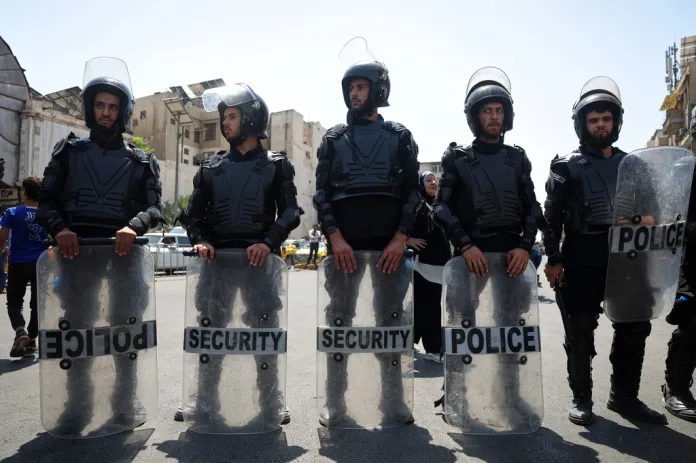
<p> ” data-large-file=”https://conservativemodern.com/wp-content/uploads/2026/08/syrias-death-sentence-for-assad-puts-new-strain-on-revamped-relationship-with-russia.webp” src=”https://conservativemodern.com/wp-content/uploads/2026/08/syrias-death-sentence-for-assad-puts-new-strain-on-revamped-relationship-with-russia.webp” alt=”Riot police in Syria” class=”wp-image-4683227″ srcset=”https://conservativemodern.com/wp-content/uploads/2026/08/syrias-death-sentence-for-assad-puts-new-strain-on-revamped-relationship-with-russia-1.webp 1024w, https://conservativemodern.com/wp-content/uploads/2026/08/syrias-death-sentence-for-assad-puts-new-strain-on-revamped-relationship-with-russia-1.webp?resize=300,200 300w, https://conservativemodern.com/wp-content/uploads/2026/08/syrias-death-sentence-for-assad-puts-new-strain-on-revamped-relationship-with-russia-1.webp?resize=768,512 768w, https://conservativemodern.com/wp-content/uploads/2026/08/syrias-death-sentence-for-assad-puts-new-strain-on-revamped-relationship-with-russia-1.webp?resize=150,100 150w, https://conservativemodern.com/wp-content/uploads/2026/08/syrias-death-sentence-for-assad-puts-new-strain-on-revamped-relationship-with-russia-1.webp?resize=696,464 696w” sizes=”(max-width: 1024px) 100vw, 1024px”><figcaption class=) Riot police stand outside the Palace of Justice during a court session that sentenced Atef Najib, a cousin of ousted President Bashar Assad, to death for overseeing a crackdown in Daraa that helped spark Syria’s uprising and civil war, while Assad and his brother Maher were sentenced to death in absentia, in Damascus, Syria, Tuesday, Aug. 11, 2026. (Ghaith Alsayed/AP Photo)
Riot police stand outside the Palace of Justice during a court session that sentenced Atef Najib, a cousin of ousted President Bashar Assad, to death for overseeing a crackdown in Daraa that helped spark Syria’s uprising and civil war, while Assad and his brother Maher were sentenced to death in absentia, in Damascus, Syria, Tuesday, Aug. 11, 2026. (Ghaith Alsayed/AP Photo)“Bashar Assad used state agencies to commit war crimes and crimes against humanity,” Judge Fakhreddine al Aryan said during a court session that was aired live on state TV, the Associated Press reported.
The sentence gives Syria a legal avenue to push for Assad’s extradition. The 2022 Russia-Syria extradition treaty, signed during Assad’s reign, commits each country to extraditing each other’s criminals.
Sharaa was reported to have personally asked for the extradition of Assad during his visit to Russia last year, during which he met with Russian President Vladimir Putin. The request wasn’t accepted, but the added legal justification could give rise to hopes that Assad could actually be extradited to Syria.
In practice, however, most analysts agree that there’s next to zero chance that Russia will extradite Assad. A major part of Russia’s appeal to its strongman allies is that Putin has their back if they’re ever ousted, promising a comfortable retirement. If Assad were handed over to certain mistreatment and death, Moscow would be increasingly viewed as a fair-weather ally, especially by its more unstable partners such as the dictators of Burkina Faso, Niger, and Mali, all of whom face existential danger from insurgencies.
Russia proved itself to be Assad’s greatest ally during the war, surpassing even Iran’s extensive help. It launched a decisive intervention in 2015 when Assad’s government looked to be on the ropes, reversing the rebels’ gains and confining them to a small enclave based around the northwest city of Idlib before freezing the conflict in March 2020.
Without Russia’s assistance and ultimate intervention, Assad would have been ousted nearly a decade earlier. This assistance led many analysts to believe that al Sharaa’s new government would expel Russian influence altogether, shifting instead toward Turkey and the United States. To many’s surprise, neither Russia nor Syria has shown any willingness to end their relationship, choosing instead to cement ties despite significant pressure from the U.S. and Gulf states to eject Russia’s military presence altogether.
Syria’s relationship with Russia extends back to Soviet times, when it forged a close relationship with Moscow to counter U.S. and Israeli influence. The main benefit was to the regime’s military, with nearly all its equipment up until the fall of the Assad government being of Soviet or Russian origin.
The new Syrian military inherited much of this Soviet and Russian equipment, along with decades of administrative and technical cooperation with Moscow. Damascus likely decided that it would be easier to continue operating off these templates, rather than replace everything with U.S. or Turkish equipment.
On Sunday, Russia and Syria signed a memorandum of understanding dictating their military cooperation in the near future. According to the agreement, Russia would turn over control of the civilian parts of its naval base in Tartous and military base at Khmeimim to the Syrian government, while the bases themselves would be turned into joint training centers.
“The agreement follows about a year and a half of intensive negotiations led by Syria’s Ministry of Foreign Affairs and Expatriates and settles the future status of the Russian facilities at Khmeimim and Tartous,” the Foreign Ministry’s Media and Communications Department told the Syrian Arab News Agency, a state media outlet.
“This move marks the most significant development since negotiations began approximately a year and a half ago, paving the way for a new phase in Syrian-Russian relations,” it added.
The new agreement will take effect after three months.
Political analyst Ruslan Trad, a nonresident fellow at the Atlantic Council, told Al Jazeera that the deal “confirms the classic realist maxim that in politics there are no permanent enemies, only permanent interests.”
He argued that Damascus made the rational calculation that punishing Russia over its support for Assad was more trouble than it was worth. From this angle, leveraging threats to expel Russia in exchange for the extradition of Assad is unlikely.
For the war-ravaged country struggling to rebuild, Russia also has many levers it can use in response to any provocations. Russia maintains its veto power in the United Nations Security Council, Syria’s reliance on Moscow’s wheat and energy exports, the Kremlin’s technical expertise in repairing and maintaining inherited military equipment, an inherited debt of roughly $1.2 billion, reconstruction contracts, and ties to the phosphate and currency-printing sectors.
The Alma Research Center, an Israeli think tank, noted that Syria has explored avenues to decrease this reliance, including shifting currency printing to the United Arab Emirates and Germany, and is reportedly examining shifting crude oil imports to the U.S. in exchange for lifting remaining sanctions.
The think tank noted that Russia’s position in Syria has shifted from its hegemonic stance under the Assad government to “a model resembling a security partnership with the host country. This model is less costly, less exposed to political pressure, and allows Russia to maintain physical access in Syria.”
“The focus of Russian influence is shifting from the direct use of force to institutional dependence in force development,” the Alma Research Center added. “Weapons maintenance, military training, the supply of spare parts, and ties with the Syrian officer corps may become more important tools than the number of troops or aircraft on the ground.”
Overall, the balance of power has clearly shifted in Syria’s favor, the analysis argued, but Syria has no interest or plans to eject Russia altogether.
Rybar, a popular Russian analyst Telegram channel with ties to the Russian Ministry of Defense, noted that Russian influence was declining in Syria, and that it was “naive to expect anything more, especially considering those currently in power in the country are the very people that the Russian armed forces have been bombing for years.”
However, it said, “It would be equally foolish to think that Russia will abandon Khmeimim and Tartus,” noting the substantial bargaining chip Moscow has in the form of desperately-needed oil and fertilizer exports.
While Rybar argued that the Russian military presence in the country is likely to continue to decline, it argued that a shift toward soft power could preserve Russian influence in the country.
“While the sign of a base can be removed under pressure from sponsors, the demand from ordinary Syrians for education and medical assistance does not disappear, regardless of the political situation in Damascus,” it wrote, adding that the humanitarian channel “currently looks like one of the few areas where Russia can still increase its presence, rather than just maintain its positions.”
Moscow has already begun pursuing this boost in soft power.
A delegation from the Rossotrudnichestvo, the Federal Agency for the Commonwealth of Independent States Affairs, Compatriots Living Abroad, and International Humanitarian Cooperation, met with their Syrian counterparts from Sunday to Monday, during which the two discussed reopening the so-called Russian House, a cultural center in Damascus that closed in December 2024. Russia expressed its willingness to increase the number of Syrian students studying in Russia, and the two outlined upcoming scientific, cultural, and technological cooperation.
US NEGOTIATES DEAL FOR REMOVAL OF NUCLEAR MATERIAL FROM COVERT SYRIAN SITE: REPORT
Rybar argued that the Russian House served as far more than just a cultural center, serving instead as a “hybrid structure — simultaneously a humanitarian hub and a platform for consolidating a presence where military and diplomatic channels are narrowing under external pressure.”
If Russia continues to play its cards right, it could get the best of both worlds, retaining a significant presence in Syria while keeping its credibility in the eyes of strongman partners elsewhere.


