





Polish President Karol Nawrocki is focusing on negotiations with the United States over troop placement in his country, seeking the reassurance of an ally’s presence amid unprecedented instability and opposition from technocrats in Brussels.
The head of state opened a meeting of the National Security Council on Tuesday, which sought to address the ongoing stand-off outside the Constitutional Tribunal in Warsaw. Accusing Prime Minister Donald Tusk of attempting to “illegally take over” the nation’s highest court and plunging Poland into a “serious constitutional crisis,” Nawrocki said he was seeking to bolster U.S. presence in the country as a security stopgap.
“The main focus of our meeting was the state and future of Polish security, including the strategic importance of the permanent presence of United States troops on the territory of the Republic of Poland,” Nawrocki said after the meeting.
</p>
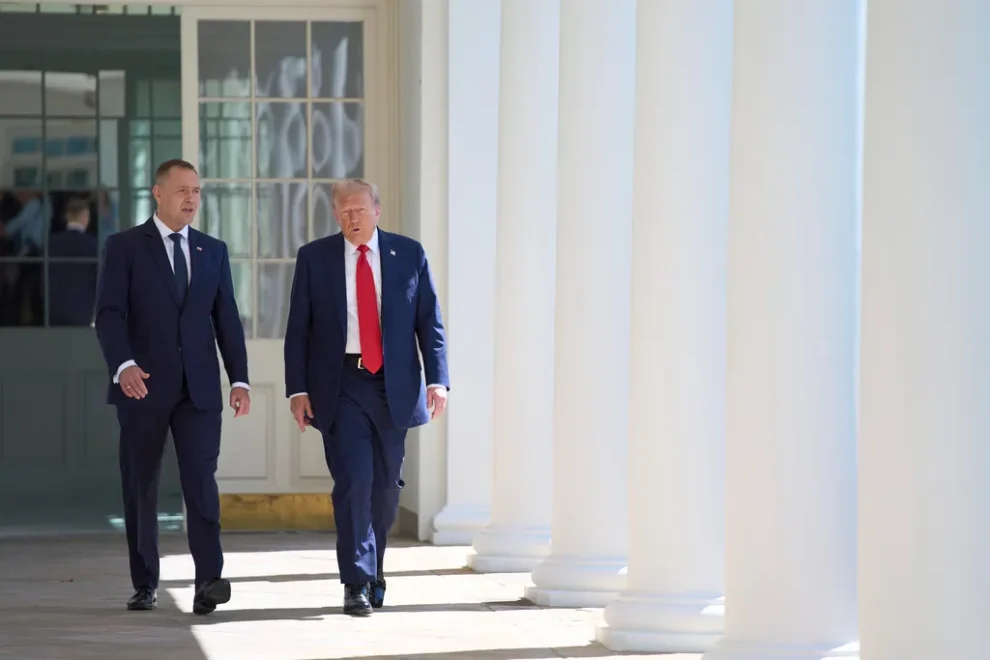
<p> ” data-large-file=”https://conservativemodern.com/wp-content/uploads/2026/11/nawrocki-urgently-seeking-us-troops-in-poland-amid-high-court-coup-detat-supported-by-eu.webp” src=”https://conservativemodern.com/wp-content/uploads/2026/11/nawrocki-urgently-seeking-us-troops-in-poland-amid-high-court-coup-detat-supported-by-eu.webp” alt=”President Donald Trump walks with Polish President Karol Nawrocki to a meeting in the Oval Office of the White House, Wednesday, Sept. 3, 2025, in Washington. ” class=”wp-image-4789578″ srcset=”https://conservativemodern.com/wp-content/uploads/2026/11/nawrocki-urgently-seeking-us-troops-in-poland-amid-high-court-coup-detat-supported-by-eu.webp 1024w, https://conservativemodern.com/wp-content/uploads/2026/11/nawrocki-urgently-seeking-us-troops-in-poland-amid-high-court-coup-detat-supported-by-eu.webp?resize=300,200 300w, https://conservativemodern.com/wp-content/uploads/2026/11/nawrocki-urgently-seeking-us-troops-in-poland-amid-high-court-coup-detat-supported-by-eu.webp?resize=768,512 768w” sizes=”(max-width: 1024px) 100vw, 1024px”><figcaption class=) President Donald Trump walks with Polish President Karol Nawrocki to a meeting in the Oval Office of the White House, Wednesday, Sept. 3, 2025, in Washington. (AP Photo/Evan Vucci)
He continued: “This is one of the pillars of deterring a potential aggressor. It’s an important element of security on NATO’s eastern flank. It’s also a testament to the trust between Poland and the United States.”
The demand for U.S. troops in Poland is not new. The government had been lobbying for such an arrangement for months, framed largely around the threat of Russian aggression against NATO’s Eastern border.
In September, Deputy Defense Minister Pawel Zalewski told the media that Poland was negotiating with the Pentagon to pay for a U.S. presence on Polish soil, offering to cover infrastructure costs and pay thousands of dollars per American soldier. Trump has been optimistic about the deal, stating around the same time that “major progress is being made toward establishing a U.S. Army base in Poland.”
“If this happens, the location will be announced very soon,” the president wrote on Truth Social. “This will be a historic step for our Great U.S./Polish Alliance.”
But U.S. troops would also be a valuable asset for Nawrocki domestically following last week’s chaos. Neither side has budged following Tusk’s surprise raid on the Constitutional Tribunal, through which his government ushered out the court’s president and vice president before installing ideologically sympathetic replacements. Nawrocki scrambled back to Warsaw and forced his way into the tribunal building as the ousted court declared that Tusk was staging a “coup d’etat.”
The fate of the judiciary now hangs in limbo, with severe consequences for whichever political faction is iced out of power.
Trump has previously called Nawrocki a “friend,” and following the defeat of Prime Minister Viktor Orban in Hungary this year, officials in the State Department began to see Poland as the administration’s closest ideological ally in Europe.
</p>
<p> ” data-large-file=”https://conservativemodern.com/wp-content/uploads/2026/11/nawrocki-urgently-seeking-us-troops-in-poland-amid-high-court-coup-detat-supported-by-eu.jpg” src=”https://conservativemodern.com/wp-content/uploads/2026/11/nawrocki-urgently-seeking-us-troops-in-poland-amid-high-court-coup-detat-supported-by-eu.jpg” alt=”A demonstrator wears a cap with the name of U.S. President Trump and Polish President Nawrocki during a protest in front of the Polish Constitutional Court in Warsaw, Poland, Saturday, Oct. 31, 2026. ” class=”wp-image-4789577″ srcset=”https://conservativemodern.com/wp-content/uploads/2026/11/nawrocki-urgently-seeking-us-troops-in-poland-amid-high-court-coup-detat-supported-by-eu-1.jpg 1024w, https://conservativemodern.com/wp-content/uploads/2026/11/nawrocki-urgently-seeking-us-troops-in-poland-amid-high-court-coup-detat-supported-by-eu-1.jpg?resize=300,200 300w, https://conservativemodern.com/wp-content/uploads/2026/11/nawrocki-urgently-seeking-us-troops-in-poland-amid-high-court-coup-detat-supported-by-eu-1.jpg?resize=768,512 768w” sizes=”(max-width: 1024px) 100vw, 1024px”><figcaption class=) A demonstrator wears a cap with the name of U.S. President Trump and Polish President Nawrocki during a protest in front of the Polish Constitutional Court in Warsaw, Poland, Saturday, Oct. 31, 2026. (AP Photo/Beata Zawrzel)
The presence of U.S. troops in Poland might bolster Nawrocki’s authority amid the constitutional crisis.
“It would certainly change his standing among the public,” said Filip Styczynski, a Polish correspondent-at-large for the Institute of World Politics. “His popularity would likely increase further.
“This is why I suspect Tusk’s government will try to sabotage the U.S. base project,” he said. “In fact, during the [President George W.] Bush administration, Tusk was already instrumental in preventing the successful establishment of an American base in Poland when he had the opportunity to facilitate it.”
A base deal would also help even the playing field after Tusk and his government received explicit political support from the European Union last week.
“It is for the Polish authorities to ensure that the Constitutional Tribunal can function in accordance with the Polish constitution and in respect of the relevant case law of the Court of Justice of the European Union,” a spokesman for the European Commission said over the weekend.
They further stated that the formal appointment of judges to the Constitutional Tribunal lies “within the constitutional power of the Sejm, Poland’s parliament” — which is currently controlled by Tusk’s camp.
Professor Zdzisław Krasnodębski — a professor of sociology at the University of Bremen who previously served as an MEP and Vice President of the European Parliament — is a strong supporter of PiS and told the Washington Examiner that Polish conservatives see the EU as threatening their desire to “live peacefully and prosperously in their own country as free people.”
“For an increasingly number of Poles, the EU has gone from being a source of hope to a threat to our sovereignty,” Krasnodębski said. “And the fight over the Constitutional Tribunal is, for us, a fight for our independence, which — as many believe — is threatened by German and EU neo-imperialism.”
The prime minister, who previously served as president of the European Council, is a hard-line supporter of Polish reintegration into the EU after the previous PiS government disrupted ties with the continental bloc through judicial overhauls and challenges to the supremacy of EU law.
“As usual, Poles look to America for hope,” Krasnodębski said, suggesting that the U.S. “withdraw as many of their military forces as possible from Germany and redeploy them to Poland.”
</p>
<p> ” data-large-file=”https://conservativemodern.com/wp-content/uploads/2026/11/nawrocki-urgently-seeking-us-troops-in-poland-amid-high-court-coup-detat-supported-by-eu-1.webp” src=”https://conservativemodern.com/wp-content/uploads/2026/11/nawrocki-urgently-seeking-us-troops-in-poland-amid-high-court-coup-detat-supported-by-eu-1.webp” alt=”Poland’s Prime Minister Donald Tusk, center, French President Emmanuel Macron, right, and German Chancellor Friedrich Merz attend a press conference at the E5 NATO Summit in Berlin, Germany.” class=”wp-image-4789576″ srcset=”https://conservativemodern.com/wp-content/uploads/2026/11/nawrocki-urgently-seeking-us-troops-in-poland-amid-high-court-coup-detat-supported-by-eu-2.jpg 1024w, https://conservativemodern.com/wp-content/uploads/2026/11/nawrocki-urgently-seeking-us-troops-in-poland-amid-high-court-coup-detat-supported-by-eu-2.jpg?resize=300,200 300w, https://conservativemodern.com/wp-content/uploads/2026/11/nawrocki-urgently-seeking-us-troops-in-poland-amid-high-court-coup-detat-supported-by-eu-2.jpg?resize=768,512 768w” sizes=”auto, (max-width: 1024px) 100vw, 1024px”><figcaption class=) Poland’s Prime Minister Donald Tusk, center, French President Emmanuel Macron, right, and German Chancellor Friedrich Merz attend a press conference at the E5 NATO Summit in Berlin, Germany, Wednesday, June 24, 2026. (AP Photo/Ebrahim Noroozi)
Tusk and his government have characterized their conservative opposition as buoyed by foreign agitators, particularly Russian interference.
POLISH LEFT PUSHING ABORTION LIBERALIZATION THROUGH PARLIAMENT DESPITE LOOMING PRESIDENTIAL VETO
Foreign Minister Radoslaw Sikorski explicitly attributed support for anti-government protesters to “cooperation online between Russian accounts and propagandists, and the global far right,” accusing his political opponents of coordinating with Moscow.
“This is an evident alliance. Or at least collaboration,” the foreign minister alleged on Tuesday. “This should give all of us food for thought about who wants to stir things up in Poland and who this serves.”
The threat of Russian expansionism is something both parties agree on. But conservatives such as Krasnodębski assert that “the threat comes not only from a military invasion by Russia, but also from the unchecked ambitions of the Eurocrats.”


