







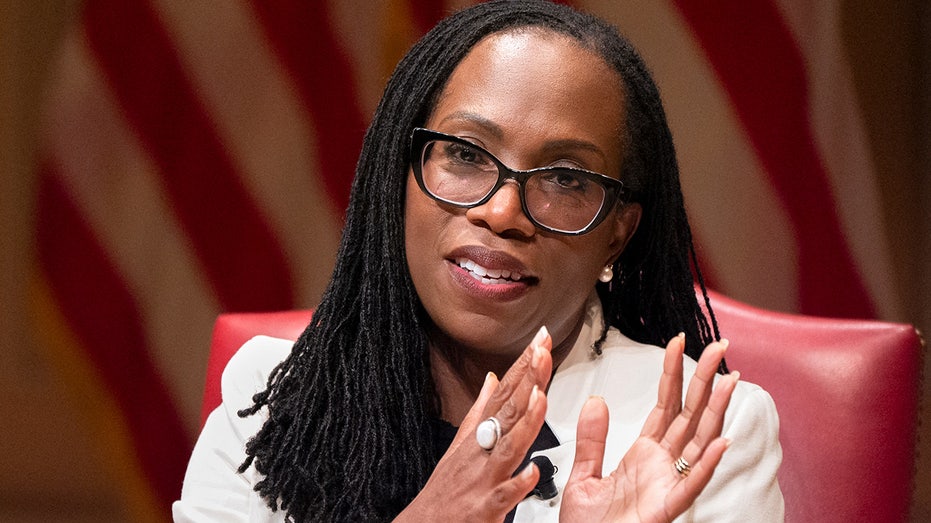
Justice Ketanji Brown Jackson stood out from her colleagues this week when she broke with them to rail against the high court’s decision to fast-track its landmark order dismantling a key provision in the Voting Rights Act.
But Jackson’s solo dissent was far from the first time the Biden-appointed justice has been on an island, as she has routinely blasted the court for not asserting more judicial authority over President Donald Trump’s executive actions and drawn rebukes from her colleagues for taking what they have viewed as flawed positions.
Ideological divides over high-profile cases have been common. The trio of liberals has remained unified against the Trump administration by opposing decisions, including on the interim docket, to curb universal injunctions, allow states to ban transgender medical treatments for minors, permit Trump to fire members of independent agencies, authorize the government to cancel immigrants’ temporary protected status and more.
But even in some of those cases, Jackson goes on solo diatribes, highlighting a deeper internal divide within the liberal bloc.
WHY JUSTICE JACKSON IS A FISH OUT OF WATER ON THE SUPREME COURT
Below are five recent times Jackson gave lone opinions.
The Supreme Court struck down Louisiana’s map last month, finding 6-3 it contained an unconstitutional racial gerrymander.
Upon request, the Supreme Court also decided 8-1 to fast-track the landmark decision — handing it down immediately rather than in roughly a month like it usually does — allowing several red states to more quickly attempt to implement new congressional lines after the high court weakened Section 2 of the Voting Rights Act by limiting the role race may play in congressional redistricting.
Jackson, the bench’s most junior justice, broke with her eight colleagues in that decision, saying the court improperly “[dove] into the fray” of active elections by handing its judgment down immediately.
“Not content to have decided the law, it now takes steps to influence its implementation,” Jackson wrote.
LATEST SCOTUS LEAK A GIFT TO LIBERALS ‘SALIVATING’ OVER CONTROL OF HIGH COURT NARRATIVE: EXPERTS
Justice Samuel Alito, joined by Justices Clarence Thomas and Neil Gorsuch, wrote a scathing concurrence for the sole purpose of ripping apart Jackson’s dissent, saying her claims were “groundless and utterly irresponsible.”
The Supreme Court is still weighing Trump’s signature plan to severely limit birthright citizenship, but it first entertained the subject last year by addressing how lower courts across the country uniformly issued nationwide injunctions against the plan. The high court decided 6-3 to ban such injunctions but left room for judges and plaintiffs to deploy other methods when seeking widespread relief.
Jackson gave a rogue, separate dissent in the case, drawing eyebrow-raising jabs from Justice Amy Coney Barrett.
“We will not dwell on Justice Jackson’s argument, which is at odds with more than two centuries’ worth of precedent, not to mention the Constitution itself,” Barrett wrote in the court’s opinion in 2025. “We observe only this: Justice Jackson decries an imperial Executive while embracing an imperial Judiciary.”
Jackson wrote that nationwide injunctions should be permissible because the courts should not allow the president to “violate the Constitution.”
Barrett disagreed.
“She offers a vision of the judicial role that would make even the most ardent defender of judicial supremacy blush,” Barrett wrote.
The high court fractured last August in dual 5–4 decisions that allowed the National Institutes of Health to cancel nearly $800 million in research grants.
Jackson, in one of her most memorable one-person dissents, appeared to boil over with frustration, observing that the majority “bends over backward to accommodate” the Trump administration.
“This is Calvinball jurisprudence with a twist. Calvinball has only one rule: There are no fixed rules,” Jackson wrote. “We seem to have two: that one, and this Administration always wins.”
Some of the canceled grants were geared toward research on diversity, equity and inclusion; COVID-19; and gender identity. Jackson argued the grants went further and that “life-saving biomedical research” was at stake.
When the Supreme Court sided 8-1 with a Christian counselor who challenged Colorado’s ban on counseling minors about sexual orientation and gender identity — which the state barred as conversion therapy — Jackson was the lone dissenter, warning that “to be completely frank, no one knows what will happen now.”
Jackson said the key free speech decision defied “treatment standards” and bucked the medical profession, leading an unlikely colleague, Justice Elena Kagan, to openly reject her dissent.
Kagan, an Obama appointee, said Jackson’s view “rests on reimagining—and in that way collapsing—the well-settled distinction between viewpoint-based and other content-based speech restrictions.”
In a lower profile case about police stops, Jackson conspicuously found in April that the high court overstepped its authority by improperly meddling in a lower court’s assessment of how Washington, D.C., police decided to stop a man in a suspicious vehicle.
The Supreme Court reversed the decision by the lower court, saying it should have weighed the “totality of the circumstances” surrounding the vehicle and approved of an officer’s decision to briefly detain the man.
The decision was 7-2, but Justice Sonia Sotomayor opposed the ruling while also opting against joining Jackson’s dissent. Jackson accused the majority of trying to “wordsmith” and interfere with a typically routine evaluation of a police stop.
“I cannot fathom why that kind of factbound determination warranted correction by this Court,” Jackson wrote.
Jonathan Turley, George Washington University law professor and Fox News contributor, said in an op-ed this month that Jackson has “quickly developed a radical and chilling jurisprudence.”
Despite establishing herself as an outlier, Jackson also has a swathe of supporters from civil rights groups to celebrities. She has been showered with praise on “The View,” nominated for a Grammy for her audiobook and drawn encouragement from Democratic lawmakers.
Jackson said during her appearance this year on “The View” that “criticism is part of the job.”
“Dissents are an opportunity for the justices who disagree with the majority to really describe their view of the law but also their concerns,” Jackson said, adding that “you hope that your view will prevail in the long run.”
Fox News Digital reached out to the Supreme Court’s press office for comment.


