







Just the other day, I was thinking about how much I have enjoyed Sally Field’s performances through the years.
I was charmed by her earliest parts: her winsome performances opposite leading men Jeff Bridges (Stay Hungry) and Burt Reynolds (Smokey and the Bandit, its first sequel, and its assorted copycats). Then, without losing her spunk and spirit, Field demonstrated that she had sufficient reserves of seriousness to play a purposeful union advocate (Norma Rae) and, most touchingly, a sheriff’s widow who summons the strength to retain her house and her family amid the Great Depression (Places in the Heart). Those two parts netted her Oscars, for which, on the basis of her “You like me” acceptance speech for the latter, she was evidently most grateful.
And perhaps because she was always more fetching than stunning, Field transitioned fairly painlessly to more (how to put this?) seasoned parts. Twice, she embodied America’s idealized vision of a faithful homemaker (as the mom in Forrest Gump and as the 16th president’s spouse in Steven Spielberg’s Lincoln), and she was a credible Aunt May in The Amazing Spider-Man.
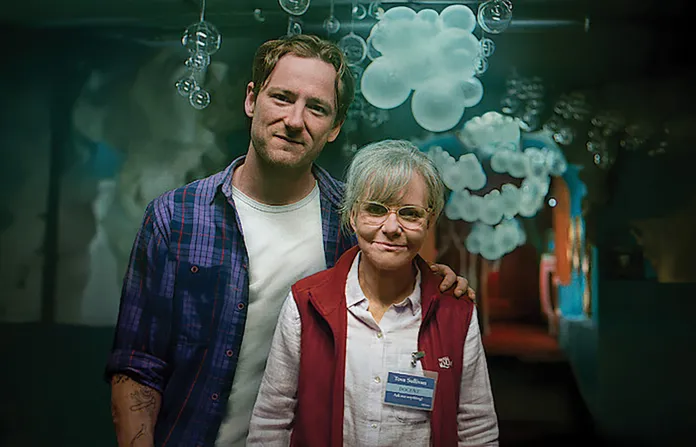
Ironically, this reminiscence preceded my viewing of Remarkably Bright Creatures, the recent Netflix release that seeks to inaugurate a new, regrettable phase in Field’s five-decade-long movie career. Here, in this sickeningly sweet drama set in a Hallmark Channel-style gloss on the Pacific Northwest, Field has entered the phase in which she is compelled to play second banana to an animal — specifically, an aquarium-encased octopus dubbed Marcellus who apparently has made an evolutionary leap in his ability to think in English (his thoughts are enunciated, ploddingly, by Alfred Molina) and possess self-consciousness and, indeed, a healthy ego (he is forever reminding us of his first-rate intelligence and keen psychological acuity). That Field finds herself in this state is a low moment indeed; even the human performers in the sitcom My Mother the Car escaped with more dignity than a two-time Oscar-winning actress spilling her soul to a cephalopod mollusk.
Field plays Tova Sullivan, a widowed, allegedly elderly woman who, because she is inhabited by the still-spunky actress, never quite seems elderly enough. Fortunately, the plot machinations demand that Tova sprain her ankle early in the film, which gives the otherwise ageless Field the excuse to limp or shuffle around in a walking boot. Even so, we simply do not believe that this woman — independent, self-sufficient, in pretty good shape — would even consider signing up for a senior living community, a major subplot in the movie. Field has also been directed to bark her lines, as though impatience was an essential component of old age.
Equally confusing is the exact nature of Tova’s economic condition: Although she works as a glorified janitor at the aquarium that houses Marcellus, she makes her home in a beautifully decorated log cabin-like cottage that suggests she would have little need to subject herself to the indignities of physical labor at this point in her life. Of course, as with so many things in a movie like this, plausibility stands no chance next to narrative expediency, and we quickly catch on that the only reason that Tova is seen scrubbing aquarium glass and extracting flattened gum from floors is so that she can appear in proximity to her costar the octopus, whom she moons over so relentlessly that it may be the best evidence for her senescence.
At one point, Marcellus maneuvers himself out of the aquarium tank and is found slithering around the aquarium offices, and although Tova’s concern to return him to the water is somewhat believable, the intensity of her affection is more befitting a cuter creature — say, a penguin or a panda — rather than the slimy, thoroughly uncompanionable organism here. At least the recent (and distressingly similar) The Sheep Detectives had the good sense to revolve around sheep.
In fact, Field does have a human co-star, and that I have taken so long to make note of him is indicative of his notable lack of charisma. Lewis Pullman is the son of Bill Pullman, and on the basis of this performance, he is indeed the best possible choice to play the son of his dad’s character, Lone Starr, in the upcoming Spaceballs sequel. In the original Spaceballs, Pullman pere was meant to be a one-dimensional mannequin, and Pullman fils has exactly the same quality. But this is not Spaceballs. He plays Cameron Cassmore, a bedraggled itinerant guitarist whose not-fit-for-the-road van ceases operating in Tova’s town — which, incidentally, seems modeled less on any known place in the Pacific Northwest and more on a village on the British Isles like the one in a far (far) greater movie, Bill Forsyth’s classic Local Hero. Perhaps that’s why Irish actor Colm Meaney has been called in to play the proprietor of a convenience store who, in short order, conspires to get Cameron a job alongside Tova, asks Tova out on a date, and is forever giving away coffee and other goods. I guess inflation has not hit this idyllic burg? As for Cameron, his character development is measured by his increasing attentiveness to janitorial duties.
For his part, Molina, as Marcellus, is asked to deliver sub-Shakespearean dialogue, including the line, as the octopus clings to Tova, “My tug was instinctual because I felt the hole in her heart,” or the solemn reflection, “It seems to be a hallmark of the human species: abysmal communication skills.” At least Molina read these lines in the privacy of a recording studio rather than on the set of this stinker.
NETFLIX’S 4-PART ‘LORD OF THE FLIES’ IS A SAVAGE, SURREAL SURVIVAL TALE
What is the point of all this? Astonishingly, Marcellus means to orchestrate gloppy intergenerational bonding between Tova and Cameron, who each have complex emotional backstories — lots of pain, lots of loss, several unresolved familial questions — which are not interesting enough to detail here but with which we are beaten over the head. Even more astonishingly (spoiler alert), Marcellus seems to have, among his other un-octopus-like gifts, powers of precognition since Tova and Cameron turn out to be, uh, kin in a plot turn of soap opera-esque subtlety.
Miss Field, we still like you — so much so, in fact, that it is our fondest wish for you to never again agree to share screen time with any sea creatures.
Peter Tonguette is the Life & Arts editor of the Washington Examiner magazine.


