







Republicans preparing to trade the halls of Congress for the campaign trail ahead of the midterm elections lament they have few achievements to tout as higher gas prices from the Iran war and voters’ affordability concerns drag them down.
The House left town a day early this week and won’t return until after the Nov. 3 elections. The Senate has two more weeks until it departs but is prioritizing a bipartisan college sports bill to create standards on, among other things, how athletes are paid.
On the other side of Pennsylvania Avenue, President Donald Trump has spent energy on inflation-inducing trade wars and Washington-centric legacy projects such as putting his name on the Kennedy Center and building a towering “triumphal” arch while making lofty promises to award voters $5,000 for reelecting GOP majorities, a notion even Republicans have spurned.
“I’ve said since we passed the One Big Beautiful Bill that we ought to be doing something to address the cost of living. We haven’t,” said Sen. John Kennedy (R-LA), referencing the party’s 2025 law that extended Trump’s first-term tax cuts. “All we’ve done since then is stand around sucking on our teeth.”
Kennedy is headed to conservative turf in Kansas, Iowa, and Nebraska this weekend to campaign for Senate candidates who have found themselves in surprisingly competitive races as Democrats look to flip the chamber. In a ding to the college sports bill, Kennedy added: “I’ll bet you making the football coaches happy doesn’t come up.”
“We have seen the prices of fuel and related products … rise as a consequence of what we’re seeing in Iran, and people are feeling it, and they don’t like it,” said centrist Sen. Lisa Murkowski (R-AK), whose home state colleague, Sen. Dan Sullivan (R-AK), faces a competitive reelection. “And what kind of response are we seeing out of the White House? Is there a recognition that there’s a connection here? If there is, I’m not hearing anybody enunciate it.”
The White House sees the college sports proposal, a priority of the president, as a potential win that Republicans could present to voters. They’re also bullish on Senate negotiators brokering a bipartisan deal on a permitting package for new energy projects, something the administration has pursued for months. But any agreement would not pass until after the elections. White House officials also want Senate Republicans to confirm Trump’s labor secretary designate, Keith Sonderling, before the break.
The White House, much like Senate Majority Leader John Thune (R-SD) and House Speaker Mike Johnson (R-LA), views the recess as a balancing act between legislating and giving members more time to make their case to constituents.
“I think you always want to be able to take back some good news to voters, especially in an election year. But I also get that this is the final push and lawmakers need to be home actively campaigning, so it’s kind of a catch-22,” a White House aide told the Washington Examiner. “The bottom line is, when it comes to prices and the economy, Republicans secured the most consequential tax cuts in history, with no help from Democrats, and voters know that.”
A bipartisan bill meant to shield households from rising energy costs caused by data centers passed the House this week overwhelmingly, 417-3. While it was shot down by Senate Democrats when Republicans tried to pass it via unanimous consent, a process any senator can block, it’s the type of pocketbook policy proposal that Republicans wanted more votes on, whether they’re stopped by Democrats. The legislation, the Ratepayer Protection Act, was championed in the Senate by Sen. Jon Husted (R-OH), who’s locked in a toss-up race increasingly defined by data center politics.
“I think we ought to be doing way more votes every day,” Sen. Rick Scott (R-FL) said.
The White House, in a statement to the Washington Examiner, outlined the administration’s accomplishments in Congress, which include “passing the largest working-class tax cuts in history, confirming a record number of the President’s highly qualified nominees, and fully funding President Trump’s border security agenda to Make America Safe Again.”
“President Trump will continue working with Republicans to pass the SAVE America Act, lower costs for working families, and deliver on the commonsense, America First agenda that Republicans were elected with an overwhelming mandate to enact,” White House spokeswoman Olivia Wales said.
</p>
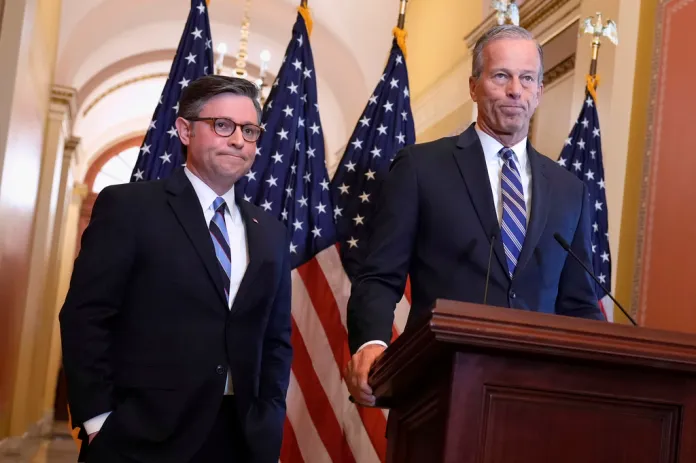
<p> ” data-large-file=”https://conservativemodern.com/wp-content/uploads/2026/09/republicans-fear-they-have-little-to-offer-voters-as-congress-leaves-town.webp” src=”https://conservativemodern.com/wp-content/uploads/2026/09/republicans-fear-they-have-little-to-offer-voters-as-congress-leaves-town.webp” alt=”Johnson and Thune” class=”wp-image-4734339″ srcset=”https://conservativemodern.com/wp-content/uploads/2026/09/republicans-fear-they-have-little-to-offer-voters-as-congress-leaves-town-1.webp 1024w, https://conservativemodern.com/wp-content/uploads/2026/09/republicans-fear-they-have-little-to-offer-voters-as-congress-leaves-town-1.webp?resize=300,200 300w, https://conservativemodern.com/wp-content/uploads/2026/09/republicans-fear-they-have-little-to-offer-voters-as-congress-leaves-town-1.webp?resize=768,512 768w, https://conservativemodern.com/wp-content/uploads/2026/09/republicans-fear-they-have-little-to-offer-voters-as-congress-leaves-town-1.webp?resize=150,100 150w, https://conservativemodern.com/wp-content/uploads/2026/09/republicans-fear-they-have-little-to-offer-voters-as-congress-leaves-town-1.webp?resize=696,464 696w” sizes=”(max-width: 1024px) 100vw, 1024px”><figcaption class=) House Speaker Mike Johnson (R-LA), left, and Senate Majority Leader John Thune (R-SD) speak to reporters at the Capitol on April 10, 2025. (AP Photo/J. Scott Applewhite)
House Speaker Mike Johnson (R-LA), left, and Senate Majority Leader John Thune (R-SD) speak to reporters at the Capitol on April 10, 2025. (AP Photo/J. Scott Applewhite)Sen. Josh Hawley (R-MO) said it would be a mistake to leave Washington without trying to suspend the federal gas tax, an 18.4-cent-per-gallon fee, amid concerns he hears from farmers operating on diesel, which is now above $6 per gallon.
“It is beyond me why we have done nothing,” Hawley said. “For candidates who are going home and campaigning, and voters say, ‘What have you done to bring down energy prices?’ I mean, I don’t know what these people are going to say.”
For his part, it’s possible Thune begins the lengthy procedural process of teeing up a roll call vote for the Ratepayer Protection Act next week, but the Senate’s plans remain unclear.
“I’m talking to [Thune] about it,” Trump said Friday in the Oval Office in response to the Washington Examiner. “We’ll see what happens.”
Thune is under no illusion about the difficult midterm map but has tried to temper expectations about Congress’s ability to significantly impact short-term economic factors such as gas prices, so long as the Iran war continues and the Strait of Hormuz remains shuttered to oil transports.
“I’m not denying the fact. I think there’s some headwinds out there. It’s not a great environment for us,” Thune said. “But we’ve got really quality candidates.”
DEMOCRATS FIND PLENTY OF CAMPAIGN AMMO FROM THE GOP’S MIDTERM CONVENTION
Meanwhile, Democrats are putting money into Trump-dominated territories or states that Democrats haven’t won a Senate seat in for decades, forcing the GOP to spend in conservative areas. They credit Trump and his sagging approval numbers for the opportunities to expand their map.
“It sort of feels like he’s trying to lose as badly as he can,” said Sen. Chris Murphy (D-CT), a member of Senate Democratic leadership and a potential 2028 presidential candidate. “If you sort of put together a plan for what he would say down the closing stretch to guarantee a wave, he’s executing it pretty flawlessly.”
Naomi Lim and Hailey Bullis contributed to this report.


