






Much in American politics has changed over the past 50 years. Perhaps on no topic more than which party is more favorable or hostile to Israel.
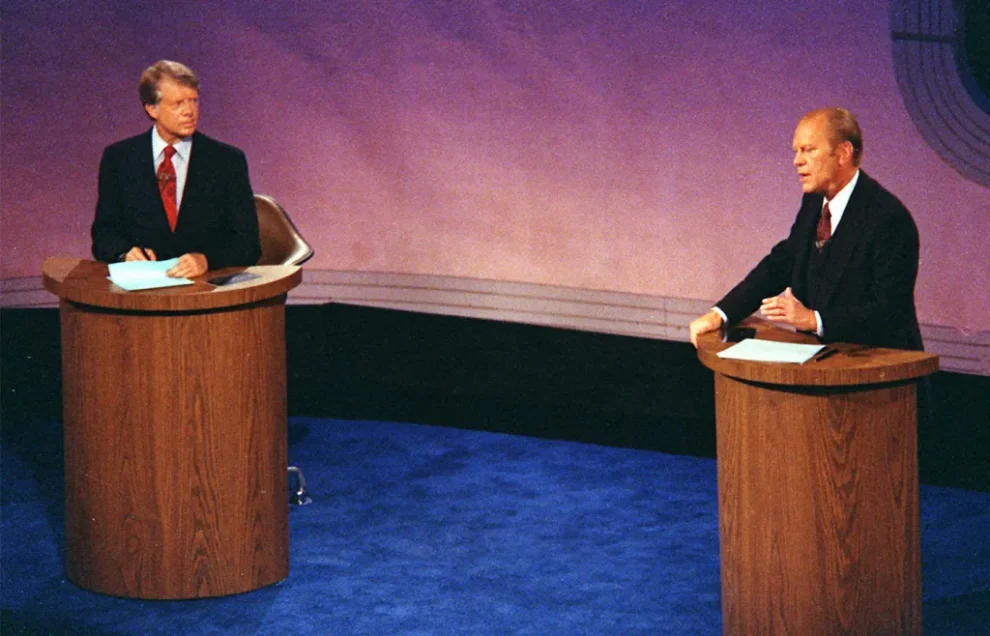
In a move seemingly unrecognizable in today’s political climate, during the 1976 presidential race, Democratic nominee Jimmy Carter ran to the right on Israel against the Republican president he sought to oust from office, Gerald Ford. The issue likely helped Carter win narrowly over the GOP incumbent.
Now, on the Democratic side, debate over U.S. policy toward Israel is increasingly a game of how hostile to be. Or whether to even say the country should exist as a Jewish state. It’s an internecine debate that’s only grown more heated since the Oct. 7, 2023, Hamas attacks killed more than 1,200 people in Israel, with 251 taken hostage. This spurred Israel’s attacks on Gaza, which has led to an estimated 70,000 Palestinians killed.
The anti-Israel cause motivated several Democratic congressional candidates in this year’s Democratic primaries. Among them, notably, were a pair of winning Democratic Socialists of America candidates in New York backed by New York City Mayor Zohran Mamdani: Claire Valdez in the 7th Congressional District, covering northern Brooklyn and western Queens, and Darializa Avila Chevalier in the 13th Congressional District, covering northern Manhattan and western Bronx.
</p>
<p> ” data-large-file=”https://conservativemodern.com/wp-content/uploads/2026/10/the-parties-have-flipped-on-support-for-israel.webp” height=”658″ width=”1024″ src=”https://conservativemodern.com/wp-content/uploads/2026/10/the-parties-have-flipped-on-support-for-israel.webp” alt=”President Gerald Ford speaks as Democratic nominee Jimmy Carter listens during a televised debate in Sept. 23, 1976, held at Philadelphia’s Walnut Street Theater. (AP Photo)” class=”wp-image-4778509″ srcset=”https://conservativemodern.com/wp-content/uploads/2026/10/the-parties-have-flipped-on-support-for-israel-1.webp 1400w, https://conservativemodern.com/wp-content/uploads/2026/10/the-parties-have-flipped-on-support-for-israel-1.webp?resize=300,193 300w, https://conservativemodern.com/wp-content/uploads/2026/10/the-parties-have-flipped-on-support-for-israel-1.webp?resize=768,494 768w, https://conservativemodern.com/wp-content/uploads/2026/10/the-parties-have-flipped-on-support-for-israel-1.webp?resize=1024,658 1024w” sizes=”(max-width: 1024px) 100vw, 1024px”><figcaption class=) President Gerald Ford speaks as Democratic nominee Jimmy Carter listens during a televised debate in Sept. 23, 1976, held at Philadelphia’s Walnut Street Theater. (AP Photo)
Mamdani also backed a one-time mayoral rival, Brad Lander, in the 10th Congressional District, covering Lower Manhattan and northwestern Brooklyn. Lander beat four-year Rep. Dan Goldman (D-NY) in the primary. Lander, Valdez and Chevalier are set to enter Congress in January, as the Nov. 3 midterm general elections are only formalities in their deep-blue districts.
They’ll be joined in the House by a new swath of far-left Democratic primary winners set for November wins in districts overwhelmingly favoring their party: Melat Kiros in Colorado, Adam Hamawy in New Jersey and Chris Rabb in Pennsylvania. These newcomers will be in office during the last two years of President Donald Trump’s second, nonconsecutive term.
Trump has called himself the “best president in the history of Israel.” His supporters cite large-scale joint military strikes against Iran initiated on Feb. 28. And they point to his first White House stint, in 2018, when the Trump administration recognized Jerusalem as Israel’s capital and moved the U.S. Embassy there from Tel Aviv, along with a 2019 presidential proclamation recognizing Israeli sovereignty over the Golan Heights, which Israel captured from Syria in 1967.
Of course, Trump has sometimes clashed with Israeli Prime Minister Benjamin Netanyahu. In June, after an Israeli strike in Beirut threatened a peace deal with Iran, Trump told Axios about the strikes in Lebanon, “Why did Bibi have to do a f***ing attack? I was so pissed off. I let him know. He has no f***ing judgment. I let him know that.”
Still, on Oct. 18, Trump endorsed Netanyahu, just nine days before Israel’s Oct. 27 elections.
Carter capitalized on strong bipartisan support for Israel
Today, opposition to Israel has emerged as a litmus test for some Democrats. But 50 years ago, the Democratic presidential nominee saw political opportunity in taking the opposite tack. Carter, who had been Georgia governor from 1971-75, called himself a far better friend of Israel than his Republican opponent, Ford.
Carter would eventually become a sharp critic of Israel, especially after leaving the White House. During a record nearly 45-year ex-presidency until his Dec. 29, 2024 death, Carter increasingly lashed out at the Jewish State, including the 1985 book The Blood of Abraham. Nearly 22 years later, he came out with another provocatively titled (to Israel supporters) successor book, Palestine: Peace Not Apartheid.
But back in 1976, Israel still enjoyed strong bipartisan support, and Carter was eager to win Jewish votes in key swing states like Florida and New York (yes, both were battleground states at the time). Amid protracted negotiations between Israel and Egypt over military disengagement in the Sinai Peninsula following the 1973 Yom Kippur War, a frustrated Ford warned Israeli Prime Minister Yitzhak Rabin in 1975 that he was directing an immediate reassessment of U.S. policy in the Middle East, “including our relations with Israel.” Seventy-five senators pushed back on him.
In a May 1975 letter to Ford, the senators – including 50 Democrats – wrote that they expected the administration’s foreign aid request “will be responsive to Israel’s urgent military and economic needs.” They added that the history of the Arab-Israeli conflict “demonstrates that any Israeli withdrawal (from captured territories) must be accompanied by meaningful steps toward peace by its Arab neighbors.”
The following year, Carter went on a strikingly personal attack on Ford at their Oct. 6 debate, accusing him of showing “a weakness in yielding to pressure” from Arab countries. At the time, Israel didn’t have diplomatic relations with any of its Arab neighbors.
“The Arabs have put pressure on Mr. Ford, and he’s yielded, and has permitted a boycott by the Arab countries of American businesses who trade with Israel, or who have American Jews owning or taking part in the management of American companies,” Carter said.
Today, that debate is mostly remembered for Ford’s gaffe that there was “no Soviet domination of Eastern Europe.” But Carter also tried to capitalize on what he considered another foreign policy liability and claimed that military support for Israel had eroded under Ford.
“This is a deviation from idealism,” Carter said. “It’s a deviation from a commitment to our major ally in the Middle East, which is Israel. It’s a yielding to economic pressure on the part of the Arabs on the oil issue. And it’s also a tremendous indication that under the Ford administration we have not addressed the energy policy adequately.”
Two weeks later, at an event in Miami Beach, Carter vowed to end the Arab boycott.
“For the first time in the history of our nation, we have a president and an administration who are circumventing the Bill of Rights,” he shouted to an enthusiastic and predominantly Jewish audience, as the New York Times described it.
“It doesn’t matter in principle whether it’s Jews or Catholics or Baptists,” Carter said. “It’s a matter of morality. It’s got to be changed, and you have my word that it will be. We’ll get rid of the Arab boycott,” which he called “an insult and a disgrace.”
After Carter’s remarks, he made his way through hundreds of “nearly delirious” supporters, the Times reported, “shaking hands, groping through the screen of security agents around him, munching a chocolate pastry at a kosher bakery, chatting amiably with little old ladies and sampling the grapes at a produce market. South Miami Beach, a retirement haven for elderly Jews from all parts of the country, embraced Mr. Carter as though he were a member of the Knesset.”
After Carter beat Ford in a close election – carrying both New York and Florida – the new president signed an amendment to the Export Administration Act in 1977 which banned American companies from complying with some foreign boycott practices, such as secondary and tertiary boycotts targeting Israel. More significantly, he presided over the 1978 Camp David Accords, which led to a March 26, 1979 peace treaty between Israel and Egypt.
But his post-presidency was often marked by sharp criticism of Israeli policy. In his book, Palestine: Peace Not Apartheid, Carter included an incendiary line that Arabs and Palestinians should “make it clear that they will end the suicide bombings and other acts of terrorism when international laws and the ultimate goals” of a proposed peace accord “are accepted by Israel.”
At an appearance at Brandeis University in 2007, Carter admitted that the sentence “was worded in a completely improper and stupid way,” and that he had asked the publisher to remove it. “I apologize to you personally, to everyone here,” he said.
That same year, 14 Jewish members of the Carter Center’s board of councilors resigned in protest over the book for blaming Israel for the lack of progress on a peace deal.
“We can no longer support your strident and uncompromising position,” they wrote in a letter to Carter. “This is not the Carter Center or the Jimmy Carter we came to respect and support.”
TRUMP BACKS NETANYAHU FOR REELECTION, SAYS ISRAELI PM CRITICAL ALLY AGAINST IRAN
Abe Foxman, the late director of the Anti-Defamation League, responded to the book by calling Carter a “bigot.” Deborah Lipstadt, who went on to become special envoy against antisemitism under President Joe Biden, wrote in a Washington Post opinion piece at the time that the book, “while exceptionally sensitive to Palestinian suffering, ignores a legacy of mistreatment, expulsion and murder committed against Jews. It trivializes the murder of Israelis.”
It’s a safe bet that in 2028, the Democratic candidate will not be eager to outflank the Trump administration when it comes to supporting Israel.
Frederic J. Frommer (@ffrommer) is a sports and politics historian who has written for the Washington Post, the New York Times, the Atlantic, and other national publications, and is working on a book on ’70s baseball.


