







Public approval of the Supreme Court has fallen to a record low, according to a new Gallup poll released Tuesday.
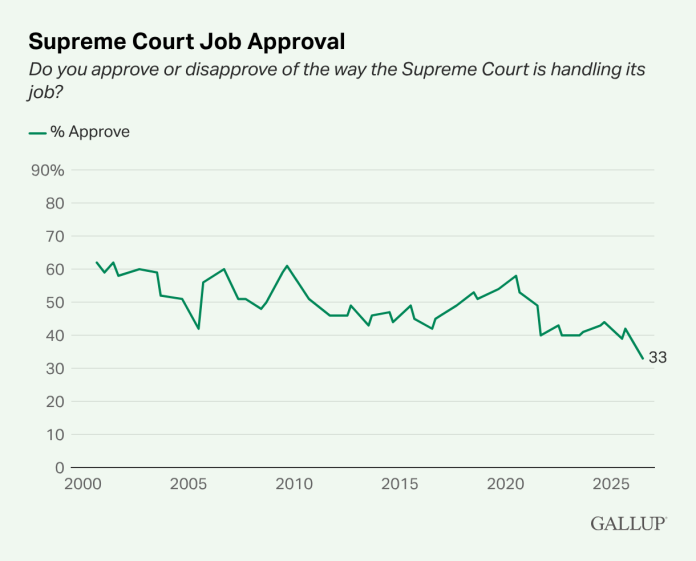
The survey found that just 33% of U.S. adults approve of the way the Supreme Court is handling its job, down from the previous record low of 39% measured a year ago. Meanwhile, disapproval reached a record high of 61% in Gallup’s July 1-19 survey, conducted shortly after the conclusion of the court’s 2025-26 term.
The term included several major rulings, both favorable and unfavorable to President Donald Trump’s administration. The court expanded the president’s authority to remove members of independent federal agencies and upheld state laws restricting transgender athletes from competing in women’s sports. But it also struck down Trump’s executive order limiting birthright citizenship, rejected his legal justification for imposing tariffs without congressional approval, blocked his attempt to remove Federal Reserve Board governor Lisa Cook on due process grounds, and allowed states to continue counting mail-in ballots received after Election Day.
Gallup found that the court’s public standing has steadily eroded over the past two decades. In 2000, 62% of Americans approved of the Supreme Court’s performance, and approval remained above 50% for most of the following decade. Since 2010, however, approval has largely hovered in the 40% range as partisan divisions over the court have deepened.
Republicans’ approval of the court dropped to 58%, down from a near-record 79% in September 2025. Gallup suggested the decline may reflect dissatisfaction with several rulings that went against the Trump administration. Even so, Republican approval remains close to the party’s long-term average of 56%.
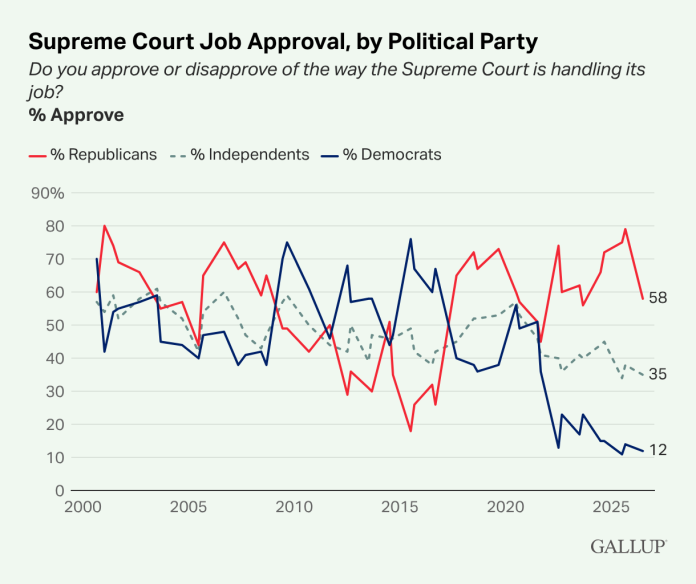
Democrats’ approval remained at 12%, while independents’ stood at 35%, both largely unchanged from September 2025 and near historic lows. Gallup noted that Democratic approval has remained especially low throughout the court’s current 6-3 conservative majority.
The poll surveyed 1,200 adults nationwide by telephone from July 1-19 and has a margin of error of plus or minus 4 percentage points.
The findings come days after Justice Elena Kagan rejected claims that the high court has acted as a “puppet” of the Trump administration. Speaking at the 9th Circuit Judicial Conference, Kagan acknowledged the court’s conservative majority but pointed to several high-profile decisions against Trump this term as evidence of its independence.
FIVE TAKEAWAYS FROM THE SUPREME COURT’S BIG DAY ON CAPITOL HILL
“Is this court very conservative?… Yes,” Kagan said. “But is this court the kind of puppet for the current administration? I think definitely not.”
Kagan also described Trump’s attendance at April oral arguments in the birthright citizenship case, which was the first by a sitting president, as a “non-event,” saying it had no effect on the justices’ handling of the case.


