






North Korea quietly dropped its longtime goal of Korean reunification from its constitution for the first time after 70 years, signaling a major change in its self-conception.
An academic revealed at a press conference hosted by the South Korean Ministry of Unification that North Korea changed its constitution to drop its commitment to reunification, the Financial Times reported. Pyongyang had long defined itself within a larger revolutionary struggle to unite the Korean peninsula under the banner of Juche, a branch of communism stressing economic self-sufficiency and nationalism, which it claims has only been thwarted by the intervention of imperialist U.S. forces.
The new constitution explicitly acknowledges the existence of the state of South Korea, breaking from its past characterizations of its southern neighbor as an illegitimate puppet state. The new constitution reads, “the territory of the Democratic People’s Republic of Korea includes the territory bordering the People’s Republic of China and the Russian Federation to the north and the Republic of Korea to the south, and the territorial sea and airspace established on it.”
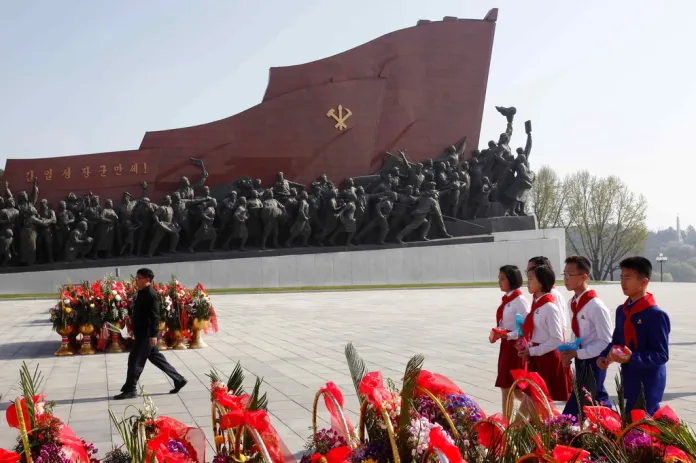
Previously, the constitution vowed that North Korea would “strive to reunify the country on the principles of independence, peaceful unification, and great national unity.”
The new constitution also removed language saying it “inherited the glorious revolutionary struggle achieved in the liberation of the country and the freedom and happiness of the people against imperialist invaders.”
Despite the hermit kingdom’s acknowledgment of the South Korean state, the constitution also designates it as a “hostile state.”
Analysts were split on the meaning of the revisions. Christopher Green, a senior consultant at the International Crisis Group, told the Financial Times that the revision was meant to “reinforce a difference of opinion and set up the conditions for potential future clashes.”
“This fits in the context of a prolonged effort to redefine North Korea as a ‘normal state’ just like any other,” he said. “Normal states define their adversaries in defence white papers and defence reviews and the like; they do not define their adversaries in the constitution.”
North Korea has garnered key international legitimacy through its new alliance with Russia, receiving much-needed aid and recognition. Its acknowledgment of South Korea and backtracking on irredentist territorial aims could be a further bid to boost its international legitimacy.


