





Maryland Gov. Wes Moore could finally get the mid-decade redistricting he’s long championed to counter similar efforts by GOP-led states, but it won’t be in the fashion or timeline he envisioned.
In an about-face and in the aftermath of a grueling primary, Maryland Senate President Bill Ferguson, a Democrat, will support a special legislative session in August to consider a constitutional amendment for mid-decade redistricting. Initial opponents like himself say the move would bolster a new congressional map against legal scrutiny, but it comes with caveats.
Voters would still need to approve such an amendment in the November elections, and a new map would not be implemented until the 2028 cycle. Moore, himself up for reelection this year, has made mid-decade redistricting a campaign rallying cry that echoes other Democratic governors with potential White House ambitions. He described the move as better late than never.
“For months, I have said that inaction is not an option and we cannot sit on the sidelines while voting rights, fair representation, and the foundations of our democracy come under attack across the country,” Moore said, referencing a rollback of the Voting Rights Act earlier this year by the Supreme Court. “Until we have national redistricting reform, Maryland will not be caught flat-footed.”
In a state former Vice President Kamala Harris won by nearly 30 points, Moore is all but certain to win this fall against Republican nominee Dan Cox. But with heavy speculation of aspirations for a presidential run in 2028 — Moore insists he’s not interested — the timing for the governor could ultimately mean he scores a bigger political boost among national Democrats.
Maryland Democrats, who have supermajorities in both chambers, want to eliminate the lone Republican in the state and create a map that favors Democrats in all eight seats. That would mean gerrymandering the map against Rep. Andy Harris (R-MD), who chairs the conservative House Freedom Caucus.
“This has nothing to do with Maryland’s future and everything to do with his own,” Maryland Senate Minority Leader Steve Hershey, a Republican, said of Moore.
Ferguson, who previously rebuffed redistricting efforts by state and national Democrats, including Moore and House Minority Leader Hakeem Jeffries (D-NY), said the Supreme Court’s voting rights ruling prompted his shift. Others see it as a capitulation after being snubbed an endorsement from Moore and facing his first primary challenger in more than a decade.
 Convention in New York, April 9, 2026. (AP Photo/Angelina Katsanis, File)</p>
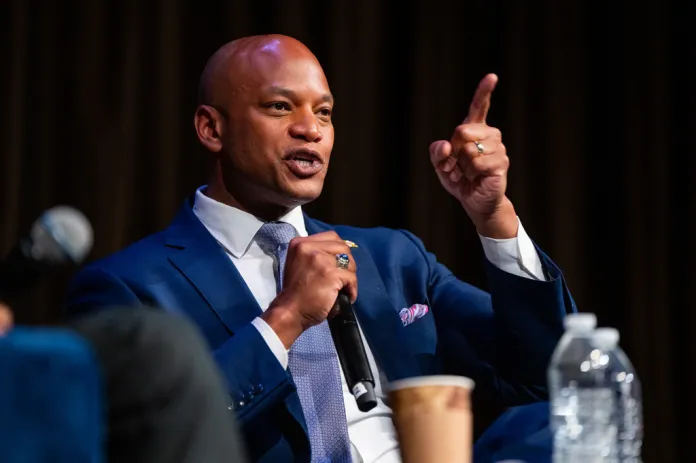
<p> ” data-large-file=”https://conservativemodern.com/wp-content/uploads/2026/07/maryland-may-finally-see-redistricting-action-just-not-the-way-wes-moore-wanted.webp” src=”https://conservativemodern.com/wp-content/uploads/2026/07/maryland-may-finally-see-redistricting-action-just-not-the-way-wes-moore-wanted.webp” alt=”FILE – Wes Moore, Governor of Maryland, speaks during the National Action Network (NAN) Convention in New York, April 9, 2026″ class=”wp-image-4641426″ srcset=”https://conservativemodern.com/wp-content/uploads/2026/07/maryland-may-finally-see-redistricting-action-just-not-the-way-wes-moore-wanted-1.webp 1024w, https://conservativemodern.com/wp-content/uploads/2026/07/maryland-may-finally-see-redistricting-action-just-not-the-way-wes-moore-wanted-1.webp?resize=300,200 300w, https://conservativemodern.com/wp-content/uploads/2026/07/maryland-may-finally-see-redistricting-action-just-not-the-way-wes-moore-wanted-1.webp?resize=768,512 768w, https://conservativemodern.com/wp-content/uploads/2026/07/maryland-may-finally-see-redistricting-action-just-not-the-way-wes-moore-wanted-1.webp?resize=150,100 150w, https://conservativemodern.com/wp-content/uploads/2026/07/maryland-may-finally-see-redistricting-action-just-not-the-way-wes-moore-wanted-1.webp?resize=696,464 696w” sizes=”(max-width: 1024px) 100vw, 1024px”><figcaption class=) Wes Moore, governor of Maryland, speaks during the National Action Network convention in New York, April 9, 2026. (AP Photo/Angelina Katsanis, File)
Wes Moore, governor of Maryland, speaks during the National Action Network convention in New York, April 9, 2026. (AP Photo/Angelina Katsanis, File)“After recent court decisions weakened the federal Voting Rights Act and created new uncertainty around congressional redistricting, Maryland needs a clear legal path forward,” Ferguson said. “This special session will allow the General Assembly to do its part while ensuring that Maryland voters make the final decision.”
A state Democratic operative, granted anonymity to discuss behind-the-scenes matters, saw Ferguson’s shift on redistricting as part of a pattern over the past year of moving to the left on policies that also involved state cooperation with federal immigration enforcement and youth sentencing.
MARYLAND TO LAY GROUNDWORK FOR 2028 REDISTRICTING IN AUGUST SPECIAL SESSION
“We always knew the Voting Rights Act was going to fall,” they said. “The governor was sounding the alarm nearly a year ago, and yet Ferguson ignored it.”
House Speaker Joseline Pena-Melnyk, also a Democrat, said the “consensus on this issue has been clear in the House,” which has been largely united around the effort.


