Judge questions whether Hegseth’s testosterone plan undermines transgender troops ban
A federal judge is questioning whether the Pentagon’s new testosterone initiative undermines its legal defense of restrictions on transgender troops, ordering the government to explain why hormone treatment is acceptable for some service members yet disqualifying when provided for gender dysphoria. U.S. District Judge Ana C. Reyes took notice Wednesday of War Secretary Pete Hegseth’s […]
A federal judge is questioning whether the Pentagon’s new testosterone initiative undermines its legal defense of restrictions on transgender troops, ordering the government to explain why hormone treatment is acceptable for some service members yet disqualifying when provided for gender dysphoria.
U.S. District Judge Ana C. Reyes took notice Wednesday of War Secretary Pete Hegseth’s recent announcement that troops 30 and older would be screened annually for testosterone deficiency and could voluntarily receive testosterone replacement therapy. Reyes, who is overseeing a challenge to the transgender military executive order in Talbott v. Trump, said the department’s new “High-T” plan could affect the government’s justification for the restrictions.
” data-image-caption=”
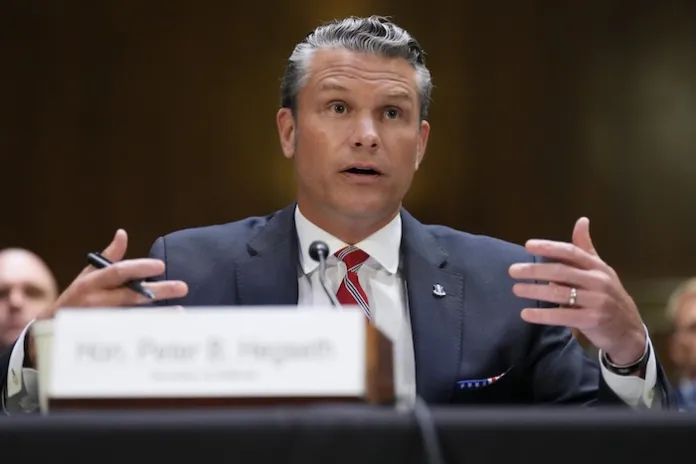
War Secretary Pete Hegseth testifies at a Senate Appropriations Committee hearing, Tuesday, July 21, 2026, on Capitol Hill in Washington. (AP Photo/Jacquelyn Martin)
” data-large-file=”https://conservativemodern.com/wp-content/uploads/2026/07/judge-questions-whether-hegseths-testosterone-plan-undermines-transgender-troops-ban.webp” src=”https://conservativemodern.com/wp-content/uploads/2026/07/judge-questions-whether-hegseths-testosterone-plan-undermines-transgender-troops-ban.webp” alt=”War Secretary Pete Hegseth.” class=”wp-image-4657885″ srcset=”https://conservativemodern.com/wp-content/uploads/2026/07/judge-questions-whether-hegseths-testosterone-plan-undermines-transgender-troops-ban-1.webp 700w, https://conservativemodern.com/wp-content/uploads/2026/07/judge-questions-whether-hegseths-testosterone-plan-undermines-transgender-troops-ban-1.webp?resize=300,200 300w, https://conservativemodern.com/wp-content/uploads/2026/07/judge-questions-whether-hegseths-testosterone-plan-undermines-transgender-troops-ban-1.webp?resize=150,100 150w, https://conservativemodern.com/wp-content/uploads/2026/07/judge-questions-whether-hegseths-testosterone-plan-undermines-transgender-troops-ban-1.webp?resize=696,464 696w” sizes=”(max-width: 700px) 100vw, 700px”>War Secretary Pete Hegseth testifies at a Senate Appropriations Committee hearing, Tuesday, July 21, 2026, on Capitol Hill in Washington. (Jacquelyn Martin/AP Photo)
“The Military Ban states that ‘the Armed Forces must adhere to high mental and physical health standards … without the benefit of routine medical treatment or special provisions,’” said Reyes, an appointee of former President Joe Biden. “The court must assess the impact of this newly announced policy on the parties’ positions.”
Reyes ordered both sides in Talbott v. Trump to address the screening, monitoring, cost, and administration of TRT. She also directed the government to explain “the Department’s basis for treating trans men and other service members differently” under the two policies.
The orders create a new predicament for the government, which has argued since the inception of the second Trump administration against providing hormone-related treatments for military members, while now simultaneously encouraging similar treatments for other individuals not diagnosed with gender dysphoria.
In a 52-page filing opposing a preliminary injunction submitted by the Justice Department in February 2025, the Trump administration invoked the military’s need for troops who can deploy without requiring “routine medical treatment or special provisions.” It also cited the cost, monitoring requirements, and potential “non-deployability” associated with gender transitions.
Hegseth’s initiative could weaken those arguments, though it is far from a forfeiture of the administration’s legal battle.
TRT for testosterone deficiency and testosterone therapy for biological women who identify as men can both require continuing prescriptions, laboratory testing, and medical supervision. Some critics have argued Hegseth’s TRT initiative may function as a tacit admission that hormone treatment alone is not necessarily incompatible with military readiness.
However, the government’s arguments in the case have drawn on several different reasons for banning transgender troops. For example, the Trump administration characterized gender dysphoria in court filings as a condition involving “clinically significant distress or impairment” and argued that transition-related procedures can make troops nondeployable for significant periods.
The government has also cited concerns beyond military readiness, including complications that come from allowing transgender-identifying members in the military, such as problems with privacy, sleeping and bathing facilities, physical-fitness standards, and unit cohesion.
Therefore, the government may yet still have ample room to argue that those considerations are large enough to distinguish transgender hormone drugs from TRT provided for testosterone deficiency.
The government may also contend that the two groups are not similarly situated. The February filing expressly argued that men and biological women who identify as men can be treated differently under equal-protection principles and emphasized the large degree of deference courts traditionally give military judgments.
Still, Reyes’s order puts pressure on the medical portion of the administration’s defense, and the Pentagon may have difficulty relying on those same arguments to justify offering hormone treatments in some cases but not in others.
Beyond Reyes’s Wednesday order, both sides were told to have their briefs prepared by Aug. 7 to address how the Supreme Court’s ruling in B.P.J. v. West Virginia, the landmark case allowing states to bar men from competing in women’s sports, implicates the dispute over the transgender troops executive order. Parties were also told to make their service discovery requests ready before Aug. 14.
The ban on transgender troops in the armed forces remains in effect for transgender-identifying people not already in the military who are seeking to join, despite Reyes and an appeals court finding that the Pentagon policy is likely illegal.
In June, a 2-1 decision by a three-judge panel of the U.S. Court of Appeals for the D.C. Circuit backed Reyes’s prior decision against the administration, but the Supreme Court stepped in last year to allow the Pentagon to enforce the rule while litigation continues.