






Israel launched its first armored incursion into Hamas territory in Gaza beyond the “Yellow Line” dictated in the October 2025 ceasefire agreement, aimed at destroying a tunnel network.
The October 2025 ceasefire has always been fragile, and Israel has moved the Yellow Line to increasingly squeeze Hamas-held territory in Gaza. Israel Defense Forces troops and Hamas gunmen have repeatedly exchanged fire, and Israeli air and drone strikes have become commonplace.
On Wednesday, however, Israel took a step up from previous skirmishes, launching an armored raid with tanks and armored fighting vehicles to dismantle a tunnel system the IDF claimed “posed an immediate and direct threat to IDF troops.” The raid was backed by drone strikes and heavy gunfire.
</p>
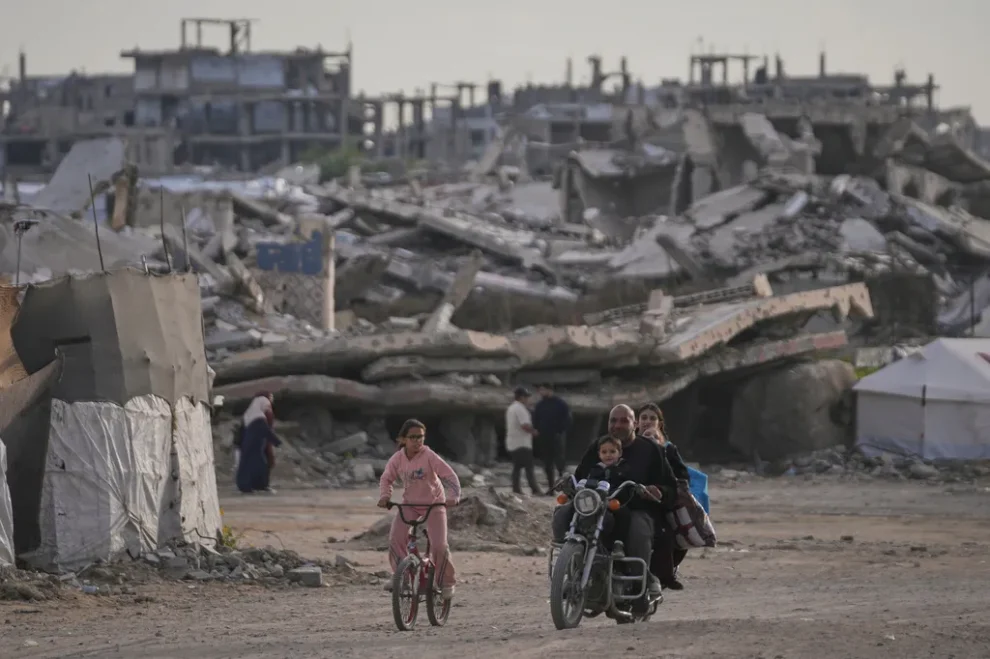
<p> ” data-large-file=”https://conservativemodern.com/wp-content/uploads/2026/11/israel-launches-first-armored-incursion-into-hamas-territory-since-ceasefire.webp” src=”https://conservativemodern.com/wp-content/uploads/2026/11/israel-launches-first-armored-incursion-into-hamas-territory-since-ceasefire.webp” alt=”Gaza” class=”wp-image-4808633″ srcset=”https://conservativemodern.com/wp-content/uploads/2026/11/israel-launches-first-armored-incursion-into-hamas-territory-since-ceasefire.jpg 1024w, https://conservativemodern.com/wp-content/uploads/2026/11/israel-launches-first-armored-incursion-into-hamas-territory-since-ceasefire.jpg?resize=300,200 300w, https://conservativemodern.com/wp-content/uploads/2026/11/israel-launches-first-armored-incursion-into-hamas-territory-since-ceasefire.jpg?resize=768,512 768w” sizes=”(max-width: 1024px) 100vw, 1024px”><figcaption class=) Palestinians ride past the rubble of buildings destroyed during the Israel-Hamas war in Gaza City, Tuesday, Nov. 17, 2026. (AP Photo/Jehad Alshrafi)
Local Palestinians were warned of the raid beforehand, and an evacuation order was issued. Large numbers of Palestinians were filmed leaving the area, some with luggage but others not having time to grab any belongings. The Hamas-run Gaza government media office said 6,000 Palestinians were displaced by the raid.
Hamas and its allies condemned the raid as a major ceasefire violation, but put up little to no resistance. It said the Board of Peace, which is overseeing the implementation of the Gaza peace deal, bore “full responsibility” for Israel’s violations of the agreement.
The IDF announced that the operation concluded on Thursday and that its forces withdrew.
IDF sources told the Jerusalem Post that the raid may have been a way to exert more pressure on Hamas to disarm — the refusal of which has stalled any further breakthrough in the peace plan. However, they also said there are no plans for a wider invasion in the foreseeable future.
Just one day before the IDF launched its incursion, the Board of Peace, which is overseeing the Gaza peace deal, issued a pessimistic report to the United Nations Security Council, bashing Hamas and Israel for failing to uphold their commitments as part of the deal. It warned that the deal was at risk of collapsing if the situation continued as is.
US STRIKES REVOLUTIONARY GUARD MISSILE LAUNCH SITE ON QESHM ISLAND IN RETALIATORY ATTACK
“The distance between what has been agreed and what is happening on the ground nonetheless remains the principal risk to the process,” the report read, according to the Associated Press.
“A ceasefire that delivers nothing visible cannot be sustained indefinitely,” it added. “Should it collapse, there would be no road map to return to, no administration to deploy and no enabling environment to rebuild.”


