





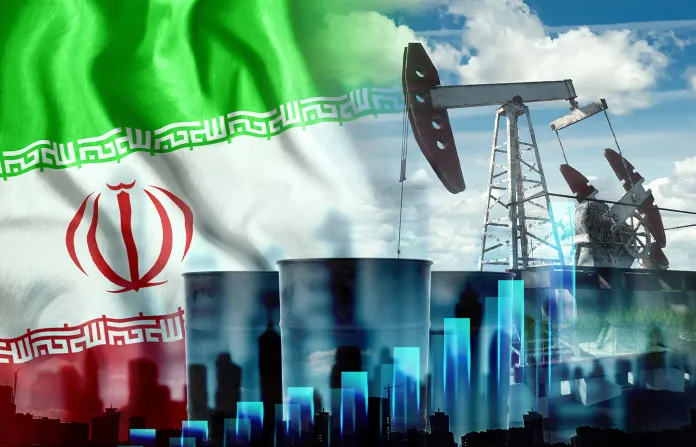
The announcement of an end-of-hostility deal between the United States and Iran has done little to shift investor expectations that the Federal Reserve will hold or even raise interest rates this year, even as oil prices fall in response to the apparent diplomatic breakthrough.
President Donald Trump recently announced the planned signing of the ceasefire deal between the U.S. and Iran. Just days after the announcement, crude prices dropped below $80 per gallon for the first time since March. The agreement would mean a key release valve on energy prices, the biggest driver of the latest wave of inflation in recent months.
DEAL REACHED TO PASS MAJOR BILL MEANT TO ADDRESS HOUSING AFFORDABILITY CRISIS
But investors still don’t think that an end to the war, and presumably a more stable Strait of Hormuz, will be enough to cause inflation to fall to a level this year where the Fed will feel comfortable cutting interest rates — something that has long been the biggest goal for Trump on the monetary policy front.
“One thing would be that there’s uncertainty as to whether this deal is going to stick or whether oil prices might go back up,” Desmond Lachman, a senior fellow at the American Enterprise Institute, told the Washington Examiner.
Inflation has mounted quickly since the start of hostilities in the Middle East.
</p>
<p> ” data-large-file=”https://conservativemodern.com/wp-content/uploads/2026/06/interest-rate-cut-not-likely-on-the-table-even-after-iran-deal-and-somewhat-falling-oil-prices.webp” height=”658″ width=”1024″ src=”https://conservativemodern.com/wp-content/uploads/2026/06/interest-rate-cut-not-likely-on-the-table-even-after-iran-deal-and-somewhat-falling-oil-prices.webp” alt=”Interest rates oil prices middle east Iran” class=”wp-image-4615869″ style=”width:791px;height:auto” srcset=”https://conservativemodern.com/wp-content/uploads/2026/06/interest-rate-cut-not-likely-on-the-table-even-after-iran-deal-and-somewhat-falling-oil-prices-1.webp 1400w, https://conservativemodern.com/wp-content/uploads/2026/06/interest-rate-cut-not-likely-on-the-table-even-after-iran-deal-and-somewhat-falling-oil-prices-1.webp?resize=300,193 300w, https://conservativemodern.com/wp-content/uploads/2026/06/interest-rate-cut-not-likely-on-the-table-even-after-iran-deal-and-somewhat-falling-oil-prices-1.webp?resize=768,494 768w, https://conservativemodern.com/wp-content/uploads/2026/06/interest-rate-cut-not-likely-on-the-table-even-after-iran-deal-and-somewhat-falling-oil-prices-1.webp?resize=1024,658 1024w, https://conservativemodern.com/wp-content/uploads/2026/06/interest-rate-cut-not-likely-on-the-table-even-after-iran-deal-and-somewhat-falling-oil-prices-1.webp?resize=150,96 150w, https://conservativemodern.com/wp-content/uploads/2026/06/interest-rate-cut-not-likely-on-the-table-even-after-iran-deal-and-somewhat-falling-oil-prices-1.webp?resize=696,447 696w, https://conservativemodern.com/wp-content/uploads/2026/06/interest-rate-cut-not-likely-on-the-table-even-after-iran-deal-and-somewhat-falling-oil-prices-1.webp?resize=1068,687 1068w” sizes=”auto, (max-width: 1024px) 100vw, 1024px”><figcaption class=) (Getty Images)
(Getty Images)Consumer price index inflation rose four-tenths of a percentage point to 4.2% for the year ending in May — that marks the highest rate of annual inflation since April 2023. In just the month of May, prices rose 0.5%.
That was all buttressed by an even more concerning inflation report from the Producer Price Index. In that gauge, inflation lurched eight-tenths of a percentage point to 6.5% for the year ending in May, the Bureau of Labor Statistics reported.
Much of the most recent inflation in the CPI has been driven by gasoline prices, but Lachman pointed out that core inflation, a measure that strips out volatile food and energy prices, rose one-tenth of a percentage point to 2.9% for the year ending in May. That is nearly a full percentage point above the Fed’s 2% level.
And Dennis Lockhart, former president of the Federal Reserve Bank of Atlanta, noted that “the Fed had an inflation problem before the Iran war, and the economic circumstances still suggest prioritizing inflation.”
“Which certainly will be affected by oil prices, but may take longer than simply the time it takes for the spot oil price to drop,” Lockhart told the Washington Examiner.
And inflation was too high even before the Iran war, with policymakers at the Fed declining to lower interest rates at the start of the year, even before energy prices shot up.
The Fed’s inflation target — the level of annual inflation that it considers to be healthy in a well-functioning economy — is 2%. The last time inflation was running at or below 2% was in February 2021, as the economy was still emerging from the COVID-19 pandemic.
Just this past December, it was running at 2.7%, and in January and February, it was running at 2.4%.
Lachman also pointed out that, absent Iran, many economists believe that the Trump administration’s aggressive tariff policies are also not helping the inflationary landscape. He predicted that it would be some time before inflation fell back to the 2% goal.
“I think it’s going to take a long while, because you know … they’ve been pushing up the prices with the tariffs; there are a whole bunch of things going on,” Lachman said.
And even though oil prices have dropped in response to the peace agreement announcement, some believe that oil and energy prices will remain elevated for longer — essentially, that they will not simply tumble to pre-war levels and quickly drive down headline inflation.
Ryan Young, senior economist at the Competitive Enterprise Institute, told the Washington Examiner that he thinks oil prices will remain high at least into 2027. He said that a big part of that is that oil and energy infrastructure was destroyed during the war and will take time to build, which will affect the oil supply coming from the region.
“And then, at least at this point, we still don’t know if Iran’s going to do tolls or fees for services rendered, or however they were putting it, so that’s going to keep oil prices high,” Young said.
Jamie Cox, managing partner for Harris Financial Group, also said he doesn’t think that the oil price woes are over yet. He highlighted the Strategic Petroleum Reserve and other uncertainties.
“In addition, just because the war is over does not mean that the negative oil supply effects are — since there is a lag in how oil flows, prices will remain higher until supplies on things like the refill of the SPR are complete,” Cox told the Washington Examiner.
There could also be concerns from investors that the latest ceasefire deal doesn’t hold or is violated, and things just go back to how they were.
“There’s much yet to happen in the agreement with Iran that could derail it, so you may see the markets being somewhat cautious about just jumping to a conclusion that this necessarily spells lower inflation, lower pressure on the Fed, and so forth,” said Lockhart, who worked with new Fed Chairman Kevin Warsh for several years at the Fed.
The labor market has also been stronger than expected, meaning that the Fed has more leeway to focus on the inflation side of its dual mandate.
The economy once again beat expectations and added 172,000 new payroll jobs in May, the Bureau of Labor Statistics reported. The unemployment rate remained at a relatively low 4.3%.
FED AND WARSH UNDER INCREASING PRESSURE TO KEEP RATES HIGHER THANKS TO LABOR MARKET STRENGTH
Also, the April Job Openings and Labor Turnover Survey report showed that job openings increased from 6.9 million in March to 7.6 million in April, the highest level since May 2024. The reading was much higher than anticipated. Most economists were expecting job openings to remain static, not rise by 731,000.
“The economy is hot, the financial markets are booming, there’s a lot of support to the economy, so you know that doesn’t surprise me that they’re still thinking that maybe a rate hike is needed,” Lachman said.
Zach Halaschak (@zhalaschak) is the economics reporter for the Washington Examiner, based in Washington, D.C.


