How Russia turned the tide of the summer air war in Ukraine
The narrative surrounding the Russia-Ukraine war shifted dramatically from the start of the summer to the end. In early summer, for the first time since Ukraine’s ill-fated invasion of Russia’s Kursk province in 2024, Western capitals and media claimed that Ukraine was winning, with the boldest predicting outright victory. Lines at Russian gas stations, crippled […]
The narrative surrounding the Russia-Ukraine war shifted dramatically from the start of the summer to the end.
In early summer, for the first time since Ukraine’s ill-fated invasion of Russia’s Kursk province in 2024, Western capitals and media claimed that Ukraine was winning, with the boldest predicting outright victory. Lines at Russian gas stations, crippled refineries, and images of burning oil depots blackening the sky lent credence to the narrative, as did blackouts and fuel shortages in Crimea.
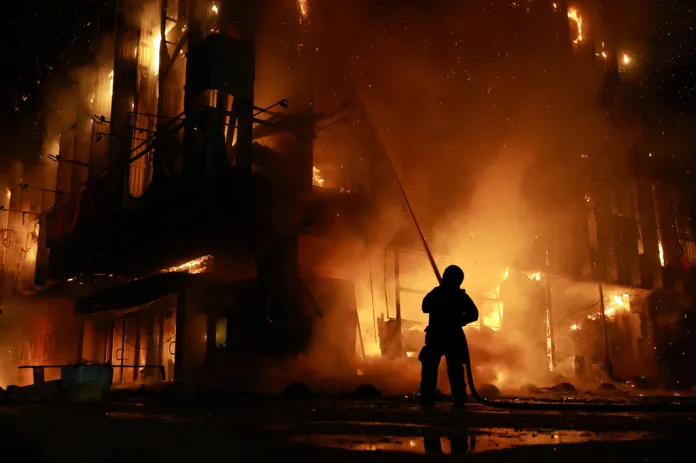
” data-large-file=”https://conservativemodern.com/wp-content/uploads/2026/09/how-russia-turned-the-tide-of-the-summer-air-war-in-ukraine.webp” src=”https://conservativemodern.com/wp-content/uploads/2026/09/how-russia-turned-the-tide-of-the-summer-air-war-in-ukraine.webp” alt=”Ukraine” class=”wp-image-4743859″ srcset=”https://conservativemodern.com/wp-content/uploads/2026/09/how-russia-turned-the-tide-of-the-summer-air-war-in-ukraine-3.webp 1024w, https://conservativemodern.com/wp-content/uploads/2026/09/how-russia-turned-the-tide-of-the-summer-air-war-in-ukraine-3.webp?resize=300,200 300w, https://conservativemodern.com/wp-content/uploads/2026/09/how-russia-turned-the-tide-of-the-summer-air-war-in-ukraine-3.webp?resize=768,512 768w, https://conservativemodern.com/wp-content/uploads/2026/09/how-russia-turned-the-tide-of-the-summer-air-war-in-ukraine-3.webp?resize=150,100 150w, https://conservativemodern.com/wp-content/uploads/2026/09/how-russia-turned-the-tide-of-the-summer-air-war-in-ukraine-3.webp?resize=696,464 696w” sizes=”(max-width: 1024px) 100vw, 1024px”>A rescue worker puts out a fire at the Intrade trade center after a Russian drone strike on Zaporizhzhia, Ukraine, Monday, Sept. 21, 2026. (AP Photo/Kateryna Klochko)
Three months later, the picture was flipped. Russia pounds Ukrainian cities with missiles and drones almost at will, while Ukrainian drones almost never get past Moscow’s air defenses. Odesa has been battered into a de facto blockade while logistical targets across the country lay in ruins, wreaking havoc on Ukraine’s economy.
Along with Ukrainian miscalculations, the reversal came from three main causes: a Western interceptor shortage worsened by the war with Iran, a surge in Russian missile and drone production, and the rapid adaptation of Russia’s own air defenses.
Russia’s ballistic onslaught and Ukraine’s interceptor shortage
Western air defense systems let Ukraine hold off Russia’s increasing drone and missile onslaught for years. But Russia’s increasing production of missiles ate through interceptor stocks, while the U.S. war with Iran reportedly drained the U.S.’s Patriot inventory by over two-thirds. As late as March, Ukraine reported a 70% ballistic interception rate. By July, it was 20% on average, the Economist reported. July 6 marked the first day that Ukraine failed to intercept any ballistic missiles — a milestone that has become a regular occurrence.
On Aug. 18, the Economist, one of Ukraine’s primary cheerleaders since the beginning of the invasion, said that the air war was “turning into a turkey-shoot.”
The key change occurred in April, when Moscow halted production of its issue-prone Kinzhal and Kh-32 missiles to redirect their propellant and components toward more effective ballistic missiles, Maj. Gen. Vadym Skibitsky, deputy head of Ukraine’s military intelligence, told RBC-Ukraine. By July, factories were beating monthly targets for key missiles by 10% to 20%.
Russian ballistic launches climbed from 61 in April to 107 in May, 134 in June, and 174 in July, according to a Kyiv Independent tally.
“Russia has a much higher production capacity and makes everything themselves, whereas Ukraine relies heavily on foreign aid and has a much smaller capacity,” AMK Mapping, a New Zealand open-source analyst whose air war research has been used by Western militaries and the U.S. Embassy in Kyiv, told the Washington Examiner.
Firefighters try to extinguish a fire following a Russian missile attack in Kyiv, Ukraine, early Tuesday, Sept. 8, 2026. (AP Photo/Francisco Seco)
Much of the surge came from the RM-48U, a surface-to-air missile converted for ground attack and fired on a ballistic trajectory. Less accurate and powerful than Russia’s other ballistic missiles but far cheaper, it made up for over half of the ballistic and hypersonic missiles fired at Ukraine in July and early August, Reuters reported. RUSI analyst Sidharth Kaushal said that Russia was using the cheaper missiles to drain Ukraine’s last interceptors while saving its Iskanders and other premium missiles for winter.
Russia’s drone revolution continues
Early in the war, Iran supplied Russia with the design for its Shahed 136 drone, which was soon mass-produced under the new name Geran-2. Slow but cheap, the drones could overwhelm Ukrainian air defenses through sheer numbers. Then, Ukraine’s cheap interceptor drones began downing the slow, propeller-driven Gerans.
Russia went back to the drawing board, settling on investments in speed. After its first jet-powered model, the Geran-3, proved too fragile, Russian engineers redesigned the airframe entirely for the Geran-4 and Geran-5, according to a report from the Center for Strategic and International Studies. The new models fly nearly three times as fast as the Geran-2, too fast for most interceptor drones.
Worse yet, the scaling of production has been far more rapid than that for the Geran-2. Russia began mass production in May, producing around 500 units per month. By August, it had reached 3,000 per month. It took nearly three years to have a comparable increase in Geran-2 drone production. In August, the jet models overtook the Geran-2 in production, and Russia halted the Geran-3.
Russian drones increasingly carry mesh-network radios that relay signals to each other and ground-based transmitters, letting operators control them in real time. Once limited largely to fixed targets, Russia now hunts moving ones, above all trains. Of roughly 500 Ukrainian locomotives damaged or destroyed during the war, 60% were hit in the past eight months, Politico reported on Sept. 17, and it now loses an estimated 37 to 40 a month. Ukraine had about 1,600 before the invasion.
A sapper examines fragments of a drone after a Russian drone attack on a railway station in the Novovodolazka community, Kharkiv region, Ukraine, Friday, Sept. 18, 2026. (AP Photo/Andrii Marienko)
Then there is the S8000 Banderol, a jet-powered cruise missile that Ukrainian analysts describe as a “hybrid of a drone, an aerial bomb, and a missile.” Estimated to cost between $50,000 and $300,000, it carries a heavier warhead than any Geran and can be launched from drones, planes, helicopters, and, as of recently, from ground launching sites. Its use surged over the summer, and Ukrainian intelligence estimates Russia builds about 80 a month, with producers targeting 250 a month. The Banderol would play a central role in shutting down Greater Odessa’s ports in July.
As Ukraine’s interceptor stocks ran critically low, Russia no longer needed massive swarms to saturate defenses. It now launches drones in small waves around the clock, keeping air sirens blaring in major cities and stifling economic activity.
“Ukraine has to launch hundreds of drones to hit a few targets… while Russia just launches drones periodically through the day and night, hitting almost any target they want,” AMK Mapping said.
Russia’s evolving air defenses
In late June, Peter Korotaev, an independent Ukrainian journalist who has written extensively about the drone dimension of the war in his Events in Ukraine Substack, argued that Ukraine’s attacks would make Russia’s air defenses stronger.
“Air defenses are something that only develop through practice and exposure to threats,” he told the Washington Examiner. Russia’s system, he said, lacked “a wide-ranging radar system and mobile air defense groups around cities and at the border areas. But that isn’t so hard to set up and will happen due to the exigencies.”
He was right on both counts.
By July, TASS reported, the Moscow Military District had fielded dedicated mobile fire groups armed with heavy machine guns and electronic warfare gear, and provided with “several weeks” of training. In Crimea, most of the officer corps now serves in mobile fire teams.
Most Ukrainian long-range drones, chiefly the Fire Point FP-1, are propeller-driven and slow, easy prey for these teams and for cheap AI-guided interceptor drones like Russia’s roughly $500, hand-held Yolka. By mid-June, Fire Point CEO Iryna Terekh said, the FP-1’s success rate had collapsed from about 70% to 10%, a figure that has further declined since then.
Russia also enlisted the private sector. In late May, Alexander Shokhin, head of Russia’s main business lobby, personally lobbied Russian President Vladimir Putin for private companies to be able to acquire heavy weapons. Putin signed a law allowing the practice shortly after. Russian Army reservists have been assigned to man the weapons and protect business targets. In August, Putin signed an executive order allowing the state to seize strategic sites if they were deemed improperly protected from Ukrainian attacks.
The most important change may have been invisible. Defense Minister Andrey Belousov said on June 28 that the military had begun building a “unified information environment” in April.
“I now have one strict requirement: a radar does not exist if it cannot be seen in the common system,” he said, which has given units “a complete picture of the battlefield.”
Tablets connected to the network let mobile units deep inside Russia track drones detected by distant radars and decide who engages them.
The results were clearest over Moscow, whose three rings of air defenses were breached repeatedly in May and June. In July, Moscow Mayor Sergei Sobyanin said 6,225 drones flew toward the region, a figure higher than all drones launched at Russia entirely in January. An analysis of 1,500 interceptions and detections from Russian monitoring channels found that only 6% of drones reached the innermost ring of defenses, with just a single drone reaching the city itself, where it was intercepted.
August and the first half of September passed without a single confirmed hit inside city limits, even as Sobyanin’s August tally rose to 8,670 drones. In two widely publicized salvos on Aug. 16 and 18, over 500 drones targeted the city, without a single breaching its defenses.
Ukraine was only able to breach Moscow’s air defenses after June on Sept. 18, and only after launching the largest drone attack in history, with anywhere from 1,000 to 1,600 drones involved. Even so, only about a dozen were able to breach the air defense network.
Winter stands to make the situation worse. Russia is expected to turn its strikes back onto Ukraine’s energy grid, and Ukrainian officials have openly warned that entire cities may become unlivable and empty out.
“We could have humanitarian disasters of the magnitude that nobody has seen,” Ukrainian MP Ivanna Klympush-Tsintsadze warned on Wednesday.








</p>
<p> ” data-large-file=”https://conservativemodern.com/wp-content/uploads/2026/09/how-russia-turned-the-tide-of-the-summer-air-war-in-ukraine-1.webp” src=”https://conservativemodern.com/wp-content/uploads/2026/09/how-russia-turned-the-tide-of-the-summer-air-war-in-ukraine-1.webp” alt=”Kiev” class=”wp-image-4743861″ srcset=”https://conservativemodern.com/wp-content/uploads/2026/09/how-russia-turned-the-tide-of-the-summer-air-war-in-ukraine-2.jpg 1024w, https://conservativemodern.com/wp-content/uploads/2026/09/how-russia-turned-the-tide-of-the-summer-air-war-in-ukraine-2.jpg?resize=300,200 300w, https://conservativemodern.com/wp-content/uploads/2026/09/how-russia-turned-the-tide-of-the-summer-air-war-in-ukraine-2.jpg?resize=768,512 768w, https://conservativemodern.com/wp-content/uploads/2026/09/how-russia-turned-the-tide-of-the-summer-air-war-in-ukraine-2.jpg?resize=150,100 150w, https://conservativemodern.com/wp-content/uploads/2026/09/how-russia-turned-the-tide-of-the-summer-air-war-in-ukraine-2.jpg?resize=696,464 696w” sizes=”auto, (max-width: 1024px) 100vw, 1024px”><figcaption class=) Firefighters try to extinguish a fire following a Russian missile attack in Kyiv, Ukraine, early Tuesday, Sept. 8, 2026. (AP Photo/Francisco Seco)
Firefighters try to extinguish a fire following a Russian missile attack in Kyiv, Ukraine, early Tuesday, Sept. 8, 2026. (AP Photo/Francisco Seco)</p>
<p> ” data-large-file=”https://conservativemodern.com/wp-content/uploads/2026/09/how-russia-turned-the-tide-of-the-summer-air-war-in-ukraine-2.webp” src=”https://conservativemodern.com/wp-content/uploads/2026/09/how-russia-turned-the-tide-of-the-summer-air-war-in-ukraine-2.webp” alt=”Ukraine train” class=”wp-image-4743860″ srcset=”https://conservativemodern.com/wp-content/uploads/2026/09/how-russia-turned-the-tide-of-the-summer-air-war-in-ukraine-5.jpg 1024w, https://conservativemodern.com/wp-content/uploads/2026/09/how-russia-turned-the-tide-of-the-summer-air-war-in-ukraine-5.jpg?resize=300,200 300w, https://conservativemodern.com/wp-content/uploads/2026/09/how-russia-turned-the-tide-of-the-summer-air-war-in-ukraine-5.jpg?resize=768,512 768w, https://conservativemodern.com/wp-content/uploads/2026/09/how-russia-turned-the-tide-of-the-summer-air-war-in-ukraine-5.jpg?resize=150,100 150w, https://conservativemodern.com/wp-content/uploads/2026/09/how-russia-turned-the-tide-of-the-summer-air-war-in-ukraine-5.jpg?resize=696,464 696w” sizes=”auto, (max-width: 1024px) 100vw, 1024px”><figcaption class=) A sapper examines fragments of a drone after a Russian drone attack on a railway station in the Novovodolazka community, Kharkiv region, Ukraine, Friday, Sept. 18, 2026. (AP Photo/Andrii Marienko)
A sapper examines fragments of a drone after a Russian drone attack on a railway station in the Novovodolazka community, Kharkiv region, Ukraine, Friday, Sept. 18, 2026. (AP Photo/Andrii Marienko)


