







Many congressional races remain uncalled, but it is clear that Democrats will end up with solid majorities in both chambers. To the victors go the spoils, and chief among them are committee chairmanships in the House of Representatives and Senate.
Rep. Robert Garcia (D-CA) is expected to become chairman of the potent House Oversight and Government Reform Committee, and he has promised investigations into what he calls an “unprecedented amount of corruption.” He advised President Donald Trump and his administration to “lawyer up.” The committee has a very broad jurisdiction, and Garcia has indicated that the panel will look into the Trump family’s cryptocurrency and other deals, along with no-bid contracts issued by the Department of Homeland Security. And, yes, the committee will again look into the Jeffrey Epstein files.
There is a good chance that every one of the House’s 17 authorizing committees will conduct aggressive oversight of the Trump administration. Rep. Jamie Raskin (D-MD), who is expected to lead the House Judiciary Committee, has vowed to examine the agreements under which private law firms were pressured to provide nearly $1 billion in free legal services to the Trump administration. Raskin, who served as an impeachment manager, has not ruled out starting impeachment proceedings.
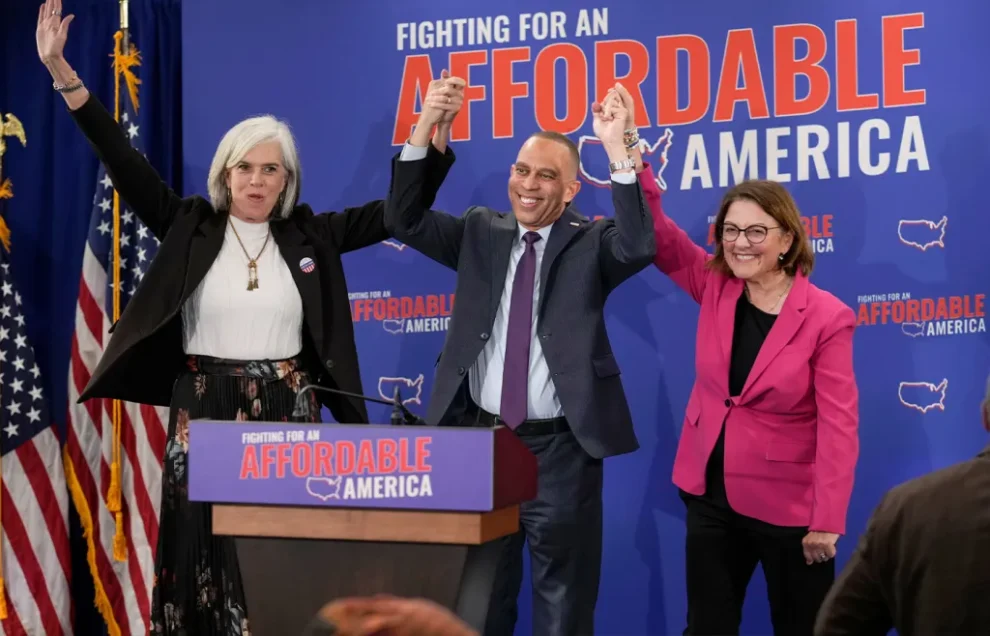
, House Minority Leader Hakeem Jeffries (D-NY) and the House Democratic campaign arm chairwoman, Rep. Susan DelBene (D-WA) attend a Nov. 3 Election Night watch party at a Capitol Hill hotel in Washington, D.C. When Democrats are in the majority starting Jan. 3, Jeffries will be House speaker. Clark will become House majority leader. (J. Scott Applewhite/AP)</p>
<p> ” data-large-file=”https://conservativemodern.com/wp-content/uploads/2026/11/congressional-dems-promise-to-investigate-trump-administration.webp” height=”658″ width=”1024″ src=”https://conservativemodern.com/wp-content/uploads/2026/11/congressional-dems-promise-to-investigate-trump-administration.webp” alt=”House Minority Whip Katherine Clark (D-MA), House Minority Leader Hakeem Jeffries (D-NY) and the House Democratic campaign arm chairwoman, Rep. Susan DelBene (D-WA) attend a Nov. 3 Election Night watch party at a Capitol Hill hotel in Washington, D.C. When Democrats are in the majority starting Jan. 3, Jeffries will be House speaker. Clark will become House majority leader. (J. Scott Applewhite/AP)” class=”wp-image-4796396″ srcset=”https://conservativemodern.com/wp-content/uploads/2026/11/congressional-dems-promise-to-investigate-trump-administration-1.webp 1400w, https://conservativemodern.com/wp-content/uploads/2026/11/congressional-dems-promise-to-investigate-trump-administration-1.webp?resize=300,193 300w, https://conservativemodern.com/wp-content/uploads/2026/11/congressional-dems-promise-to-investigate-trump-administration-1.webp?resize=768,494 768w, https://conservativemodern.com/wp-content/uploads/2026/11/congressional-dems-promise-to-investigate-trump-administration-1.webp?resize=1024,658 1024w” sizes=”(max-width: 1024px) 100vw, 1024px”><figcaption class=) House Minority Whip Katherine Clark (D-MA), House Minority Leader Hakeem Jeffries (D-NY) and the House Democratic campaign arm chairwoman, Rep. Susan DelBene (D-WA) attend a Nov. 3 Election Night watch party at a Capitol Hill hotel in Washington, D.C. When Democrats are in the majority starting Jan. 3, Jeffries will be House speaker. Clark will become House majority leader. (J. Scott Applewhite/AP)
In the Senate, Sen. Richard Blumenthal (D-CT), an ardent Trump critic, is in line to lead the Permanent Subcommittee on Investigations. He already is looking into SpaceX CEO Elon Musk’s curbs on Ukraine’s access to satellite internet service. Blumenthal might use his authority as chairman to expand his inquiry into crypto companies’ dealings with the White House.
Other senators may press the administration to reconsider or reverse additional actions. Democrats are stewing about Trump’s closure of the John F. Kennedy Center for the Performing Arts and his move to construct a colossal arch near the Lincoln Memorial. Legislators are also vexed at the president’s effort to bulldoze part of East Potomac Park at Hains Point to expand a golf course, and his refusal to spend congressionally appropriated funds. The new majority seems all but certain to push back against Trump’s moves to gut the Department of Education and to reverse cuts to federal student loan repayment programs.
How congressional Republicans will respond is not entirely clear. Many of Trump’s defenders lost their seats, and those who survived may feel little incentive to rush to his aid. The president is a lame duck, and fewer than 40% of Americans approve of the job he is doing.
Speaker Mike Johnson (R-LA), who has spent the past two years defending Trump, announced that he will not run for minority leader. For now, Rep. Jim Jordan (R-OH) and House Majority Leader Steve Scalise (R-LA), both ardent defenders of Trump, appear to be the top contenders for the position. Whether a majority of House Republicans will support anyone whom voters closely identify with the president remains to be seen.
Senate Majority Leader John Thune (R-SD) said he would like to continue leading Senate Republicans. Thune has faced relentless criticism from both Trump and Make America Great Again activists because he could not muster enough votes to pass the SAVE America Act, which would have created new federal election policies such as mandatory voter identification.
To date, no other senator has declared interest in serving as minority leader. Yet it may prove difficult for Senate Republicans to agree on a leader. A debate over the party’s future direction is simmering, and Utah’s two senators illustrate the divide. Like Trump, Sen. Mike Lee (R-UT) decries voter fraud, open borders, and aid to Ukraine. Sen. John Curtis (R-UT) holds more Reagan-like views. He founded the Conservative Climate Caucus and is a foreign policy hawk who wants the United States to counter Russian expansionism.
Although partisan acrimony between Democrats and Trump is guaranteed, the two sides will need to find ways to work together. Trump is entering the final two years of his presidency and may be looking for ways to bolster his public approval and forge a positive legacy. The president has also proven famously (or notoriously, depending on your perspective) willing to reverse his previous policy positions.
Democrats ran against the war with Iran, tariffs, and raids by Immigration and Customs Enforcement. They campaigned on affordability in hopes of winning the support of blue-collar and low-income Americans who are suffering from high gas and consumer prices. House Minority Leader Hakeem Jeffries (D-NY), who likely will become speaker in the 120th Congress, declared, “This is a change election, and we understand as House Democrats that we need to deliver dramatic change.” Investigating Trump will not be enough to satisfy voters who swung from Republicans to Democrats.
Trump may make only small concessions on immigration enforcement, but he could see an advantage in striking deals on these other issues. Along with lower-salience matters such as federal permitting reform and expanding Americans’ access to substance abuse treatment.
The congressional budget and spending process, which by law is scheduled to restart in early 2027, may force Democrats and Trump to seek deals. The 12 annual spending bills are a venue for the contending sides to address these issues and others.
2026 MIDTERM ELECTIONS LIVE UPDATES: DEMOCRATS REGAIN CONTROL OF CONGRESS IN HISTORIC BLUE WAVE
But collaboration between the branches is anything but guaranteed. Democrats are feeling their oats and itching to stick it to the president and his team, and Trump shows signs that he feels resentful. The day after Democrats’ election romp, Trump noted that he could issue vetoes against legislation passed by the opposition party. And neither House nor Senate Republicans will have close to the two-thirds membership needed to override.
The continuing resolution funding the government expires Dec. 11, before the new Congress convenes. Keeping the government open will require bipartisan support. How Trump and the outgoing Congress handle that deadline may indicate whether the next two years will be legislatively productive or destructive.
Kevin R. Kosar (@kevinrkosar) is a senior fellow at the American Enterprise Institute and edits UnderstandingCongress.org.


