






On a sunny Tuesday morning 25 years ago, Congress reconvened. Speaker Dennis Hastert called the House of Representatives to order, and the Illinois Republican recognized Rep. Earl Blumenauer. The bowtie-wearing Democrat from Oregon began delivering a speech criticizing the marketing of tobacco. He was the first of three members queued to give speeches.
Only a handful of representatives were in the chamber, recalled Eve Butler-Gee, who was the chamber’s chief journal clerk. Most lawmakers were in their personal offices preparing for a full day of votes, hearings, and meetings, beginning at 10 a.m.
Much the same was happening across the Capitol, where senators and their staff were preparing to start the day’s business. Majority Leader Tom Daschle, a South Dakota Democrat, was in his office having coffee with former Sen. John Glenn, an Ohio Democrat who had retired from the chamber in 1999. Soon, senators were on the floor resuming the debate and consideration of the annual Commerce Department spending legislation.
</p>
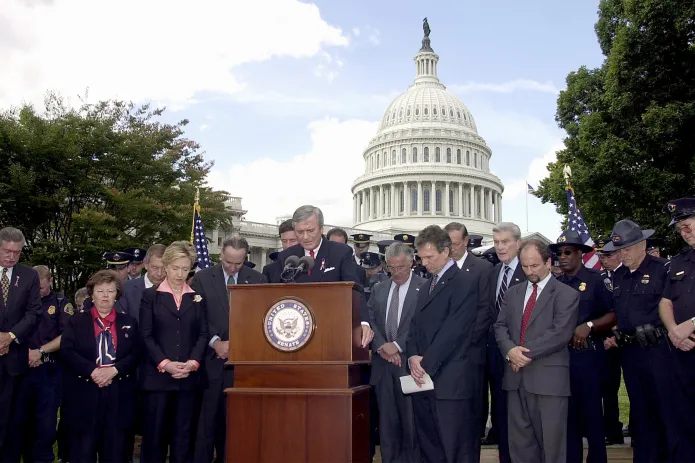
<p> ” data-large-file=”https://conservativemodern.com/wp-content/uploads/2026/09/congress-is-vulnerable-to-a-paralyzing-terrorist-attack.webp” height=”683″ width=”1024″ src=”https://conservativemodern.com/wp-content/uploads/2026/09/congress-is-vulnerable-to-a-paralyzing-terrorist-attack.webp” alt=”Members of Congress, fire fighters, and police officers attend a memorial to mark one month passed since the terrorist attacks in New York and Washington, on Capitol Hill on October 11, 2001. (Photo by Roger L. Wollenberg via Newscom)” class=”wp-image-4732864″ style=”width:846px;height:auto” srcset=”https://conservativemodern.com/wp-content/uploads/2026/09/congress-is-vulnerable-to-a-paralyzing-terrorist-attack-1.webp 3000w, https://conservativemodern.com/wp-content/uploads/2026/09/congress-is-vulnerable-to-a-paralyzing-terrorist-attack-1.webp?resize=300,200 300w, https://conservativemodern.com/wp-content/uploads/2026/09/congress-is-vulnerable-to-a-paralyzing-terrorist-attack-1.webp?resize=768,512 768w, https://conservativemodern.com/wp-content/uploads/2026/09/congress-is-vulnerable-to-a-paralyzing-terrorist-attack-1.webp?resize=1024,683 1024w, https://conservativemodern.com/wp-content/uploads/2026/09/congress-is-vulnerable-to-a-paralyzing-terrorist-attack-1.webp?resize=1536,1024 1536w, https://conservativemodern.com/wp-content/uploads/2026/09/congress-is-vulnerable-to-a-paralyzing-terrorist-attack-1.webp?resize=2048,1365 2048w, https://conservativemodern.com/wp-content/uploads/2026/09/congress-is-vulnerable-to-a-paralyzing-terrorist-attack-1.webp?resize=150,100 150w, https://conservativemodern.com/wp-content/uploads/2026/09/congress-is-vulnerable-to-a-paralyzing-terrorist-attack-1.webp?resize=696,464 696w, https://conservativemodern.com/wp-content/uploads/2026/09/congress-is-vulnerable-to-a-paralyzing-terrorist-attack-1.webp?resize=1068,712 1068w, https://conservativemodern.com/wp-content/uploads/2026/09/congress-is-vulnerable-to-a-paralyzing-terrorist-attack-1.webp?resize=1920,1280 1920w” sizes=”(max-width: 1024px) 100vw, 1024px”><figcaption class=) Members of Congress, fire fighters, and police officers attend a memorial to mark one month passed since the terrorist attacks in New York and Washington, on Capitol Hill on October 11, 2001. (Photo by Roger L. Wollenberg via Newscom)
Members of Congress, fire fighters, and police officers attend a memorial to mark one month passed since the terrorist attacks in New York and Washington, on Capitol Hill on October 11, 2001. (Photo by Roger L. Wollenberg via Newscom)By 9:45 a.m., legislators were fleeing the Capitol, and Hastert, Daschle, and other top legislative leaders were whisked to an undisclosed location in Virginia by the Capitol Police and their security details. Planes had struck and set aflame two World Trade Center towers and the Pentagon. United Airlines Flight 93 out of Newark, New Jersey, with enough fuel to carry it to San Francisco, had also been hijacked and was headed toward Washington, and possibly the Capitol.
Like the nation, Congress was ill-prepared for the 9/11 terrorist attacks. The House was not even certain how to halt business. Only Rep. Porter Goss, a Florida Republican, was in the chamber when the evacuation began at 9:45 a.m., and it was unclear if House rules permitted him to gavel the House back in and then put it into recess before 10 a.m. (Goss put the House in session for a minute during which a chaplain offered a brief prayer before recessing it.)
</p>
<p> ” data-large-file=”https://conservativemodern.com/wp-content/uploads/2026/09/congress-is-vulnerable-to-a-paralyzing-terrorist-attack.jpg” height=”1024″ width=”819″ src=”https://conservativemodern.com/wp-content/uploads/2026/09/congress-is-vulnerable-to-a-paralyzing-terrorist-attack.jpg” alt=”Smoke and flames rise over the Pentagon late into the night of Sept. 12, following the Sept. 11 terrorist attack of the southwest corner of the Pentagon. The building was evacuated, as were the federal buildings in the Capitol area, including the White House. (Photo by Bob Houlihan via Newscom)” class=”wp-image-4732866″ style=”width:435px;height:auto” srcset=”https://conservativemodern.com/wp-content/uploads/2026/09/congress-is-vulnerable-to-a-paralyzing-terrorist-attack-9.jpg 1080w, https://conservativemodern.com/wp-content/uploads/2026/09/congress-is-vulnerable-to-a-paralyzing-terrorist-attack-9.jpg?resize=240,300 240w, https://conservativemodern.com/wp-content/uploads/2026/09/congress-is-vulnerable-to-a-paralyzing-terrorist-attack-9.jpg?resize=768,960 768w, https://conservativemodern.com/wp-content/uploads/2026/09/congress-is-vulnerable-to-a-paralyzing-terrorist-attack-9.jpg?resize=819,1024 819w, https://conservativemodern.com/wp-content/uploads/2026/09/congress-is-vulnerable-to-a-paralyzing-terrorist-attack-9.jpg?resize=150,188 150w, https://conservativemodern.com/wp-content/uploads/2026/09/congress-is-vulnerable-to-a-paralyzing-terrorist-attack-9.jpg?resize=300,375 300w, https://conservativemodern.com/wp-content/uploads/2026/09/congress-is-vulnerable-to-a-paralyzing-terrorist-attack-9.jpg?resize=696,870 696w, https://conservativemodern.com/wp-content/uploads/2026/09/congress-is-vulnerable-to-a-paralyzing-terrorist-attack-9.jpg?resize=1068,1335 1068w” sizes=”(max-width: 819px) 100vw, 819px”><figcaption class=) Smoke and flames rise over the Pentagon late into the night of Sept. 12, following the Sept. 11 terrorist attack of the southwest corner of the Pentagon. The building was evacuated, as were the federal buildings in the Capitol area, including the White House. (Photo by Bob Houlihan via Newscom)
Smoke and flames rise over the Pentagon late into the night of Sept. 12, following the Sept. 11 terrorist attack of the southwest corner of the Pentagon. The building was evacuated, as were the federal buildings in the Capitol area, including the White House. (Photo by Bob Houlihan via Newscom)More ominously, Congress had no policies in place to enable it to resume operations if the Capitol had been destroyed or if a large number of legislators were killed or incapacitated. The Constitution assigns Congress the lion’s share of federal powers. Were it not for the brave passengers of Flight 93 who stormed the cockpit and brought the plane down in Shanksville, Pennsylvania, the federal government could have been crippled for months. None of the 13 annual spending bills had become law as of Sept. 11, 2001, and all were due to expire at the end of the month, which would have pitched the government into a shutdown.
Sadly, Congress today is still not fully prepared to endure a crippling mass casualty event.
To its credit, Congress has improved its readiness. It adopted rules to enable rapid recesses, and it requires the speaker to produce a list of legislators who can temporarily discharge his critical duties, such as presiding over sessions, deciding what legislation gets voted upon, and overseeing the operations of the Capitol Police, if he is killed or disabled. Congress can now also convene at locations other than the Capitol to vote. Security screenings of visitors to the Capitol were moved a few hundred feet away from the Capitol to reduce the likelihood of anyone killing legislators by detonating a bomb or spraying hundreds of bullets.
The big vulnerability, however, is the House’s inability to quickly replace dead or deceased members. The Constitution requires a majority of each chamber to be present to conduct business. This quorum requirement is not a big problem for the Senate because the 17th Amendment permits governors to replace dead senators promptly.
The House, however, must replace its members through direct elections, and that process is controlled by states. Congress passed a law in 2005 mandating that states hold special elections to fill vacant House seats within 49 days. States have not followed the law much, according to data collected by the nonpartisan Congressional Research Service. Only four of the 110 special elections held between 2002 and 2024 were completed on time. On average, states took 136 days to replace a departed legislator.
Governors set House special election days, and some have flaunted that power. Rep. Christian Menefee (D-TX) took office Feb. 2, 2026, nearly 11 months after the death of his predecessor in Texas’s 18th Congressional District, based in Houston. With the House Republican majority precariously small, Gov. Greg Abbott (R-TX) took his time setting a special election date to replace the late Rep. Sylvester Turner in a deep-blue district.
After the January death of GOP Rep. Doug LaMalfa, which made the House Republican majority even slimmer, Gov. Gavin Newsom (D-CA) took his time establishing an election timeline to replace him. Newsom scheduled a special election date for California’s 1st Congressional District, a heavily Republican seat in the northeast part of the state, on the last possible date under state law. Rep. James Gallagher (R-CA) took office on June 10, about two months later than he needed to.
As for the quorum problem, the House of Representatives has also tried to elude it by adopting rules that permit it to declare a provisional quorum as a majority of the members elected, sworn, and living. Not everyone believes this solution comports with the Constitution.
Former congressional attorney John Bryan Williams asks us to imagine a scenario in which everyone in the House dies except for the Massachusetts delegation, which was not at work that day because its members were celebrating the Boston Red Sox’s World Series victory. Under House Rules, these nine individuals would become Congress, and five of them would constitute a quorum. They could name one of themselves speaker, a position in the line of presidential succession, and pass laws with the concurrence of the Senate. The House would be composed entirely of Democrats who were in the minority before the slaughter.
“It would be absurd to assert that a legislative body composed of these ten men is ‘representative’ of the United States in any meaningful way,” Williams wrote in a 2006 William & Mary Law Review article. “In an uncanny way, this group would resemble the ‘junctos,’ or small groups of unrepresentative elected officials that the Framers wanted to avoid when they adopted the majority quorum rule.”
John Fortier, who served on two commissions studying the continuity of Congress, told the Washington Examiner that Congress will not be truly prepared for a mass casualty event until it tackles “the core problem of the House being left without significant numbers of its membership for months. … We need a way to temporarily replace members of the House until special elections take place.” Various legislators have introduced constitutional amendments to do just that, but none of them have come close to passing the House and Senate by two-thirds votes, to say nothing of being ratified by three-fourths of the states.
BIG TECH’S AI FUTURE RELIES ON AN UNLIKELY HERO: THE BLUE-COLLAR WORKER
Sixty-five years ago, Congress confronted the mortal threat posed to it by nuclear weapons. It secretly funded the construction of a bunker under The Greenbrier hotel in West Virginia, should the Soviets fire nuclear missiles at Washington. Members could shelter there for months and discharge their constitutional duties. Those legislators believed preserving the republic necessitated saving Congress.
To date, the legislators of the past two decades have not shown the same pride in their positions as members of the first branch. Leaving Congress vulnerable to a paralyzing attack dishonors the passengers of Flight 93 who gave their lives to preserve the nation’s government.
Kevin R. Kosar (@kevinrkosar) is a senior fellow at the American Enterprise Institute and edits UnderstandingCongress.org.


