




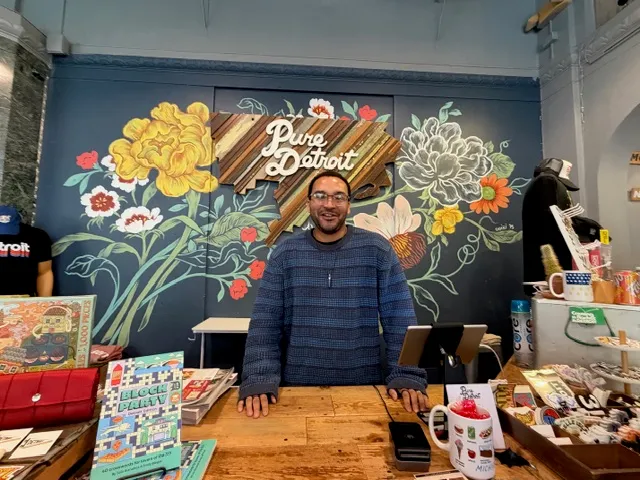
DETROIT — Inside the historic buildings that give Detroit its character, pressure on the city’s businesses is becoming harder to ignore. At Pure Detroit, where Brandon Haugabook works part-time in the landmark Fisher Building, he sees rising costs squeezing businesses and leaving customers with less money to spend. His work teaching drama to children through nonprofit groups offers another view of the strain, as arts organizations contend with funding cuts and uncertainty.
Across both worlds, Haugabook hears a familiar refrain: People are fed up.
Some are struggling themselves. Others are watching friends and family fall behind. Increasingly, he said, people who supported President Donald Trump in 2024 are considering voting differently, even if their underlying political beliefs haven’t changed.
</p>
<p> ” data-large-file=”https://conservativemodern.com/wp-content/uploads/2026/10/voters-who-helped-trump-win-in-michigan-are-having-second-thoughts.webp” src=”https://conservativemodern.com/wp-content/uploads/2026/10/voters-who-helped-trump-win-in-michigan-are-having-second-thoughts.webp” alt=”Brandon Haugabook stands at a counter inside the landmark Fisher Building in Detroit, Michigan.” class=”wp-image-4782362″ srcset=”https://conservativemodern.com/wp-content/uploads/2026/10/voters-who-helped-trump-win-in-michigan-are-having-second-thoughts.webp 640w, https://conservativemodern.com/wp-content/uploads/2026/10/voters-who-helped-trump-win-in-michigan-are-having-second-thoughts.webp?resize=300,225 300w” sizes=”(max-width: 640px) 100vw, 640px”><figcaption class=) Brandon Haugabook works part-time at Pure Detroit inside the landmark Fisher Building in Detroit, Michigan, on Tuesday, Oct. 27, 2026. (Barnini Chakraborty/Washington Examiner)
Tariffs have complicated relationships with suppliers and driven up costs, Haugabook said. One small business in the building where he works was recently forced to close one of its locations.
“It’s not necessarily the flow of people as much as it is people not having money to spend to put into the businesses,” he told the Washington Examiner.
Haugabook, who helped his mother campaign for local office two years ago, sees the financial pressures spilling into political conversations. In Michigan, where Trump won in 2024, the question is whether voters who helped return him to the White House will stick with Republicans on Tuesday.
For some, the disillusionment is economic. For others, it is rooted in Trump’s approach to the Middle East and his rhetoric toward Arab Americans and Muslims.
For Bishara Bahbah, a former Trump ally who helped build the president’s support in Dearborn, the rupture has become personal.
Four years ago, Bahbah helped make an unlikely pitch to voters who had spent generations looking warily at the Republican Party. In Michigan, where Arab American and Muslim voters could help decide a presidential election, he argued that Trump understood their anger over Gaza and offered an alternative to a Democratic Party they believed had taken their support for granted.
The effort was called Arab Americans for Trump.
Two years later, the name is gone. So is Bahbah’s support for the president.
The breaking point came after Trump attacked Abdul el Sayed, the Democratic Senate candidate in Michigan and a former Detroit health official who could become the nation’s first Muslim senator if elected.
Trump called el Sayed a “jihadist,” accused him of being “on the side of the terrorists,” and suggested he would have to pass through a metal detector before entering the Senate. He invoked 9/11 and compared efforts to keep el Sayed out of the chamber to the passengers who fought back against hijackers aboard United Airlines Flight 93.
“The president’s statements are out of line,” Bahbah told the media. “They are crossing a red line. They are racist.”
For Bahbah, the comments challenged the premise of the political alliance he had helped build — that Trump would treat Arab Americans as partners rather than targets.
Bahbah now identifies himself as chairman of Arab Americans for Peace. The organization he founded to help Trump win eventually dropped the president’s name.
The disillusionment extends beyond political organizers. Jalah Hassan, a 19-year-old from Grand Rapids who voted for Trump in her first election, said she regrets her decision.
“I was so proud of myself when I voted, but now we’re desperate,” Hassan told the Washington Examiner. “His agenda is harmful for everyone in this state. In this country, really. It’s do or die, and I need to reverse the damage I caused.”
Trump’s attacks on el Sayed have coincided with Republican efforts to link the Democrat to the Muslim Brotherhood, an Islamist movement founded in Egypt in 1928, parts of which have been designated terrorist organizations by the State Department.
The issue surfaced again Monday, when Health and Human Services Secretary Robert F. Kennedy Jr. campaigned in Michigan alongside Republican Senate nominee Mike Rogers and Republican gubernatorial candidate John James. Kennedy argued that the Muslim Brotherhood had stifled contributions by Muslim-majority societies to science, literature, art, and engineering, and questioned why Arab Muslims no longer won prestigious prizes such as Nobel Prizes. The remarks drew criticism as historically misleading and bigoted.
Hassan questioned not only Trump but Kennedy’s comments, saying they raised questions about whether earlier outreach meant anything.
Other former Trump supporters are reconsidering their allegiance for reasons closer to home.
Geoff Anthony, a Lansing businessman who voted for Trump three times, said he was once the lone Republican in a family of Democrats. He spent years trying to persuade relatives that Trump would put America first. Now, he said, tariffs have hurt his auto business, while the war with Iran and rising gas prices have hit his wallet.
For the first time, Anthony is considering crossing party lines.
“[Trump] says to vote like he is on the ballot,” Anthony told the Washington Examiner. “That makes it a lot easier. Do I like everything he says? Heck no. Do I believe we’re better off with [el Sayed]? I spent nearly $100 filling up my truck today. Ask me on Nov. 4.”
Democratic strategist Jay Satterfield, principal at North Shore Strategies, said the frustration resembles what he has seen among working-class voters in northwest Georgia, where he grew up. Many supported Trump because they believed he would deliver a stronger economy, he said.
“Now they’re dealing with the uncertainty of tariffs, an economy that isn’t delivering what they were promised, and a president who seems more interested in attacking Muslim Americans than bringing people together,” Satterfield told the Washington Examiner. “I don’t expect lifelong Republicans to suddenly become Democrats, but there’s only so long you can tell working people everything is great when their own pocketbooks are telling them something different.”
Democrats for Rogers
Republicans, however, are betting that dissatisfaction with Trump won’t automatically translate into votes for Democrats.
Jake Frievalt, executive director of the Kent County Republican Party, said his focus in West Michigan is on the party’s broader slate of candidates, from state legislative races to school boards. He argued that the region’s traditional values align more closely with Republican candidates.
, and supporter holding a ‘Democrats for Rogers’ yard sign, in Kent County, Michigan, on Monday, Oct. 25, 2026. (Barnini Chakraborty/Washington Examiner)</p>
<p> ” data-large-file=”https://conservativemodern.com/wp-content/uploads/2026/10/voters-who-helped-trump-win-in-michigan-are-having-second-thoughts-1.webp” src=”https://conservativemodern.com/wp-content/uploads/2026/10/voters-who-helped-trump-win-in-michigan-are-having-second-thoughts-1.webp” alt=”Jake Frievalt holds a ‘Democrats for Rogers’ yard sign.” class=”wp-image-4782363″ srcset=”https://conservativemodern.com/wp-content/uploads/2026/10/voters-who-helped-trump-win-in-michigan-are-having-second-thoughts-2.webp 640w, https://conservativemodern.com/wp-content/uploads/2026/10/voters-who-helped-trump-win-in-michigan-are-having-second-thoughts-2.webp?resize=300,225 300w” sizes=”auto, (max-width: 640px) 100vw, 640px”><figcaption class=) Jake Frievalt, executive director of the Kent County Republican Party (L), and a supporter holding a ‘Democrats for Rogers’ yard sign, in Kent County, Michigan, on Monday, Oct. 25, 2026. (Barnini Chakraborty/Washington Examiner)
Frievalt said his office has received requests for “Democrats for Rogers” signs, suggesting some voters may support the Republican Senate nominee even if they don’t identify with his party.
“We’re not perfect by any means, but, you know, we represent those values a lot more than they do,” Frievalt said of Republicans.
GOP strategist Jeff Burton argued that Rogers has demonstrated independence from Trump on issues important to Michigan, including tariffs on Canada, while maintaining the president’s support.
“These comments are another example of Trump being Trump,” Burton told the Washington Examiner. Rogers, he added, used disagreements with the president to make the case that he can be an influential voice for Michigan in Washington.
The Republican National Committee has taken a more confrontational approach, attacking el Sayed over public safety and alleged ties to the Muslim Brotherhood.
“Thousands of fired-up Michiganders packed Port Huron on Sunday to stand with Mike Rogers and President Trump, because Republicans are united behind their plan to Get Michigan Working Again and bring manufacturing jobs back home,” RNC spokesman Hunter Lovell told the Washington Examiner. He called el Sayed a “terrorist-sympathizer” and accused him of wanting to defund police and strip Michiganders of private health insurance.
ROGERS BREAKS WITH TRUMP ON EL SAYED ATTACKS: ‘I’VE NEVER CALLED HIM A TERRORIST’
The differing messages highlight the challenges facing both parties across Michigan. Democrats hope economic frustration and anger over Trump’s rhetoric will persuade some of his former supporters to cross the aisle. Republicans are split, some counting on voters to distinguish between the president and the candidates running alongside him, and others hoping Trump’s base comes out in full force.
For Haugabook, the political shift he hears about is less a wholesale change in ideology than a reassessment driven by everyday pressures, the cost of running a business, the uncertainty facing arts programs, and the difficulty people have keeping up.


