







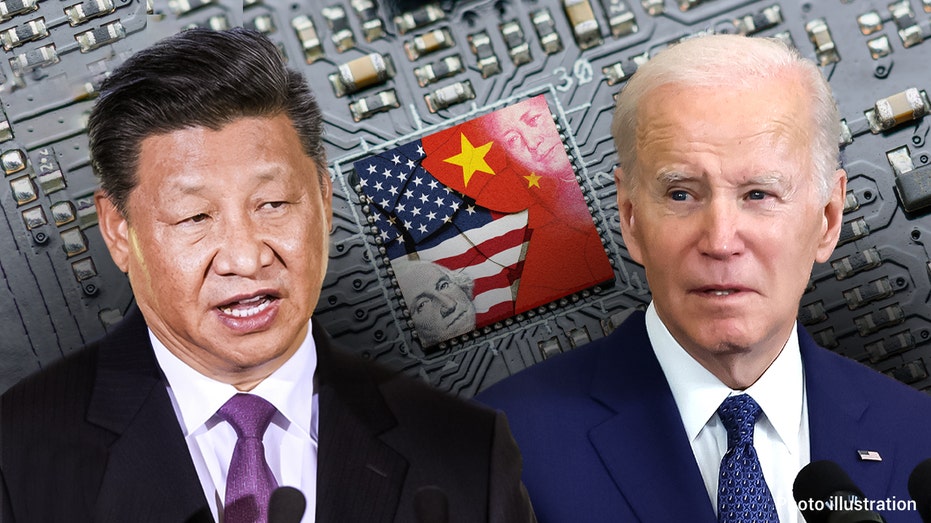
Despite American export controls designed to cut Huawei off from the world’s most advanced semiconductor technology, China’s largest technology company is poised to post a 60% jump in chip revenue this year — a far cry from the death blow the Biden administration had hoped the restrictions would deliver.
Following export controls implemented in 2023, China directed its state agencies to purchase hardware, chips, mobile devices and software from Huawei while also pouring over $1 billion in government grants into the company.
Now, three years later, Huawei is expected to close 2026 with about $12 billion in chip revenue — a massive jump from $7.5 billion in 2025, according to analysts.
The result is fueling debate over whether U.S. export controls have inadvertently made Huawei stronger—or whether they have successfully slowed China’s push to compete in advanced semiconductors.
STEPHEN MOORE: GOVERNMENT CONTROL OF CHIP SALES HAS A SHOCKING DOWNSIDE
To some, like Jensen Huang, CEO of Nvidia, the world’s largest semiconductor engineering company, there’s reason to still believe Huawei should merit respect.
“Huawei is the single most formidable technology company in China,” Huang told the Financial Times earlier this year.
“They’ve conquered every market they’ve engaged in,” he added.
The U.S. originally placed restrictions on Huawei in 2019, blacklisting its devices from government use.
The Biden administration continued to tighten restrictions in the next few years.
In 2022, it banned sales and imports from the company and, a few months later, halted export licenses to Huawei entirely, citing national security interests. In 2024, the U.S. pressed for many of its allies to follow suit. The Trump administration has continued those efforts in 2025, blocking dozens of Chinese groups from accessing semiconductors and other pieces of technology.
The compounding moves created a de facto ban on the company.
“The export controls announced in the two rules today restrict the PRC’s ability to obtain advanced computing chips, develop and maintain supercomputers, and manufacture advanced semiconductors,” the U.S. Department of Commerce wrote in a statement at the time.
“These items and capabilities are used by the [People’s Republic of China] to produce advanced military systems including weapons of mass destruction; improve the speed and accuracy of its military decision-making, planning, and logistics, as well as of its autonomous military systems; and commit human rights abuses.”
But by then, China had already begun laying the groundwork for using Huawei as a way to step away from reliance on the U.S.
CHINA IS BUILDING AN AI WAR MACHINE. WASHINGTON MUST WAKE UP BEFORE IT’S TOO LATE
Huawei’s annual reports indicate that the company’s government grants skyrocketed during the same period. From 2.5 billion yuan in 2021, worth roughly $403 million, the company received 6.5 billion yuan in 2022 and then 7.3 billion in 2023.
Notably, government investment dipped in 2025, to 3.9 billion yuan.
Even so, the investments have coincided with an important milestone by 2026: the emergence of the Ascend 910B chip — a jump in China’s cutting-edge technology designed to compete with Nvidia’s chips.
The company believes it can go further. In May, Huawei announced that it would adopt new strategies to push the boundaries of existing technology. Instead of trying to make parts inside chips increasingly smaller — a key focus for the rest of the industry — Huawei believes it has found a way to make electrical signals move faster and take more efficient shortcuts, a principle called “Tau scaling law.”
He Tingbo, a Huawei executive, seemed to believe it could reverse the company’s isolation.
“No single company can independently find all the answers along the path of semiconductor evolution. With the τ Scaling Law, we look forward to working closely with scientists, engineers, and industry partners around the world to drive the sustainable development of the semiconductor and electronics industries.”
While debates remain about just how effective Ascend 910B really is as a challenger and some of the other breakthroughs Huawei has promised, some lawmakers argue that the export controls have succeeded in one key area: forcing China to offshore at least some of its production.
Rep. John Moolenaar, R-Mich., said he believed the move had forced China to rely more on Taiwan.
“Huawei’s only path to meeting China’s internal demand has been to illegally procure chips from Taiwan — a humiliation the CCP would prefer to avoid at all costs,” Moolenaar wrote in a letter to Commerce Secretary Howard Lutnick, referring to a shell company China had used that China had used to get around restrictions.
AMERICA IS FIGHTING YESTERDAY’S AI WAR. TOMORROW’S WAR IS ON THE WAY
“While Huawei struggles to cheat its way toward meeting domestic AI-chip demand, the United States has accumulated roughly 75 percent of the world’s AI computing power.”
Representatives for Huawei did not respond to requests for comment from Fox News Digital.


