




President Donald Trump is offering support for Catholic bishops’ consecration of the United States to the Sacred Heart of Jesus, an unprecedented act of solidarity with the Catholic Church as the animosity between the White House and the Vatican is seemingly in the rearview.
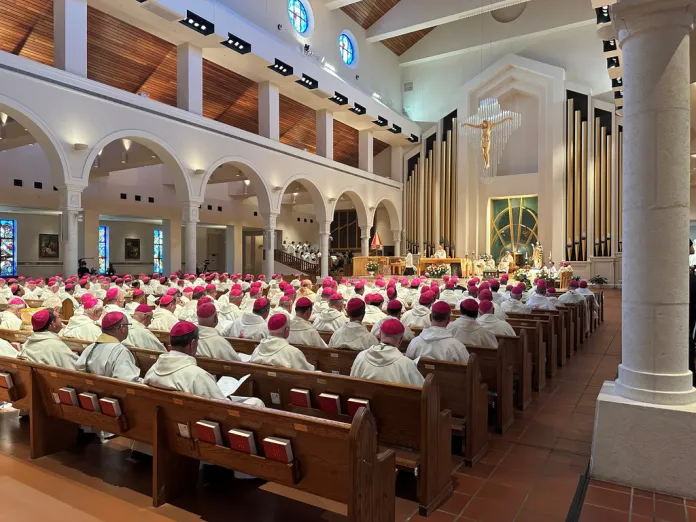
Members of the United States Conference of Catholic Bishops — which is currently gathered in Orlando, Florida, for its spring assembly — came together for the consecration service on Thursday in honor of the nation’s 250th anniversary. The occasion, marked by a presidential statement, is seen as a high point in acceptance of the Catholic Church in the historically Protestant country.
“Today, Melania and I join in prayer with Catholic Bishops gathered in Orlando, Florida, as they consecrate the United States of America to the Sacred Heart of Jesus on the occasion of our 250th year of American Independence — a powerful moment in our national story and a poignant reminder that America has always been guided by the loving hand of God,” the president said in a statement from the White House.
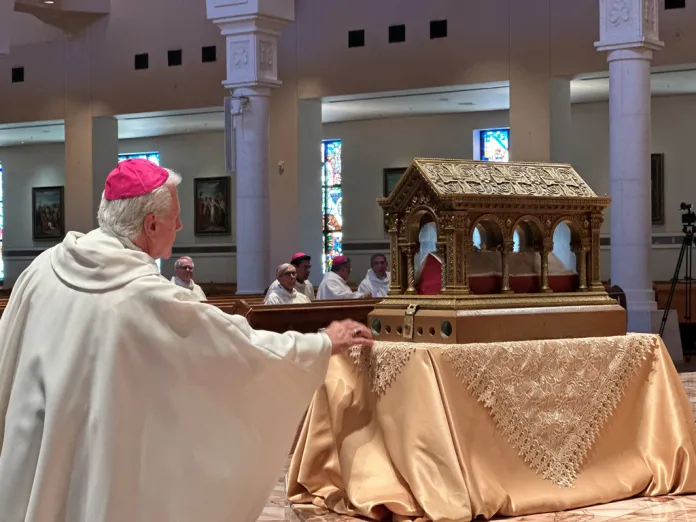
To consecrate a nation to the Sacred Heart is to spiritually entrust its people to God’s care. The Sacred Heart of Jesus is a distinctly Catholic devotion that emphasizes Jesus’s heart as a symbol for God’s mercy and love for humanity, as well as his suffering in death. It is the first time such a consecration has been made in the U.S., as such ceremonies typically take place in majority-Catholic countries with strong overlap between their civic and spiritual spheres.
“May your holy Catholic Church serve as a sign, pointing all people to your infinite love,” prayed the bishops and lay worshippers at the Basilica of the National Shrine of Mary, Queen of the Universe. “O desire of nations and center of history, we ask you to bless these United States of America.”
In his statement, Trump lauded the post-Revolutionary War archbishop, John Carroll, who helped Catholics in Boston integrate into the fledgling nation as an often unwelcome religious minority. He also celebrated the friendship between President Ronald Reagan and Pope John Paul II, the two leaders most celebrated for standing athwart the spread of communism.
“Today, nearly four decades later, our Nation and our culture confront a new set of menacing ideologies seeking once again to cast God out from our society,” the president said. “But today, as Catholic Bishops consecrate the United States of America to the Sacred Heart of Jesus in this 250th year of our Independence, we recommit ourselves, like President Reagan and Pope Saint John Paul II, to defending our spiritual identity and great civilizational inheritance.”
Bishop Robert Barron, one of the church’s most widely-followed clerical leaders and a member of the White House’s Religious Liberty Commission, told the Washington Examiner: “This seems to me to be unprecedented and demonstrates the esteem Trump Administration has for the [Catholic] Church in the United States and how mindful the President is of the many positive contributions Catholics have made to this country.”
Members of the faith swung for the GOP in the 2024 elections, and the White House responded to that realignment by commemorating Catholic feast days such as the Immaculate Conception and the feast of St. Michael the Archangel. Observers have also credited the government’s favor toward the Catholic Church to the fact that the administration is flush with believers.
“I have had the pleasure to work with and get to know many Catholics who work for President Trump’s administration,” Barron said. “I have been heartened by not only their love for this country, but the manner in which their Catholic faith informs their work and shapes their lives. I am sure that they too are delighted and grateful for this Presidential Proclamation.”
The gesture comes after Trump’s feud with Pope Leo XIV over the pontiff’s opposition to the war in Iran. The president called the bishop of Rome “weak on crime and terrible for foreign policy.” He even brought the pope’s family into the matter, writing on social media: “I like his brother Louis much better than I like him, because Louis is all MAGA. He gets it, and Leo doesn’t!”
Doug Wilson, a Reformed pastor close with Secretary of War Pete Hegseth who operates a church in Washington, D.C., popular with members of the Trump administration, wrote off the proclamation as Trump “simply trying to be nice to the Catholics in the same way that politicians want to be courteous to all faiths.”
Wilson has become a prominent voice of Christian nationalist thought on the Right. He has previously explained that in a hypothetical future where the U.S. recovers its historic faith identity, public celebrations of Catholic belief at odds with Protestant sensibilities ought to be restricted. Yet, the Thursday consecration was not a major stumbling block for Wilson.
“I don’t think there are any monumental theological issues at stake, other than our modern tendency to throw all religions into a blender, and to call the resultant puree somewhat inspiring,” he told the Washington Examiner.
The Trump administration has sought to maintain productive relationships with a wide pool of religious communities, ranging from Jews to Latter-day Saints.
Appealing to such a broad base of faith communities has occasionally proved difficult, such as the Department of War’s decision last week to reduce and simplify its religious affiliation codes. The initial reformed list included a Christian category with several denominations tagged under that label.
POPE LEO FRAMES AI WARFARE AS MORAL CHALLENGE IN ROME SPEECH: ‘INHUMAN EVOLUTION’
The Church of Jesus Christ of Latter-day Saints — formerly known as the “Mormons” — was not included under the “Christian” umbrella, resulting in statements of indignation from LDS politicians such as Republican Sens. Mike Lee and John Curtis of Utah. Christians argued LDS members were correctly excluded due to their radically idiosyncratic theology.
The Department of War eventually removed itself from the debate by erasing the “Christian” category entirely and referring to faith traditions by their denominational names, such as “Methodist” and “Presbyterian.”


