







In countless American minds, Brexit and President Donald Trump are linked, and not in a good way.
The term Brexit is shorthand for “British exit.” The vote of more than 17 million U.K. citizens on a referendum to leave the European Union and Trump’s shock election to the presidency both happened in the same year, 2016. The two events have come to be seen as part of the same demotic wave, pushing against the established international order, which has come to be called populism.
Different issues were at play at those ballot queues, several months and an ocean apart. Trump collapsed all of the issues when he went to Scotland for a golf course opening not long after the vote.
Trump, still a private citizen, said in a press conference that U.K. voters had “taken back their independence,” and he saw a “big parallel” brewing in other nations. “Not only the United States, but [in] other countries, people want to take their country back,” he said. He also called himself “Mr. Brexit,” because he knew a popular bandwagon when he saw one.
Because of the association, one way to root against Trump has been to highlight any failures of Brexit and to pin those failures on populist notions of independence and self-determination. For instance, The Atlantic magazine both features Trump skepticism as a part of its business model and blames Brexit for the United Kingdom’s decline.
</p>
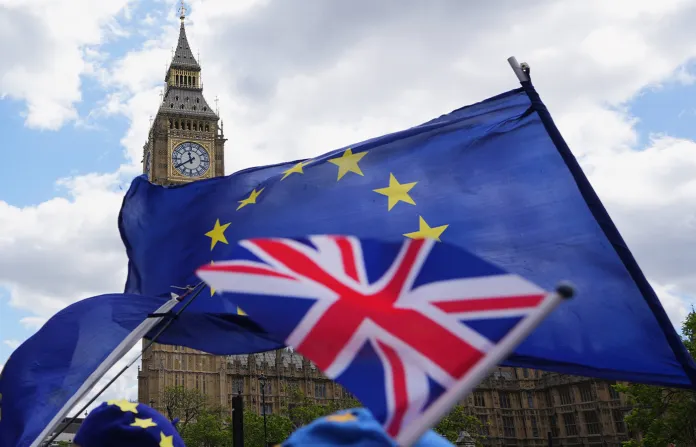
<p> ” data-large-file=”https://conservativemodern.com/wp-content/uploads/2026/08/brexit-isnt-whats-dragging-britain-down.webp” height=”658″ width=”1024″ src=”https://conservativemodern.com/wp-content/uploads/2026/08/brexit-isnt-whats-dragging-britain-down.webp” alt=”Pro European Union campaigners hold flags near parliament as Britain’s Prime Minister attends the weekly session of Prime Ministers Questions in London on May 20. (Kirsty Wigglesworth/AP)” class=”wp-image-4703721″ style=”aspect-ratio:1.557150358830737;width:379px;height:auto” srcset=”https://conservativemodern.com/wp-content/uploads/2026/08/brexit-isnt-whats-dragging-britain-down-1.webp 1400w, https://conservativemodern.com/wp-content/uploads/2026/08/brexit-isnt-whats-dragging-britain-down-1.webp?resize=300,193 300w, https://conservativemodern.com/wp-content/uploads/2026/08/brexit-isnt-whats-dragging-britain-down-1.webp?resize=768,494 768w, https://conservativemodern.com/wp-content/uploads/2026/08/brexit-isnt-whats-dragging-britain-down-1.webp?resize=1024,658 1024w, https://conservativemodern.com/wp-content/uploads/2026/08/brexit-isnt-whats-dragging-britain-down-1.webp?resize=150,96 150w, https://conservativemodern.com/wp-content/uploads/2026/08/brexit-isnt-whats-dragging-britain-down-1.webp?resize=696,447 696w, https://conservativemodern.com/wp-content/uploads/2026/08/brexit-isnt-whats-dragging-britain-down-1.webp?resize=1068,687 1068w” sizes=”(max-width: 1024px) 100vw, 1024px”><figcaption class=) Pro European Union campaigners hold flags near parliament as Britain’s Prime Minister attends the weekly session of Prime Ministers Questions in London on May 20. (Kirsty Wigglesworth/AP)
Pro European Union campaigners hold flags near parliament as Britain’s Prime Minister attends the weekly session of Prime Ministers Questions in London on May 20. (Kirsty Wigglesworth/AP)An article in the July issue called Brexit one of the U.K.’s “self-sabotaging responses” to world crises, which had “caused business investment to drop by 12 to 18 percent, productivity and employment to decline by about 3 to 4 percent, and, most striking, GDP per capita to fall by 6 to 8 percent,” according to one study.
The Atlantic also repeated another meme-able finding that is being bandied about. The U.K.’s output per person is “only just above that of Mississippi, America’s poorest state,” and if you take London off the table, “living standards fall well below Mississippi’s.”
The report was written by Idrees Kahloon, a former Washington bureau chief for the Economist, which is another magazine that is also very much anti-Trump and anti-Brexit. He interviewed Nigel Farage, a past Brexit campaign leader and current leader of the party Reform UK.
Farage has a reasonable shot of becoming the next U.K. prime minister. Kahloon asked about what he would do to reverse Britain’s decline and made it clear that he was not impressed with the answers. The Reform UK leader was portrayed as a sort of Trump 3.0 who would only deepen his nation’s dysfunction.
One gaping problem with the anti-Brexit critique of the U.K. is that it ignores Europe. If it is true that the U.K. has stagnated because of Brexit, then we should expect the EU member countries that did not leave what began as a trade union and deepened into structures of supranational governance to be going full steam.
That is not remotely the case. It is true that the U.K. has lagged or stagnated relative to the economy of the United States. But Europe has stagnated right along with it.
The Growth Commission is an international organization of economists focused on how to nurture economic growth and remove impediments to that growth. A report prepared for the organization and published last year made it abundantly clear that not a whole lot of that has been happening in recent years.
“Since the Renaissance, the world’s structures have predominantly been created and codified by European hands,” is how British economist Ewen Stewart opened the report. However, this is no longer the case and it is time to face the “harsh reality” that “European power is in acute decline on almost every measure,” he wrote.
As political power tends to follow economic power, the reverse is true as well. And the economic indicators are not great.
Stewart wrote that in 1990, the current EU member countries were the world’s single biggest economic bloc. They accounted for about one-quarter of world gross domestic product as measured by purchasing power. By 2023, the EU was the third largest economic bloc. As for its GDP, the EU is about one-seventh of the global total. From first to third and one-quarter to one-seventh is quite the drop. What happened?
Economic growth very nearly flatlined is what happened. Looking at a longer trend in the EU, Stewart wrote, “what we see is GDP growth declining from 4.8% compound in the 1960s to 3.2% in the 1970s, then subsequently 2.1%, 2.2% and then 1% in the first decade of the new millennium — with a marginal rebound to 1.3% in the long decade from 2010 to 2024.”
What went wrong with Europe?
In the 1970s, the U.K.’s economy was an economic basket case with structural problems that would eventually sweep Margaret Thatcher with her market reforms into power. During that declinist period, Britain was said to be the “sick man of Europe.” These days, the EU is something like the sick man of the world.
The Growth Commission report spells out some of the things that have slowed growth in the EU. A looming problem is the size and scope of European governments.
Europe has stalled out
“In Europe, the state generally accounts for between 44% and 55% of GDP, some ten points higher than North America and some twenty points higher than Asia,” Stewart writes.
European taxes are on average the highest in the world, and in many cases anti-competitive. Governments can be overgenerous in allowing write-offs for business expenses but most EU nations have erred in the other direction, which increases the tax burden on businesses, squeezes profits, and slows growth, the report argues, with copious charts.
EU nations take a lot of that money to fund lavish social spending. Spending on welfare and social programs in “each of the four largest members of the Eurozone … exceeds 25% of GDP,” Stewart reports. For perspective, he explains that social spending in those countries is a “figure that exceeds the entire tax take for all services in China.”
There are several other structural problems that the report calls out in the EU. These impediments to growth run from employment laws that companies hate to the world’s highest energy prices to a great number of non-tariff barriers that might as well be tariffs, for their effects on prices and trade.
In this highly regulated and taxed environment, you might be shocked to learn that there is a “lack of corporate dynamism and entrepreneurship” as well.
Ice cream, you Brexit
Economists constantly harp on the difference between correlation and causation. Two things happening in rough sequence does not make the first event the cause of the second.
Ice cream parlors regularly bulk up their orders in advance of the summer months, when it is hot out. That does not mean that ice cream sales cause seasonal warming.
The same is true of the U.K. Sure, Brexit happened and Britain stagnated. Those were things that happened. It does not follow that Brexit caused the U.K.’s stagnation.
WILL THE DEMOCRATIC ESTABLISHMENT STRIKE BACK?
If the U.K. had broken off from an EU that did fine without it, that would be an important data point for the failure of Brexit, but that is sadly not the case. Instead, the U.K. and the EU amount to sisters of the slump.
In their efforts to find their way out of that slump, Brexit is, at best, a distraction.
Jeremy Lott (@jeremylottdiary) is the author of several books, most recently The Three Feral Pigs and the Vegan Wolf.


