







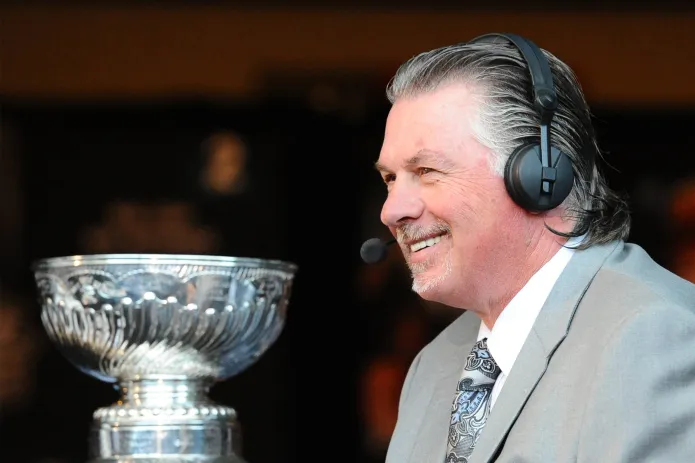
If American sports media were to have a Mount Rushmore — if we were to select four figures whose voices and presences became inseparable from the games they covered — I don’t think there’d be much doubt that for the NFL, we’d choose John Madden; for the MLB, it would be Vin Scully; and for the NBA, it would be Marv Albert. For the NHL, the face on that mountain may well belong to Barry Melrose, the former NHL coach and broadcaster who died on Sept. 9 at the age of 70. For nearly three decades, he was the voice of hockey on American television. He was the face, too, and also of course the hair. (I usually think mullets look pretty dumb, but not when Barry Melrose was rocking them). If an analyst did not sound at least a little like Melrose, it didn’t sound like hockey.
Hockey is one of the few major American sports I have never quite taken to. I admire the insane levels of speed, toughness, and skill it takes to play it, but whereas I feel at home with basketball, baseball, football, and other sports, with hockey, I’ve always felt like a tourist. But when I flipped on ESPN and Melrose was talking, I didn’t touch the remote. He made the game sound fun. He made even non-hockey fans like me want to be hockey fans, at least for those few minutes when he had the mic.
Barry James Melrose was born on July 15, 1956, in Kelvington, Saskatchewan, a prairie town of about 900 people, and raised on a nearby farm. Like every proper Canadian, his father put a rink on the property and put his son on skates almost as soon as he could walk. He left home at 15 to play junior hockey, first with the Weyburn Red Wings and then with the Kamloops Chiefs. The Montreal Canadiens drafted him in the second round in 1976. He never played for them. He began his professional career instead with the Cincinnati Stingers of the old World Hockey Association, skating three seasons there, the last alongside a young Mark Messier.
</p>
<p> ” data-large-file=”https://conservativemodern.com/wp-content/uploads/2026/09/barry-melrose-1956-2026.webp” height=”683″ width=”1024″ src=”https://conservativemodern.com/wp-content/uploads/2026/09/barry-melrose-1956-2026.webp” alt=”ESPN Analyst and NHL Network contributor Barry Melrose during Media Day for the Stanley Cup Finals at STAPLES Center in Los Angeles, California on June 3, 2014. (Photo via Newscom)” class=”wp-image-4732833″ style=”width:854px;height:auto” srcset=”https://conservativemodern.com/wp-content/uploads/2026/09/barry-melrose-1956-2026-1.webp 3000w, https://conservativemodern.com/wp-content/uploads/2026/09/barry-melrose-1956-2026-1.webp?resize=300,200 300w, https://conservativemodern.com/wp-content/uploads/2026/09/barry-melrose-1956-2026-1.webp?resize=768,512 768w, https://conservativemodern.com/wp-content/uploads/2026/09/barry-melrose-1956-2026-1.webp?resize=1024,683 1024w, https://conservativemodern.com/wp-content/uploads/2026/09/barry-melrose-1956-2026-1.webp?resize=1536,1024 1536w, https://conservativemodern.com/wp-content/uploads/2026/09/barry-melrose-1956-2026-1.webp?resize=2048,1365 2048w, https://conservativemodern.com/wp-content/uploads/2026/09/barry-melrose-1956-2026-1.webp?resize=150,100 150w, https://conservativemodern.com/wp-content/uploads/2026/09/barry-melrose-1956-2026-1.webp?resize=696,464 696w, https://conservativemodern.com/wp-content/uploads/2026/09/barry-melrose-1956-2026-1.webp?resize=1068,712 1068w, https://conservativemodern.com/wp-content/uploads/2026/09/barry-melrose-1956-2026-1.webp?resize=1920,1280 1920w” sizes=”auto, (max-width: 1024px) 100vw, 1024px”><figcaption class=) ESPN Analyst and NHL Network contributor Barry Melrose during Media Day for the Stanley Cup Finals at STAPLES Center in Los Angeles, California on June 3, 2014. (Photo via Newscom)
ESPN Analyst and NHL Network contributor Barry Melrose during Media Day for the Stanley Cup Finals at STAPLES Center in Los Angeles, California on June 3, 2014. (Photo via Newscom)When the WHA folded, he moved to the NHL as a defenseman for the Winnipeg Jets, Toronto Maple Leafs, and Detroit Red Wings. In 300 regular-season games, he scored 10 goals and piled up 728 penalty minutes. In 1987, he turned to coaching. In his first season, he led the Medicine Hat Tigers to the Memorial Cup. After a year in Seattle, he took over the Adirondack Red Wings of the American Hockey League and, in 1992, won the Calder Cup.
The Los Angeles Kings hired him that summer. He was 35, a first-time NHL head coach, and suddenly in charge of a certain player named Wayne Gretzky (aka “the Great One”). The Kings finished the 1992-93 regular season 39-35-10, then went on a run. They beat Calgary, Vancouver, and Toronto without home-ice advantage in any round and reached the franchise’s first Stanley Cup Final, where they lost to the Montreal Canadiens in five games. The next two seasons were poorer. The Kings fired him in April 1995. ESPN signed him soon thereafter as a studio analyst for the playoffs.
That was the job that made him famous. Full-time with the network from 1996, Melrose became the man American viewers associated with hockey, whether or not ESPN held the league’s broadcast rights. He sat with Steve Levy and John Buccigross and explained the game in plain speech, in double-breasted suits, and with a mullet and goatee that outlasted every fashion cycle that tried to kill them. Charles Barkley once called him “the best analyst in television.” NHL Commissioner Gary Bettman remarked that hockey fans were always fortunate whenever they had a chance run-in with him at the rink or caught him on TV, because Melrose “never failed to boost your love of the game of hockey.”
He left the desk in 2008 to coach the Tampa Bay Lightning. The stint lasted 16 games. He returned to ESPN and stayed until he retired in 2023. “For more than 30 years,” Levy said last week, “Barry was the unquestioned face and voice of hockey in the United States.” Gretzky, who had played for him in Los Angeles, once put it another way: Hockey, he said, is “a finely tuned orchestra — and Barry was our conductor.”
Melrose wanted a simpler compliment. “What I would love,” he once said, “is at the end of SportsCenter, the husband is sitting there watching, the wife is there, he turns to her and says, ‘You know, I’d love to have a beer and cigar and talk sports with Barry Melrose.’ I think that would be the ultimate compliment.” For 30 years, that is what millions of us were doing. We just never got to buy the next round.
Daniel Ross Goodman (@DanRossGoodman) is a Washington Examiner contributing writer and teaches theology and religious studies at St. John’s University. His next book, Dante’s Guide to Life: How The Divine Comedy Can Change Our Fortunes, Our World, and Ourselves, will be published this fall by Angelico Press.


