






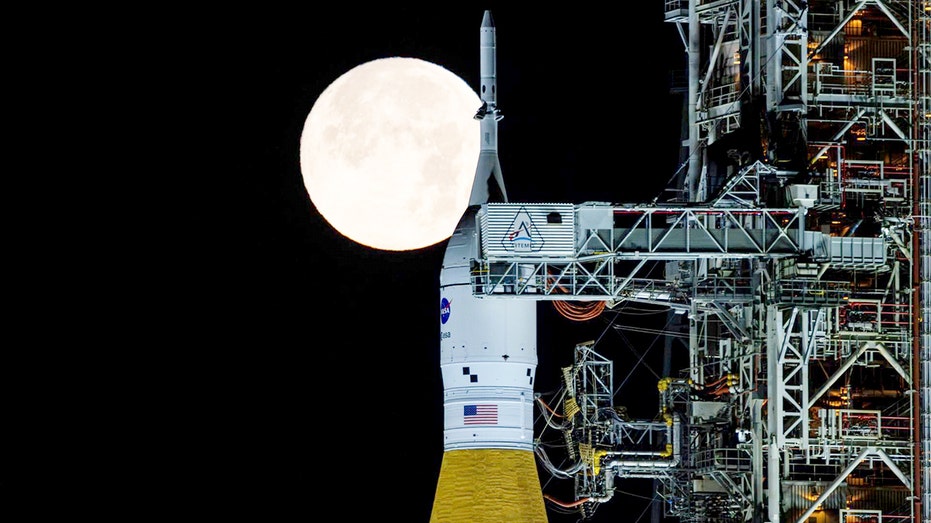
More than half a century after NASA’s final Apollo mission, astronauts on Wednesday are preparing to return to the moon — but this time, they will not land.
Instead, four crew members aboard Artemis II will fly past the moon on a 10-day mission, traveling farther into space than any humans since the Apollo era.
The mission is designed as a crewed lunar flyby, a critical test of NASA’s deep-space systems before attempting future landings, according to NASA.
Launched aboard the Space Launch System rocket, the Orion spacecraft will first enter Earth’s orbit before following a precise path known as a “free-return” trajectory.
NASA BEGINS INFRASTRUCTURE OVERHAUL UNDER ISAACMAN AS TRUMP PUSHES AMBITIOUS SPACE EXPLORATION GOALS
Scientists said the route uses the combined gravitational forces of Earth and the moon to carry the spacecraft around the far side of the moon and safely back home without requiring major course corrections.
Artemis II will mark the first time astronauts fly aboard both the Orion spacecraft and the SLS rocket, making it a key demonstration of NASA’s human deep-space capabilities.
The mission will test how well the spacecraft and its systems work with astronauts on board, including navigation, life support and communication far from Earth.
NASA RACES TO BUILD MOON BASE AS US CHALLENGES CHINA IN NEW SPACE RACE
It also will give NASA a better understanding of how crews operate during deep space travel, officials said.
Astronauts will take part in experiments during the flight, including one called A Virtual Astronaut Tissue Analog Response (AVATAR), which uses “organ-on-a-chip” technology to study how radiation and weightlessness affect the body.
NASA claims Artemis II is a necessary step before attempting a moon landing on a future mission.
By proving the spacecraft and crew can safely travel to deep space and back, the mission moves the agency closer to returning humans to the lunar surface — and eventually sending astronauts to Mars.


