






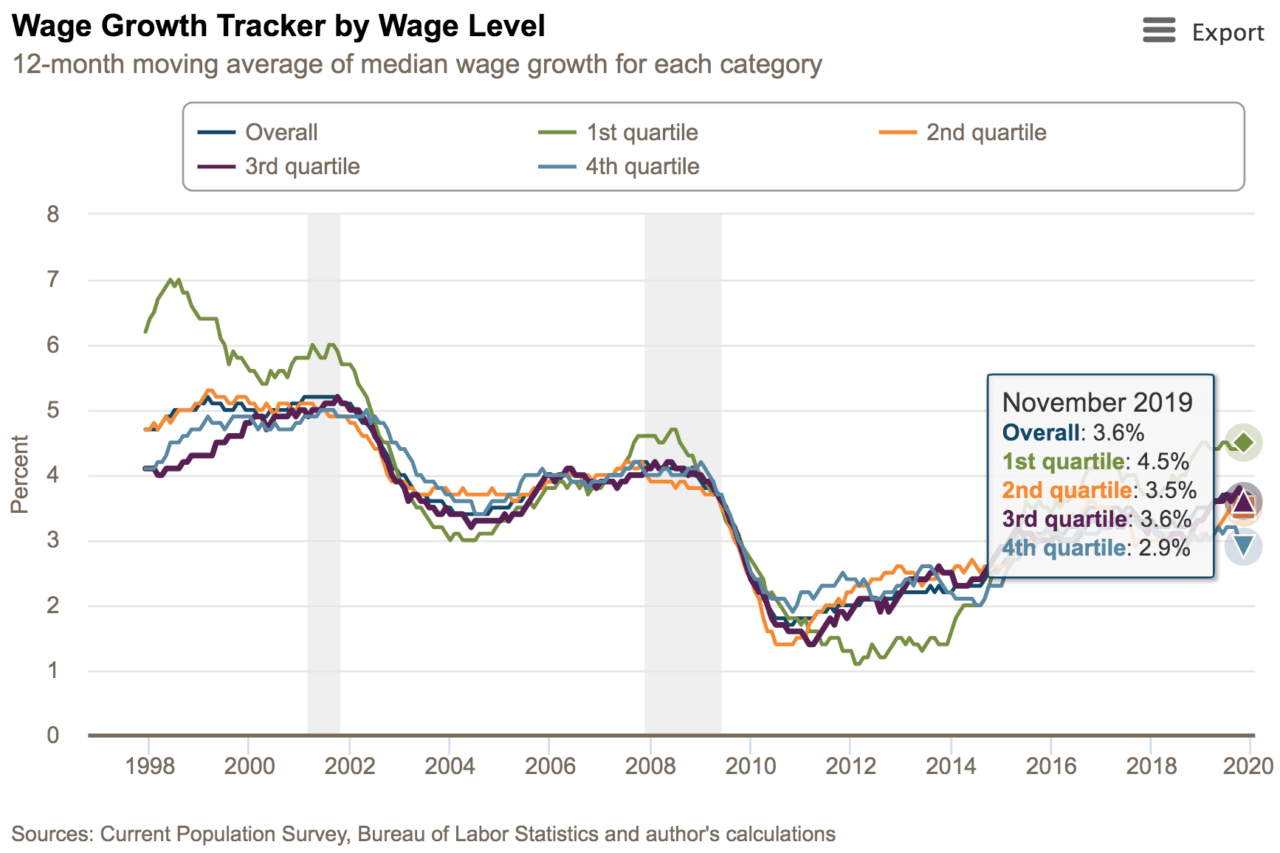
The bottom 25 percent of American wage earners secured the largest wage hikes year-to-year compared to all others for November, newly released data reveals, thanks to President Trump’s tightening of the United States labor market.
Data from the Federal Reserve Bank of Atlanta shows that for the lowest wage earners, Trump’s “Buy American, Hire American” economy has delivered the quickest rate of wage hikes in more than a decade.
In November, the bottom 25 percent of wage earners saw their wages rise 4.5 percent compared to November 2018. These bottom-tier workers, those earning less than all other Americans, have secured a labor market that now resembles the labor market of top-tier workers — a result of less low-skilled foreign competition against Americans through increased interior immigration enforcement.
Watch: Outrageous Pro-El-Sayed Ad Blames Jewish State for Raising Price of Bananas, Eggs in Michigan
Haitian illegal immigrant charged in Walmart killing entered US via Biden parole program: DHS
Flavio Bolsonaro to be issued visa by State Department after fleeing Brazil
Right-Wing Presidential Candidate Flavio Bolsonaro Secretly Flees Brazil for US After Disputed Election: Report
Luxury real estate brothers sentenced to 30 years in prison for yearslong sex-trafficking scheme
Judge who apologized to accused would-be Trump assassin lights up DOJ in Hunter Biden FBI case
Jordanian Military Goes After Targets in Syria in Response to Terrorists Killing Christians
‘Beloved’ daredevils who scaled Empire State Building inching toward deal after proposal stunt: attorney
Judge slams federal prosecutors over new charges against ex-FBI officials
DHS Shuts Down Major Chinese Birth Tourism Loophole in US Pacific Territory
175 Democrats demand Trump admin stop Ilhan Omar investigation, warn it could hurt her re-election bid
Shouting match erupts at UN as Cuban foreign minister moves toward US ambassador’s podium: ‘Back up!’
Trump administration ‘monitoring’ leftist organizers ignoring new terrorism sanctions: State Department official
90 Percent of Largest United Methodist Church Congregation Votes to Leave Denomination – But It Won’t Be Easy
Hundreds of staged armed robberies helped thousands pose as crime victims in US immigration scam: DOJ
“A strong labor market makes the bargaining power of lower-paid workers more like the labor market higher-wage workers experience during good times and bad,” Indeed.com economist Nick Bunker told the Wall Street Journal.
Watch: Outrageous Pro-El-Sayed Ad Blames Jewish State for Raising Price of Bananas, Eggs in Michigan
Haitian illegal immigrant charged in Walmart killing entered US via Biden parole program: DHS
Flavio Bolsonaro to be issued visa by State Department after fleeing Brazil
Right-Wing Presidential Candidate Flavio Bolsonaro Secretly Flees Brazil for US After Disputed Election: Report
Luxury real estate brothers sentenced to 30 years in prison for yearslong sex-trafficking scheme
Judge who apologized to accused would-be Trump assassin lights up DOJ in Hunter Biden FBI case
Jordanian Military Goes After Targets in Syria in Response to Terrorists Killing Christians
‘Beloved’ daredevils who scaled Empire State Building inching toward deal after proposal stunt: attorney
Judge slams federal prosecutors over new charges against ex-FBI officials
DHS Shuts Down Major Chinese Birth Tourism Loophole in US Pacific Territory
175 Democrats demand Trump admin stop Ilhan Omar investigation, warn it could hurt her re-election bid
Shouting match erupts at UN as Cuban foreign minister moves toward US ambassador’s podium: ‘Back up!’
Trump administration ‘monitoring’ leftist organizers ignoring new terrorism sanctions: State Department official
90 Percent of Largest United Methodist Church Congregation Votes to Leave Denomination – But It Won’t Be Easy
Hundreds of staged armed robberies helped thousands pose as crime victims in US immigration scam: DOJ
Overall wage growth year-to-year stands at about 3.6 percent. When broken down by industry, Americans in construction, mining, finance, hospitality, and manufacturing are all enjoying some of the highest wage growth in the country.
Americans in finance, for instance, secured 4.1 percent wage growth year-to-year, while those in the construction and mining industry — where Americans are most likely to compete against lower-wage illegal aliens — have secured four percent wage growth. Manufacturing workers, as well, have gotten a four percent wage hike year-to-year.
For the first year in decades, the U.S. economy has tipped toward American workers rather than employers in terms of the labor market. Today, due to less foreign competition, workers have more chances to seek out the highest-paying job. For decades, it was employers who would bid on workers.
President of the Mooyah Burgers restaurant chain, Tony Darden, told the Wall Street Journal that the tightening of the labor market has forced wages up for his employees:
“The effective labor pool is smaller than what it has been in the past,” said Tony Darden, Mooyah’s president. “As you look to bring on folks, ultimately higher wages are used to attract them.” [Emphasis added]
Experts, though, have warned that huge surges in illegal immigration — and increased legal immigration levels — can quickly diminish wage gains for America’s working and middle class.
Watch: Outrageous Pro-El-Sayed Ad Blames Jewish State for Raising Price of Bananas, Eggs in Michigan
Haitian illegal immigrant charged in Walmart killing entered US via Biden parole program: DHS
Flavio Bolsonaro to be issued visa by State Department after fleeing Brazil
Right-Wing Presidential Candidate Flavio Bolsonaro Secretly Flees Brazil for US After Disputed Election: Report
Luxury real estate brothers sentenced to 30 years in prison for yearslong sex-trafficking scheme
Judge who apologized to accused would-be Trump assassin lights up DOJ in Hunter Biden FBI case
Jordanian Military Goes After Targets in Syria in Response to Terrorists Killing Christians
‘Beloved’ daredevils who scaled Empire State Building inching toward deal after proposal stunt: attorney
Judge slams federal prosecutors over new charges against ex-FBI officials
DHS Shuts Down Major Chinese Birth Tourism Loophole in US Pacific Territory
175 Democrats demand Trump admin stop Ilhan Omar investigation, warn it could hurt her re-election bid
Shouting match erupts at UN as Cuban foreign minister moves toward US ambassador’s podium: ‘Back up!’
Trump administration ‘monitoring’ leftist organizers ignoring new terrorism sanctions: State Department official
90 Percent of Largest United Methodist Church Congregation Votes to Leave Denomination – But It Won’t Be Easy
Hundreds of staged armed robberies helped thousands pose as crime victims in US immigration scam: DOJ
Despite calls for more foreign workers from corporate interests and the big business lobby, there remain about 11.5 million Americans who are either unemployed, underemployed, or out of the labor market – all of whom want good-paying full-time jobs.
Story cited here.


