




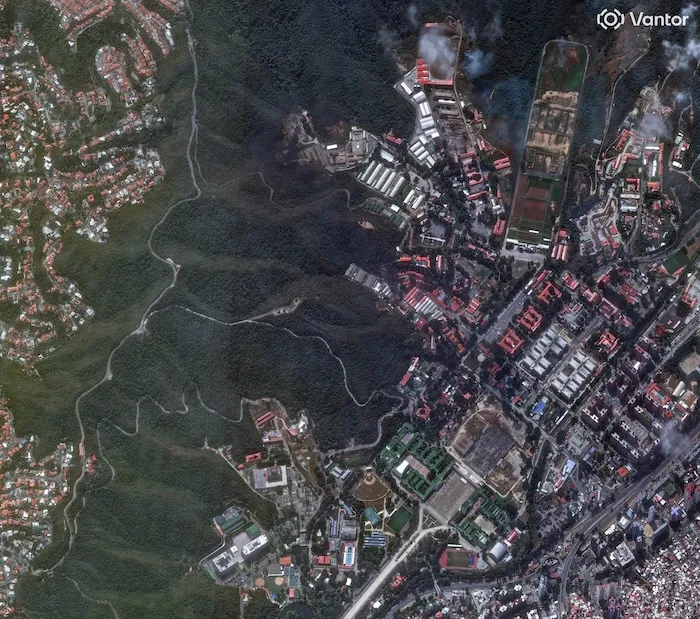
The Trump administration has been adamant that the mission to capture former Venezuelan dictator Nicolas Maduro was a “law enforcement” operation, and not an act of war, even though it involved nearly 200 U.S. service members and more than 150 aircraft.
At multiple moments during a press conference last Saturday, the president, Secretary of State Marco Rubio, and Secretary of War Pete Hegseth emphasized that the decision to deploy members of Delta Force, the Army’s most elite unit, to Caracas was a law enforcement operation with military support.
“It’s largely a law enforcement function,” Rubio said. “Remember, at the end of day, at its core, this was an arrest of two indicted fugitives of American justice, and the Department of War supported the Department of Justice in that job.”
On Monday, Attorney General Pam Bondi described it as “a law enforcement function to arrest indicted individuals.”
Why the ‘law enforcement’ justification matters
The characterization of the operation as one of law enforcement revolves around Maduro’s 2020 indictment on drug trafficking and related charges in the Southern District of New York. But legal scholars say that invoking the criminal process does not resolve the more fundamental question of whether the United States can unilaterally enforce its laws within another sovereign nation.
Cornell Law professor Maggie Gardner, writing for the Transnational Litigation Blog, warned that “labeling the capture of Maduro as a law enforcement operation does not add any legal legitimacy to what the United States did in Venezuela,” even if the underlying indictment itself is valid under U.S. law.
Gardner argued the administration’s framing risks conflating two distinct concepts under international law: the reach of U.S. law and the reach of U.S. law enforcement. While U.S. criminal statutes can apply extraterritorially in a range of circumstances, she notes that “a country’s unilateral power to enforce those laws is strictly territorial,” without the consent of the foreign head of state.
The Trump administration’s argument is in line with the 1989 Department of Justice opinion that the FBI can arrest individuals for violating U.S. law abroad, even if the law enforcement’s actions “contravene customary international law.” The DOJ opinion related to the capture of then-Panamanian military dictator Manuel Noriega, whom the U.S. arrested in a similar rendition in early 1990.
That unresolved distinction has broader implications beyond Venezuela. If the executive branch can characterize a cross-border military raid as “law enforcement” whenever a foreign leader is under U.S. indictment, critics say it raises the question of how expansively that rationale could be applied — particularly in countries the U.S. has also accused of facilitating drug trafficking, migration flows, or threats to U.S. national security.
Sean Timmons, the managing partner at Tully Rinckey PLLC, which focuses on military law, told the Washington Examiner that he “wouldn’t doubt” the possibility that there are grand juries currently looking at possible indictments of other foreign leaders so the administration could follow the same playbook it did with Maduro.
Trump has threatened to carry out similar operations in Colombia, Cuba, and Mexico, though they are not completely analogous situations, given none of those leaders has been indicted by the U.S., and in the case of Mexico, the government is not involved in the actions of the drug cartels that the U.S. is looking to thwart.
“Could they go after the president of Colombia, and Cuba, and Mexico without an indictment? Absolutely,” Timmons said. “Are they complicit in drug trafficking? Probably. Would it be the wisest thing to do? Probably not, because it would cause massive instability, but I think they’re setting up the framework for that to happen, and I think that’s up next, especially because truthfully, finding a conspiracy to commit a crime is pretty easy, low threshold.”
Bipartisan concerns raised by Senate leadership
Additionally, some divisions among Republicans are appearing to bubble up in Congress. The Trump administration did not inform senior relevant members of Congress ahead of the operation to arrest Maduro and his wife, Cilia Flores, part of a broader stance of the administration that its actions in the region do not meet the threshold that would require a congressional declaration of war.
The administration has frustrated members of Congress with its lack of candor over the course of the pressure campaign that targeted Maduro, which began over the summer. The administration’s insistence that the operation to capture him was a law enforcement action also allows it to avoid the difficult questions about Congress’s sole right to declare war, a power that the legislature has slowly but steadily ceded in recent decades.
“By characterizing it as a law enforcement operation, I think they’re trying to downplay the implication of congressional war powers. And now, candidly, I don’t think it’s a plausible characterization,” professor Geoffrey Corn, the director of the Center for Military Law and Policy at Texas Tech University’s law school, said. “There was a law enforcement objective, but just because there’s a law enforcement objective doesn’t make it a law enforcement operation. You can conduct a military operation with a law enforcement objective.”
The constitution states that the power to declare war rests with Congress, but the administration has insisted that the military buildup and pressure campaign, culminating with the capture of Maduro, is not a declaration of war.
Sens. Chuck Grassley (R-IA) and Dick Durbin (D-IL), the chairman and ranking member of the Senate Judiciary Committee, respectively, were not included in the closed-door briefing on Monday that senior administration officials held with the leaders of the Senate and House Armed Services and Intelligence committees, the Senate Foreign Relations Committee, and the House Foreign Affairs Committee.
In a joint statement, Grassley and Durbin said there is “no legitimate basis for excluding the Senate Judiciary Committee from this briefing,” and the “administration’s refusal to acknowledge our Committee’s indisputable jurisdiction in this matter is unacceptable.”
“President Trump and Secretary Rubio have stated that this was a law enforcement operation that was made at the Department of Justice’s request, with assistance from the Federal Bureau of Investigation and the Drug Enforcement Administration,” they added. “The Senate Judiciary Committee has jurisdiction over DOJ, FBI and DEA, and all three agencies are led by individuals who our Committee vetted and processed.”
Following the tersely written letter, Bondi on Tuesday allowed Grassley and Durbin to access a secure facility to hold a classified call with her about Maduro’s arrest. The senators were the only members of the Judiciary Committee to be part of the call, a source said.
Meanwhile, House Judiciary Committee Republicans have not stressed the same degree of needed disclosure as their Senate counterparts. Chairman Jim Jordan (R-OH) said Sunday he had immense confidence in the Trump administration’s handling of the operation, telling CNN that “getting a bad guy brought to justice who’s had a five-year arrest warrant … is certainly consistent” with Trump’s promises to improve the nation.
Democrats seek vote on war powers resolution
While House Republicans have largely rallied behind the administration, Senate Democrats are preparing to force a procedural showdown over Congress’s role in authorizing military action abroad.
Democrats are expected to force the issue as early as Thursday, when Senate Minority Leader Chuck Schumer (D-NY) has said the chamber will move toward a vote on a war powers resolution aimed at curbing further U.S. military action tied to Venezuela.
Despite the expectation that the vote will fail, it will serve as a test to reveal where lawmakers stand on the administration’s unilateral military action that involved the unprecedented capture of Venezuela’s former dictator.
A similar vote failed in November, 49-51, with two Republicans joining the Democrats in support of a war powers resolution that would have directed the president to stop the use of U.S. forces for hostilities against Venezuela without congressional authorization.


