Who were the key figures in the Bush administration on 9/11, and where are they now
The worst terrorist attack in U.S. history represented one of its greatest leadership challenges, and the decisions made on that day still reverberate 25 years later. President George W. Bush was elected in the contentious 2000 election largely on a domestic-focused platform. The Sept. 11 terrorist attacks were an unexpected test for his new administration, […]
The worst terrorist attack in U.S. history represented one of its greatest leadership challenges, and the decisions made on that day still reverberate 25 years later.
President George W. Bush was elected in the contentious 2000 election largely on a domestic-focused platform. The Sept. 11 terrorist attacks were an unexpected test for his new administration, only nine months old at the time. Several of the key figures in the administration remain well-known, for better or worse, while others have faded into relative obscurity.
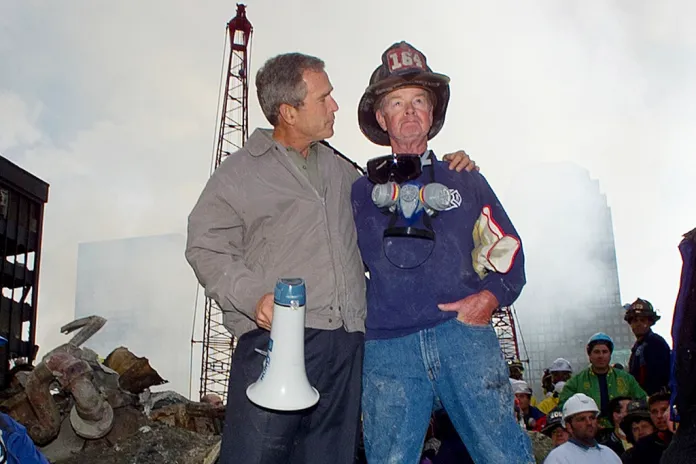
President George W. Bush
” data-large-file=”https://conservativemodern.com/wp-content/uploads/2026/09/who-were-the-key-figures-in-the-bush-administration-on-9-11-and-where-are-they-now.webp” src=”https://conservativemodern.com/wp-content/uploads/2026/09/who-were-the-key-figures-in-the-bush-administration-on-9-11-and-where-are-they-now.webp” alt=”As rescue efforts continue in the rubble of the World Trade Center in New York, President George W. Bush, left, stands with New York City firefighter Bob Beckwith on a burnt fire truck in front of the World Trade Center during a tour of the devastation, Sept. 13, 2001.” class=”wp-image-4710406″ srcset=”https://conservativemodern.com/wp-content/uploads/2026/09/who-were-the-key-figures-in-the-bush-administration-on-9-11-and-where-are-they-now-9.webp 1024w, https://conservativemodern.com/wp-content/uploads/2026/09/who-were-the-key-figures-in-the-bush-administration-on-9-11-and-where-are-they-now-9.webp?resize=300,200 300w, https://conservativemodern.com/wp-content/uploads/2026/09/who-were-the-key-figures-in-the-bush-administration-on-9-11-and-where-are-they-now-9.webp?resize=768,512 768w, https://conservativemodern.com/wp-content/uploads/2026/09/who-were-the-key-figures-in-the-bush-administration-on-9-11-and-where-are-they-now-9.webp?resize=150,100 150w, https://conservativemodern.com/wp-content/uploads/2026/09/who-were-the-key-figures-in-the-bush-administration-on-9-11-and-where-are-they-now-9.webp?resize=696,464 696w” sizes=”auto, (max-width: 1024px) 100vw, 1024px”>As rescue efforts continue in the rubble of the World Trade Center in New York, President George W. Bush, left, stands with New York City firefighter Bob Beckwith on a burnt fire truck in front of the World Trade Center during a tour of the devastation, Sept. 13, 2001. (AP Photo)
Unlike his father, President George H.W. Bush, who had served as President Ronald Reagan’s CIA director and took a special interest in foreign policy as president, the younger Bush campaigned on domestic issues and saw himself as the figurehead of “compassionate conservatism.”
However, the Sept. 11 terrorist attacks threw his plans for his presidency into disarray. Bush’s approval rating skyrocketed to 90% in late September 2001, as the country rallied around its leader as he visited the site of Ground Zero in New York City and announced the beginning of the Global War on Terror.
American troops entered Afghanistan to hunt down al Qaida terrorist cells in the country by October of that year, and Bush further escalated the GWOT by accusing Saddam Hussein’s Iraq of possessing weapons of mass destruction.
Though the Iraq War proved to be one of the most controversial parts of Bush’s presidency, the U.S. invasion boosted his approval rating from 57% to 71% in March 2003.
The subsequent years of an escalating insurgency, increased U.S. troop deployments and casualties, and the Great Recession led his approval rating to crumble to only 28% in November 2008.
After President Barack Obama took office, Bush recused himself from the political stage like many of his predecessors. While Bush publicly disagreed with Obama’s decision to withdraw troops from Iraq in 2011, calling it a “strategic blunder,” Bush also told late-night host Jay Leno, “I don’t think it’s good for the country to have a former president criticize his successor.”
The former president campaigned for his brother Jeb Bush as he battled for the Republican presidential nomination in 2016, and later refused to endorse President Donald Trump’s campaign.
Bush again did not endorse any presidential candidates in 2020, but held a virtual fundraiser for Sens. Susan Collins (R-ME) and Thom Tillis (R-NC). The former president condemned the Jan. 6, 2021, Capitol riot and the attempted assassination of Trump in 2024.
Bush also took up painting as a hobby after leaving the presidency, inspired by reading Winston Churchill’s essay “Painting as a Pastime.”
Vice President Dick Cheney
In this Wednesday, Sept. 12, 2001 file photo, from left, Secretary of State Colin Powell, President George W. Bush, Vice President Dick Cheney and Chairman of the Joint Chiefs of Staff Gen. Henry Shelton attend a meeting with the National Security Council in the Cabinet Room of the White House. While the Secret Service played “hide the president” with Bush on Sept. 11 — he was shuttled to military bases in Louisiana and Nebraska, for fear of terrorist attacks — his vice president hunkered down in a “secure, undisclosed location,” a bunker inside the White House where he helped direct the government’s actions. (AP Photo)
Arguably the most well-known figure in the Bush administration outside the president himself, Vice President Dick Cheney had decades of experience under his belt by the time of 9/11, but had not yet generated the controversy that dogged him post-Bush administration. He served in the House from 1979–1989, then as secretary of defense under George H.W. Bush. He was chosen as George W. Bush’s running mate in part to boost the president’s national defense credentials.
Cheney’s experience in foreign affairs and defense helped turn him into one of the most powerful vice presidents in history, as Bush delegated much of the handling of the Global War on Terror to him. He was a leading figure in advocating for and leading the Iraq War, something that would lead to his widespread unpopularity by the time he left office. The vice president ended his term polling at around 13%, and largely stayed out of the public eye after.
Cheney was one of the worst-hit Republicans by the Trump revolution, quickly fading into irrelevance after 2016. He backed his daughter, Liz Cheney, who was trying to position herself as a leading anti-Trump Republican, in an effort that met disaster when she lost to her Trump-backed challenger in 2022 by over 33 points.
Dick Cheney died on Nov. 3, 2025, at age 84, of complications from pneumonia and vascular disease.
Secretary of State Colin Powell
Peruvian President Alejandro Toledo, left, talks to Secretary of State Colin Powell in the Government Palace in Lima, on Tuesday, Sept. 11, 2001. Secretary of State Colin Powell on Tuesday cut short his first South American tour after terrorist aircraft attacks on the World Trade Center in New York and the Pentagon in Washington. (AP Photo/STR)
Powell was the subject of bipartisan respect at the time of 9/11, being the first black U.S. national security adviser under President Ronald Reagan, chairman of the Joint Chiefs of Staff under George H.W. Bush, and secretary of state under George W. Bush. He was the first Bush Cabinet official to accept their post, doing so before the president’s inauguration.
He was notably absent from the U.S. on 9/11, instead being in Lima, Peru, for a meeting of the foreign ministers of the Organization of American States. He played a key role in shoring up U.S. alliances to pursue the GWOT.
Powell’s most controversial moment came when he claimed Iraq possessed weapons of mass destruction in front of the United Nations Security Council in February 2003, an address he soon after admitted was filled with inaccuracies, and described it as a “blot” on his record.
He soon was on the outs with Bush and was pushed to resign shortly after his reelection in 2004.
As with several other Bush administration officials, Powell would distinguish himself as a major anti-Trump figure, even disavowing his Republican Party membership in 2021 after the Jan. 6 Capitol riot. He died on Oct. 18, 2021, at age 84 of complications related to COVID-19.
Secretary of Defense Donald Rumsfeld
President Bush examines the devastation at the Pentagon in Washington, Wednesday, Sept. 12, 2001. Accompanied by Secretary of Defense Donald Rumsfeld, left, Bush thanked rescue workers for their efforts as he stood in front of the damage created by the highjacked airliner that slammed into the building on Tuesday. (AP Photo/Pablo Martinez Monsivais)
Upon returning to the secretary of defense post under Bush after his service in the Ford administration, Rumsfeld held the unique distinction of being both the youngest and oldest man to serve in the position.
Rumsfeld was praised as a heroic figure during the Sept. 11 attacks, as he was at his office in the Pentagon when one of the hijacked planes hit. The secretary of defense ran to the crash site and personally helped evacuate the wounded.
His goodwill would run out in the years that followed, after he became the face of the administration’s defense of the Iraq War. He resigned in 2006 after sustained pressure from controversies surrounding the war, especially the Abu Ghraib prison torture scandal.
He died on June 29, 2021, at age 88 after battling a “long illness.”
National security adviser Condoleezza Rice
FILE – In this Tuesday, Sept. 11, 2001 file photo, Condoleezza Rice, National Security Adviser, waits for President Bush to arrive on the South Lawn of the White House in Washington. (AP Photo/Pablo Martinez Monsivais, File)
Rice, like Powell, set a number of civil rights-related records, including the first female national security adviser. Coming from an academic background specializing in Soviet and Russian affairs, she had previously served Bush’s father as a member of the National Security Council staff.
Rice would draw heavy scrutiny over the intelligence failures preceding 9/11, especially a now-famous Presidential Daily Briefing given just one month before the attacks in which she warned that Bin Laden was preparing to attack the United States.
She would draw even more controversy as a central advocate for the Iraq War. When asked in September 2002 about evidence for Iraq possessing Weapons of Mass Destruction, “we don’t want the smoking gun to be a mushroom cloud.”
Despite the backlash, she remained in Bush’s good graces for his entire administration, becoming the first black woman to be secretary of state after taking over the position from Powell in 2005.
Rice would return to her academic roots after Bush’s second term ended, and has served as director of the Hoover Institution at Stanford since 2020. She occupies a middle ground between the more public and reclusive Bush administration alumni, and remains well-regarded in many Republican circles.
White House chief of staff Andrew Card
President George W. Bush has his early morning school reading event interrupted by his chief of staff Andrew Card (L) shortly after news of the New York City airplane crashes was available in Sarasota, Florida. (Getty Images)
Card secured his spot as White House chief of staff through many years in Republican political operations, managing Bush’s father’s reelection campaign in 1992.
While his name isn’t well known today, he’s one of the most recognized U.S. figures in Bush’s administration on 9/11 due to his featuring in one of the day’s most infamous images and videos. While Bush was reading along in an elementary school classroom, Card walked up to him and whispered in his ear, “A second plane hit the second tower, America is under attack.”
He would go on to manage the president’s movements that day, then managed the administration’s messaging around making the case for the invasion of Iraq. He stayed in the role longer than most others, only resigning in March 2006 over Hurricane Katrina-related backlash.
Now 79, Card has retired from public life. He served in several academic and management roles in the decade after resigning.
FBI Director Robert Mueller
FBI Director Robert Mueller meets with reporters at FBI headquarters in Washington, Wednesday, Sept. 12, 2001, to discuss the investigation of Tuesday’s terrorist attacks at the Pentagon and in New York. (AP Photo/Joe Marquette)
Mueller was already a respected bipartisan figure by the time of 9/11, having been appointed to Senate-confirmed positions by Democrat and Republican presidents. He was unanimously confirmed as FBI director in a 98-0 vote on Aug. 2, 2001, and assumed the position on Sept. 4, just one week before 9/11.
He would go on to serve as FBI director until 2013 after President Barack Obama requested he serve for two more years than the usual 10-year term, a request that was unanimously approved by the Senate.
During his tenure, he won plaudits for resisting some of the more controversial elements of the Global War on Terror, such as banning FBI personnel from engaging in torture.
Mueller would win new fame as a leading anti-Trump Republican when he was tasked with investigating Trump’s ties with Russia and possible Russian interference in the 2016 election. He was one of the most vaunted figures among Trump’s liberal critics in his first term, but after failing to find any damning information implicating Trump, he quickly faded into irrelevance in the public conscience.
His family revealed in 2025 that he had been diagnosed with Parkinson’s disease in 2021. He died on March 20, 2026, at age 81.
CIA Director George Tenet
President Bush meets with his national security advisers in the Situation Room of the White House Thursday, Sept. 20, 2001. Clockwise, from left are, CIA Director George Tenet, Attorney General John Ashcroft, Treasury Secretary Paul O’Neill, Vice President Dick Cheney, President Bush, center, Secretary of State Colin Powell, Defense Secretary Donald H. Rumsfeld and chairman of the Joint Chief of Staff Gen. Henry Shelton. (Eric Draper/The White House via AP)
Tenet was unique among top cabinet officials for having been kept on from the previous Democratic administration, being appointed by President Bill Clinton in 1997. At the time of the 9/11 attacks, he was having breakfast at a Washington, D.C., hotel when an aide interrupted to inform him of the news. He reportedly identified Osama Bin Laden as the most likely culprit on the spot.
Unfortunately for Tenet, his long tenure as CIA head would be his undoing, as it included the period of major intelligence failures leading up to the attacks. He was further dogged by the faulty intelligence that led to the U.S. invasion of Iraq.
Tenet retired just ahead of the 9/11 Commission’s final report in 2004. He’s largely kept out of the public eye since publishing his memoirs in 2007.
Press secretary Ari Fleischer
President George W. Bush (R) speaks to his staff inside his private dining room at the White House in Washington, D.C., prior to his address to the nation on the day’s terrorist attacks in New York and Washington. From left, White House Counsel Al Gonzalez, National Security Advisor Condoleezza Rice, Presidential Counselor Karen Hughes, Press Secretary Ari Fleischer and Chief of Staff Andy Card. (Getty Images)
Fleischer progressed naturally from spokesman of the Bush-Cheney 2000 campaign into Bush’s first press secretary. He had his work cut out for him on Sept. 11, when he became the face of the government’s response to the terrorist attacks. He was accompanying Bush to the Florida elementary school when the planes hit.
Among the crises he had to manage on that day was explaining why Air Force One didn’t immediately return to Washington, D.C., and instead kept escorting Bush around the country. The White House’s shifting explanations were the subject of criticism at the time.
Fleischer became the public voice and face justifying the wars in Afghanistan and Iraq, with all the controversy that entailed. He resigned relatively early, leaving in July 2003.
Since leaving the position, he has had a lucrative career in communications and media, currently running Ari Fleischer Communications and Ari Fleischer Sports Communications. He’s arguably the most publicly visible of the Bush administration alumni, appearing frequently on Fox News as a contributor.
Attorney General John Ashcroft
Attorney General John Ashcroft, right, accompanied by FBI Director Robert Mueller, meets reporters at FBI headquarters in Washington Wednesday, Sept. 12, 2001 to discuss the investigation of Tuesday’s terrorist attacks at the Pentagon and in New York. (AP Photo/Joe Marquette)
Ashcroft had served two terms as Missouri governor and one as its senator, losing reelection in 2000. He was known as one of the most socially conservative members of Bush’s Cabinet.
The 9/11 attacks fully reinvented his tenure, switching his focus to combating terrorism. He was the chief architect behind the controversial Patriot Act, ensuring his spot as one of the most controversial attorneys general in U.S. history.
Ashcroft resigned in November 2004 after being the center of some internal disputes within the administration.
He’s gone on to enjoy a successful career in the private sector, chairing the Ashcroft Group and the Ashcroft Law Firm, a group filled with former U.S. attorneys. Now 84, he mostly refrains from the limelight.




</p>
<p> ” data-large-file=”https://conservativemodern.com/wp-content/uploads/2026/09/who-were-the-key-figures-in-the-bush-administration-on-9-11-and-where-are-they-now.jpg” src=”https://conservativemodern.com/wp-content/uploads/2026/09/who-were-the-key-figures-in-the-bush-administration-on-9-11-and-where-are-they-now.jpg” alt=”FILE – In this Wednesday, Sept. 12, 2001 file photo, from left, Secretary of State Colin Powell, President George W. Bush, Vice President Dick Cheney and Chairman of the Joint Chiefs of Staff Gen. Henry Shelton attend a meeting with the National Security Council in the Cabinet Room of the White House. While the Secret Service played “hide the president” with Bush on Sept. 11 — he was shuttled to military bases in Louisiana and Nebraska, for fear of terrorist attacks — his vice president hunkered down in a “secure, undisclosed location,” a bunker inside the White House where he helped direct the government’s actions. ” class=”wp-image-4710221″ srcset=”https://conservativemodern.com/wp-content/uploads/2026/09/who-were-the-key-figures-in-the-bush-administration-on-9-11-and-where-are-they-now-3.jpg 1024w, https://conservativemodern.com/wp-content/uploads/2026/09/who-were-the-key-figures-in-the-bush-administration-on-9-11-and-where-are-they-now-3.jpg?resize=300,200 300w, https://conservativemodern.com/wp-content/uploads/2026/09/who-were-the-key-figures-in-the-bush-administration-on-9-11-and-where-are-they-now-3.jpg?resize=768,512 768w, https://conservativemodern.com/wp-content/uploads/2026/09/who-were-the-key-figures-in-the-bush-administration-on-9-11-and-where-are-they-now-3.jpg?resize=150,100 150w, https://conservativemodern.com/wp-content/uploads/2026/09/who-were-the-key-figures-in-the-bush-administration-on-9-11-and-where-are-they-now-3.jpg?resize=696,464 696w” sizes=”auto, (max-width: 1024px) 100vw, 1024px”><figcaption class=) In this Wednesday, Sept. 12, 2001 file photo, from left, Secretary of State Colin Powell, President George W. Bush, Vice President Dick Cheney and Chairman of the Joint Chiefs of Staff Gen. Henry Shelton attend a meeting with the National Security Council in the Cabinet Room of the White House. While the Secret Service played “hide the president” with Bush on Sept. 11 — he was shuttled to military bases in Louisiana and Nebraska, for fear of terrorist attacks — his vice president hunkered down in a “secure, undisclosed location,” a bunker inside the White House where he helped direct the government’s actions. (AP Photo)
In this Wednesday, Sept. 12, 2001 file photo, from left, Secretary of State Colin Powell, President George W. Bush, Vice President Dick Cheney and Chairman of the Joint Chiefs of Staff Gen. Henry Shelton attend a meeting with the National Security Council in the Cabinet Room of the White House. While the Secret Service played “hide the president” with Bush on Sept. 11 — he was shuttled to military bases in Louisiana and Nebraska, for fear of terrorist attacks — his vice president hunkered down in a “secure, undisclosed location,” a bunker inside the White House where he helped direct the government’s actions. (AP Photo)</p>
<p> ” data-large-file=”https://conservativemodern.com/wp-content/uploads/2026/09/who-were-the-key-figures-in-the-bush-administration-on-9-11-and-where-are-they-now-1.webp?w=696″ src=”https://conservativemodern.com/wp-content/uploads/2026/09/who-were-the-key-figures-in-the-bush-administration-on-9-11-and-where-are-they-now-1.webp” alt=”.” class=”wp-image-4710224″ style=”width:403px;height:auto” srcset=”https://conservativemodern.com/wp-content/uploads/2026/09/who-were-the-key-figures-in-the-bush-administration-on-9-11-and-where-are-they-now-1.webp 1024w, https://conservativemodern.com/wp-content/uploads/2026/09/who-were-the-key-figures-in-the-bush-administration-on-9-11-and-where-are-they-now-1.webp?resize=150,149 150w, https://conservativemodern.com/wp-content/uploads/2026/09/who-were-the-key-figures-in-the-bush-administration-on-9-11-and-where-are-they-now-1.webp?resize=300,298 300w, https://conservativemodern.com/wp-content/uploads/2026/09/who-were-the-key-figures-in-the-bush-administration-on-9-11-and-where-are-they-now-1.webp?resize=768,764 768w, https://conservativemodern.com/wp-content/uploads/2026/09/who-were-the-key-figures-in-the-bush-administration-on-9-11-and-where-are-they-now-1.webp?resize=696,692 696w” sizes=”auto, (max-width: 1024px) 100vw, 1024px”><figcaption class=) Peruvian President Alejandro Toledo, left, talks to Secretary of State Colin Powell in the Government Palace in Lima, on Tuesday, Sept. 11, 2001. Secretary of State Colin Powell on Tuesday cut short his first South American tour after terrorist aircraft attacks on the World Trade Center in New York and the Pentagon in Washington. (AP Photo/STR)
Peruvian President Alejandro Toledo, left, talks to Secretary of State Colin Powell in the Government Palace in Lima, on Tuesday, Sept. 11, 2001. Secretary of State Colin Powell on Tuesday cut short his first South American tour after terrorist aircraft attacks on the World Trade Center in New York and the Pentagon in Washington. (AP Photo/STR)</p>
<p> ” data-large-file=”https://conservativemodern.com/wp-content/uploads/2026/09/who-were-the-key-figures-in-the-bush-administration-on-9-11-and-where-are-they-now-2.webp?w=696″ src=”https://conservativemodern.com/wp-content/uploads/2026/09/who-were-the-key-figures-in-the-bush-administration-on-9-11-and-where-are-they-now-2.webp” alt=”.” class=”wp-image-4710232″ srcset=”https://conservativemodern.com/wp-content/uploads/2026/09/who-were-the-key-figures-in-the-bush-administration-on-9-11-and-where-are-they-now-2.webp 1024w, https://conservativemodern.com/wp-content/uploads/2026/09/who-were-the-key-figures-in-the-bush-administration-on-9-11-and-where-are-they-now-2.webp?resize=300,201 300w, https://conservativemodern.com/wp-content/uploads/2026/09/who-were-the-key-figures-in-the-bush-administration-on-9-11-and-where-are-they-now-2.webp?resize=768,514 768w, https://conservativemodern.com/wp-content/uploads/2026/09/who-were-the-key-figures-in-the-bush-administration-on-9-11-and-where-are-they-now-2.webp?resize=150,100 150w, https://conservativemodern.com/wp-content/uploads/2026/09/who-were-the-key-figures-in-the-bush-administration-on-9-11-and-where-are-they-now-2.webp?resize=696,466 696w” sizes=”auto, (max-width: 1024px) 100vw, 1024px”><figcaption class=) President Bush examines the devastation at the Pentagon in Washington, Wednesday, Sept. 12, 2001. Accompanied by Secretary of Defense Donald Rumsfeld, left, Bush thanked rescue workers for their efforts as he stood in front of the damage created by the highjacked airliner that slammed into the building on Tuesday. (AP Photo/Pablo Martinez Monsivais)
President Bush examines the devastation at the Pentagon in Washington, Wednesday, Sept. 12, 2001. Accompanied by Secretary of Defense Donald Rumsfeld, left, Bush thanked rescue workers for their efforts as he stood in front of the damage created by the highjacked airliner that slammed into the building on Tuesday. (AP Photo/Pablo Martinez Monsivais)</p>
<p> ” data-large-file=”https://conservativemodern.com/wp-content/uploads/2026/09/who-were-the-key-figures-in-the-bush-administration-on-9-11-and-where-are-they-now-3.webp” src=”https://conservativemodern.com/wp-content/uploads/2026/09/who-were-the-key-figures-in-the-bush-administration-on-9-11-and-where-are-they-now-3.webp” alt=”FILE – In this Tuesday, Sept. 11, 2001 file photo, Condoleezza Rice, National Security Adviser, waits for President Bush to arrive on the South Lawn of the White House in Washington. ” class=”wp-image-4710274″ srcset=”https://conservativemodern.com/wp-content/uploads/2026/09/who-were-the-key-figures-in-the-bush-administration-on-9-11-and-where-are-they-now-13.webp 1024w, https://conservativemodern.com/wp-content/uploads/2026/09/who-were-the-key-figures-in-the-bush-administration-on-9-11-and-where-are-they-now-13.webp?resize=300,200 300w, https://conservativemodern.com/wp-content/uploads/2026/09/who-were-the-key-figures-in-the-bush-administration-on-9-11-and-where-are-they-now-13.webp?resize=768,512 768w, https://conservativemodern.com/wp-content/uploads/2026/09/who-were-the-key-figures-in-the-bush-administration-on-9-11-and-where-are-they-now-13.webp?resize=150,100 150w, https://conservativemodern.com/wp-content/uploads/2026/09/who-were-the-key-figures-in-the-bush-administration-on-9-11-and-where-are-they-now-13.webp?resize=696,464 696w” sizes=”auto, (max-width: 1024px) 100vw, 1024px”><figcaption class=) FILE – In this Tuesday, Sept. 11, 2001 file photo, Condoleezza Rice, National Security Adviser, waits for President Bush to arrive on the South Lawn of the White House in Washington. (AP Photo/Pablo Martinez Monsivais, File)
FILE – In this Tuesday, Sept. 11, 2001 file photo, Condoleezza Rice, National Security Adviser, waits for President Bush to arrive on the South Lawn of the White House in Washington. (AP Photo/Pablo Martinez Monsivais, File) President George W. Bush has his early morning school reading event interrupted by his chief of staff Andrew Card (L) shortly after news of the New York City airplane crashes was available in Sarasota, Florida. (Getty Images)
</p>
<p> ” data-large-file=”https://conservativemodern.com/wp-content/uploads/2026/09/who-were-the-key-figures-in-the-bush-administration-on-9-11-and-where-are-they-now-5.webp?w=696″ src=”https://conservativemodern.com/wp-content/uploads/2026/09/who-were-the-key-figures-in-the-bush-administration-on-9-11-and-where-are-they-now-5.webp” alt=”.” class=”wp-image-4710288″ style=”width:554px;height:auto” srcset=”https://conservativemodern.com/wp-content/uploads/2026/09/who-were-the-key-figures-in-the-bush-administration-on-9-11-and-where-are-they-now-5.webp 1024w, https://conservativemodern.com/wp-content/uploads/2026/09/who-were-the-key-figures-in-the-bush-administration-on-9-11-and-where-are-they-now-5.webp?resize=300,226 300w, https://conservativemodern.com/wp-content/uploads/2026/09/who-were-the-key-figures-in-the-bush-administration-on-9-11-and-where-are-they-now-5.webp?resize=768,580 768w, https://conservativemodern.com/wp-content/uploads/2026/09/who-were-the-key-figures-in-the-bush-administration-on-9-11-and-where-are-they-now-5.webp?resize=150,113 150w, https://conservativemodern.com/wp-content/uploads/2026/09/who-were-the-key-figures-in-the-bush-administration-on-9-11-and-where-are-they-now-5.webp?resize=696,525 696w” sizes=”auto, (max-width: 1024px) 100vw, 1024px”><figcaption class=) FBI Director Robert Mueller meets with reporters at FBI headquarters in Washington, Wednesday, Sept. 12, 2001, to discuss the investigation of Tuesday’s terrorist attacks at the Pentagon and in New York. (AP Photo/Joe Marquette)
FBI Director Robert Mueller meets with reporters at FBI headquarters in Washington, Wednesday, Sept. 12, 2001, to discuss the investigation of Tuesday’s terrorist attacks at the Pentagon and in New York. (AP Photo/Joe Marquette)</p>
<p> ” data-large-file=”https://conservativemodern.com/wp-content/uploads/2026/09/who-were-the-key-figures-in-the-bush-administration-on-9-11-and-where-are-they-now-6.webp?w=696″ src=”https://conservativemodern.com/wp-content/uploads/2026/09/who-were-the-key-figures-in-the-bush-administration-on-9-11-and-where-are-they-now-6.webp” alt=”.” class=”wp-image-4710323″ srcset=”https://conservativemodern.com/wp-content/uploads/2026/09/who-were-the-key-figures-in-the-bush-administration-on-9-11-and-where-are-they-now-6.webp 1024w, https://conservativemodern.com/wp-content/uploads/2026/09/who-were-the-key-figures-in-the-bush-administration-on-9-11-and-where-are-they-now-6.webp?resize=300,195 300w, https://conservativemodern.com/wp-content/uploads/2026/09/who-were-the-key-figures-in-the-bush-administration-on-9-11-and-where-are-they-now-6.webp?resize=768,500 768w, https://conservativemodern.com/wp-content/uploads/2026/09/who-were-the-key-figures-in-the-bush-administration-on-9-11-and-where-are-they-now-6.webp?resize=150,98 150w, https://conservativemodern.com/wp-content/uploads/2026/09/who-were-the-key-figures-in-the-bush-administration-on-9-11-and-where-are-they-now-6.webp?resize=696,453 696w” sizes=”auto, (max-width: 1024px) 100vw, 1024px”><figcaption class=) President Bush meets with his national security advisers in the Situation Room of the White House Thursday, Sept. 20, 2001. Clockwise, from left are, CIA Director George Tenet, Attorney General John Ashcroft, Treasury Secretary Paul O’Neill, Vice President Dick Cheney, President Bush, center, Secretary of State Colin Powell, Defense Secretary Donald H. Rumsfeld and chairman of the Joint Chief of Staff Gen. Henry Shelton. (Eric Draper/The White House via AP)
President Bush meets with his national security advisers in the Situation Room of the White House Thursday, Sept. 20, 2001. Clockwise, from left are, CIA Director George Tenet, Attorney General John Ashcroft, Treasury Secretary Paul O’Neill, Vice President Dick Cheney, President Bush, center, Secretary of State Colin Powell, Defense Secretary Donald H. Rumsfeld and chairman of the Joint Chief of Staff Gen. Henry Shelton. (Eric Draper/The White House via AP) speaks to his staff 11 September, 2001, inside his private dinning room at the White House in Washington, DC, prior to his address to the nation on the day’s terrorist attacks in New York and Washington. From left, White House Counsel Al Gonzalez, National Security Advisor Condoleezza Rice, Presidential Counselor Karen Hughes, Press Secretary Ari Fleischer and Chief of Staff Andy Card. AFP PHOTO/THE WHITE HOUSE/PAUL MORSE (Photo by THE WHITE HOUSE / AFP) (Photo by -/THE WHITE HOUSE/AFP via Getty Images)</p>
<p> ” data-large-file=”https://conservativemodern.com/wp-content/uploads/2026/09/who-were-the-key-figures-in-the-bush-administration-on-9-11-and-where-are-they-now-7.webp?w=696″ src=”https://conservativemodern.com/wp-content/uploads/2026/09/who-were-the-key-figures-in-the-bush-administration-on-9-11-and-where-are-they-now-7.webp” alt=”.” class=”wp-image-4710338″ srcset=”https://conservativemodern.com/wp-content/uploads/2026/09/who-were-the-key-figures-in-the-bush-administration-on-9-11-and-where-are-they-now-7.webp 1024w, https://conservativemodern.com/wp-content/uploads/2026/09/who-were-the-key-figures-in-the-bush-administration-on-9-11-and-where-are-they-now-7.webp?resize=300,200 300w, https://conservativemodern.com/wp-content/uploads/2026/09/who-were-the-key-figures-in-the-bush-administration-on-9-11-and-where-are-they-now-7.webp?resize=768,512 768w, https://conservativemodern.com/wp-content/uploads/2026/09/who-were-the-key-figures-in-the-bush-administration-on-9-11-and-where-are-they-now-7.webp?resize=150,100 150w, https://conservativemodern.com/wp-content/uploads/2026/09/who-were-the-key-figures-in-the-bush-administration-on-9-11-and-where-are-they-now-7.webp?resize=696,464 696w” sizes=”auto, (max-width: 1024px) 100vw, 1024px”><figcaption class=) President George W. Bush (R) speaks to his staff inside his private dining room at the White House in Washington, D.C., prior to his address to the nation on the day’s terrorist attacks in New York and Washington. From left, White House Counsel Al Gonzalez, National Security Advisor Condoleezza Rice, Presidential Counselor Karen Hughes, Press Secretary Ari Fleischer and Chief of Staff Andy Card. (Getty Images)
President George W. Bush (R) speaks to his staff inside his private dining room at the White House in Washington, D.C., prior to his address to the nation on the day’s terrorist attacks in New York and Washington. From left, White House Counsel Al Gonzalez, National Security Advisor Condoleezza Rice, Presidential Counselor Karen Hughes, Press Secretary Ari Fleischer and Chief of Staff Andy Card. (Getty Images)</p>
<p> ” data-large-file=”https://conservativemodern.com/wp-content/uploads/2026/09/who-were-the-key-figures-in-the-bush-administration-on-9-11-and-where-are-they-now-8.webp” src=”https://conservativemodern.com/wp-content/uploads/2026/09/who-were-the-key-figures-in-the-bush-administration-on-9-11-and-where-are-they-now-8.webp” alt=”Attorney General John Ashcroft, right, accompanied by FBI Director Robert Mueller, meets reporters at FBI headquarters in Washington Wednesday, Sept. 12, 2001 to discuss the investigation of Tuesday’s terrorist attacks at the Pentagon and in New York.” class=”wp-image-4710297″ style=”width:604px;height:auto” srcset=”https://conservativemodern.com/wp-content/uploads/2026/09/who-were-the-key-figures-in-the-bush-administration-on-9-11-and-where-are-they-now-21.webp 1024w, https://conservativemodern.com/wp-content/uploads/2026/09/who-were-the-key-figures-in-the-bush-administration-on-9-11-and-where-are-they-now-21.webp?resize=300,196 300w, https://conservativemodern.com/wp-content/uploads/2026/09/who-were-the-key-figures-in-the-bush-administration-on-9-11-and-where-are-they-now-21.webp?resize=768,501 768w, https://conservativemodern.com/wp-content/uploads/2026/09/who-were-the-key-figures-in-the-bush-administration-on-9-11-and-where-are-they-now-21.webp?resize=150,98 150w, https://conservativemodern.com/wp-content/uploads/2026/09/who-were-the-key-figures-in-the-bush-administration-on-9-11-and-where-are-they-now-21.webp?resize=696,454 696w” sizes=”auto, (max-width: 1024px) 100vw, 1024px”><figcaption class=) Attorney General John Ashcroft, right, accompanied by FBI Director Robert Mueller, meets reporters at FBI headquarters in Washington Wednesday, Sept. 12, 2001 to discuss the investigation of Tuesday’s terrorist attacks at the Pentagon and in New York. (AP Photo/Joe Marquette)
Attorney General John Ashcroft, right, accompanied by FBI Director Robert Mueller, meets reporters at FBI headquarters in Washington Wednesday, Sept. 12, 2001 to discuss the investigation of Tuesday’s terrorist attacks at the Pentagon and in New York. (AP Photo/Joe Marquette)


