





Welcome to Monday’s edition of Washington Secrets, where we say hello to hardworking members of the House of Representatives. They return from their summer vacation today just in time for the Labor Day holiday, the holiday established for people who don’t get enough vacation. Senators, of course, see the bigger picture and have no intention of returning to work any time soon. In the meantime, we look at the debate over introducing driverless cars to D.C. (insert your own Maryland driver joke here), and whether a Trumpapalooza is really the way for Republicans to drive out the vote in the midterms.
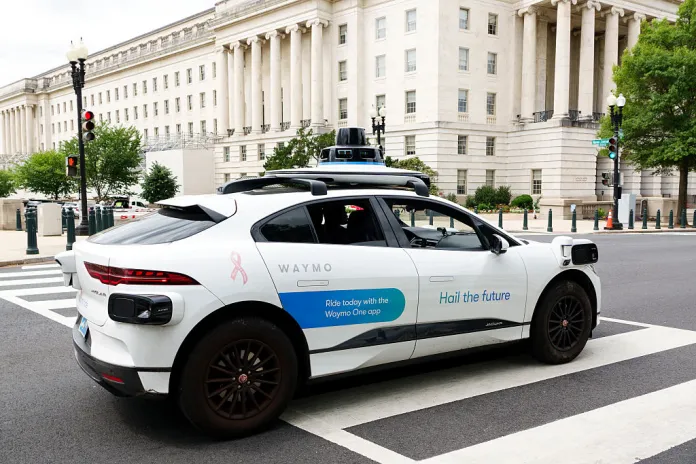
Waymo has Washington, D.C., on its list of targets for self-driving taxis.
Just two problems: Can they cope with motorcades? And how would lawmakers feel if every time the vehicles grind to a halt in front of the flashing lights of a presidential convoy, there is a chance that sensor data, maps, and camera feeds are being sent to staff in the Philippines?
“I’m not sure that people have thought through all the national security issues that go along with having remote operators looking at real-time footage of everything going on in D.C.,” said Dr. Missy Cummings, director of George Mason University’s Autonomy and Robotics Center.
The issue is up before the city council in the fall. It will consider a bill that would allow the deployment of driverless cars offering ride-hailing services, such as Waymo.
At present, self-driving vehicles are legal only if a person is behind the wheel for emergencies.
Waymo is already operating in 11 cities, and has another 21 on its target list. But experts point out that D.C. presents its own problems.
Cummings said uncertainty was the kryptonite of artificial intelligence.
“So as long as everything is going fine and normal, no bad weather, no weird event that’s causing a lot of pedestrians in the street, no motorcades, things will probably go okay,” she said.
D.C., with its VIP visitors, hordes of tourists, daily protests, constant road closures, security cordons, or fences and bollards in front of federal buildings provide exactly the sort of novelty that can cause a driverless car to freeze.
“I think we would see traffic jams in D.C. unlike anything we’ve ever seen,” she said. “Then there is the national security question.”
</p>
<p> ” data-large-file=”https://conservativemodern.com/wp-content/uploads/2026/08/what-happens-when-robotaxis-meet-motorcades-in-dc-the-mother-of-all-traffic-jams-says-ai-expert.webp” src=”https://conservativemodern.com/wp-content/uploads/2026/08/what-happens-when-robotaxis-meet-motorcades-in-dc-the-mother-of-all-traffic-jams-says-ai-expert.webp” alt=”WASHINGTON, DC – JUNE 8: A Waymo autonomous Jaguar I-PACE vehicle is driven on a road on June 8, 2026 in Washington, DC. Waymo is still in the testing phase and is not yet operating commercially in the region.” class=”wp-image-4706081″ srcset=”https://conservativemodern.com/wp-content/uploads/2026/08/what-happens-when-robotaxis-meet-motorcades-in-dc-the-mother-of-all-traffic-jams-says-ai-expert-1.webp 1024w, https://conservativemodern.com/wp-content/uploads/2026/08/what-happens-when-robotaxis-meet-motorcades-in-dc-the-mother-of-all-traffic-jams-says-ai-expert-1.webp?resize=300,200 300w, https://conservativemodern.com/wp-content/uploads/2026/08/what-happens-when-robotaxis-meet-motorcades-in-dc-the-mother-of-all-traffic-jams-says-ai-expert-1.webp?resize=768,512 768w, https://conservativemodern.com/wp-content/uploads/2026/08/what-happens-when-robotaxis-meet-motorcades-in-dc-the-mother-of-all-traffic-jams-says-ai-expert-1.webp?resize=150,100 150w, https://conservativemodern.com/wp-content/uploads/2026/08/what-happens-when-robotaxis-meet-motorcades-in-dc-the-mother-of-all-traffic-jams-says-ai-expert-1.webp?resize=696,464 696w” sizes=”(max-width: 1024px) 100vw, 1024px”><figcaption class=) WASHINGTON, DC – JUNE 8: A Waymo autonomous Jaguar I-PACE vehicle is driven on a road on June 8, 2026 in Washington, DC. (Photo by Kevin Carter/Getty Images)
WASHINGTON, DC – JUNE 8: A Waymo autonomous Jaguar I-PACE vehicle is driven on a road on June 8, 2026 in Washington, DC. (Photo by Kevin Carter/Getty Images)Waymo uses remote workers in the Philippines, as well as in Michigan and Arizona, to fix problems such as cars freezing up when confronted by new problems.
Waymo Chief Safety Officer Mauricio Pena likened it to a “phone a friend” system when he gave evidence before the Senate Commerce Committee in February.
Add in the fact that the latest Waymo robotaxis are manufactured in Ningbo, China, and the issue has caught the attention of Trump officials.
“This is a serious matter and given the constant threats against the president and officials of this administration, I cannot fathom a scenario where they’d welcome the presence of Chinese made robocars not only surveilling sensitive security areas and landmarks, but imagine stalling out the middle of rush-hour DC when a motorcade trying to get through,” said a source close to the administration.
READ MORE: WHAT THE DRIVERLESS CAR DEBATE CAN TEACH US ABOUT AI
In the meantime, Waymo is pushing ahead with its plans. Earlier this month, it showed journalists around a 32,000-square-foot depot in D.C., where its robotaxis will be serviced.
Waymo spokesman Ethan Teicher said the company had provided more than 20 million fully autonomous rides, serving the public in more than 11 major U.S. cities.
“However, the District has features that are distinct from other places we operate — from a density of motorcades to its street design based on the historic L’Enfant Plan,” Teicher said. “Waymo has been validating its technology on District streets for almost two years, driving more than 300,000 miles autonomously with a trained validation driver behind the wheel so we can responsibly deploy our service.”
Waymo also says its remote assistance is nothing to worry about. It offers guidance only when requested and does not remotely operate the vehicles, suggesting that foreign nationals using vehicles for sinister purposes is the stuff of sci-fi writers.
Teicher added: “Cybersecurity is core to Waymo’s design and our safety mission. The safety of our technology is protected by its design: it is independently in control of the vehicle and can refuse any guidance it deems unsafe.”
D.C. was once at the front of the line for autonomous vehicles, but regulatory delays mean they won’t be here until next year at the earliest. And that depends on a city council vote that has yet to be put on the calendar.
“D.C. is a unique market for autonomous vehicles and it has numerous potential pratfalls that can hinder not only public safety but in the most extreme cases, national security,” said the source close to the Trump administration. “Until these vehicles are able to adapt to all spontaneous, yet common scenarios, they really aren’t safe for this kind of environment.”
Will the midterm convention reach the right audience?
There are whispers among Republicans that their midterm convention next month could flop. Will the networks bother to cover it? And can it deliver the razzamatazz of 2024, when Hulk Hogan ripped off his shirt, and Donald Trump appeared for the first time since the Butler assassination attempt with a bandaged ear?
But here’s another problem. What if it is a success with the wrong type of voter?
The latest polling by Cygnal looks at who is most likely to turn out among voters. It found that Trump Republicans are already the most fired up and ready to vote. Some 47% were classed as “high turnout” voters, while 31% were in the “strong turnout” category. In other words, 78% of Trump voters are in the two most likely-to-vote groups.
In contrast, the figure for more traditional conservatives is 63%. And they feature more prominently in “mid-turnout” and “turnout risk” categories.
The danger is that a convention based around a “Trumpapalooza” will appeal to voters who are already likely to turn out, says Brent Buchanan, the firm’s founder.
“The real win for the convention is to build it for the Republicans who are not yet locked in, because they’re the larger bloc anyways,” he said.
Quote of the day
The midterms are drowning in dark money. At least $1 billion from anonymous donors is flowing into the elections, according to an analysis by the New York Times, through nonprofit groups that don’t have to disclose their funding sources. And that is very likely an underestimate.
This is how Nick Penniman, chief executive of Issue One, which campaigns to reduce the role of money in politics, put it:
“It’s almost like the people inside the Beltway live in a drug den, and this is just the newest drug that’s circulating.”
Lunchtime reading
Steve Hilton takes aim at Newsom and Becerra as he makes his case for a California comeback: Former adviser to British Prime Minister David Cameron talks to the Washington Examiner about his run to be the next governor of California.
‘We Want to Believe’ and ‘Faith in Space’ — Signs in the Sky: Government and media began to treat the subject of UFOs much more seriously in 2017, with leaked footage of an unexplained phenomenon. But the evidence doesn’t stack up.
You are reading Washington Secrets, a guide to power and politics in D.C. and beyond. It is written by Rob Crilly, who you can reach at [email protected] with your comments, story tips, and suggestions. If a friend sent you this and you’d like to sign up, CLICK HERE.


