





Gov. Mike Dunleavy (R-AK) has ordered an investigation into whether Alaska Democratic Senate candidate Mary Peltola’s campaign illegally recruited a spoiler candidate to siphon votes from Sen. Dan Sullivan (R-AK), escalating a controversy that could reshape one of the country’s most competitive Senate races days before Election Day.
The investigation follows a New York Times report alleging that operatives associated with Peltola’s campaign and the Democratic Senatorial Campaign Committee recruited challengers to dilute support for the incumbent Republican. The allegations have led President Donald Trump to call for Peltola and the other Dan Sullivan to be thrown off the ballot.
Peltola’s campaign and the DSCC have denied involvement with the second Sullivan’s campaign. The challenger has also denied coordinating with Democrats.
Dunleavy’s order opens a state investigation, while a separate Justice Department lawsuit presents a separate legal fight over the federal government’s authority to intervene in Alaska’s election. Neither proceeding has established that Peltola or her campaign committed a crime.
What is Alaska investigating?
Dunleavy announced Wednesday that he had directed Alaska’s Department of Public Safety to investigate whether the alleged recruitment effort violated state law and whether criminal charges or civil action are warranted.
“Today’s New York Times reporting reveals disturbing new evidence of an organized effort to manipulate Alaska’s elections by recruiting candidates—including one with the same name as an incumbent U.S. Senator—to deliberately confuse voters and misdirect their votes,” Dunleavy said in his statement announcing the investigation.
The governor said the report substantially supported concerns previously examined by the Alaska Division of Elections in June.
“Alaskans have a fundamental right to vote for the candidate they actually intend to support,” he added. “Deliberately tricking voters into casting their ballots for someone else strikes at the integrity of our elections.”
The New York Times based its reporting on interviews with 12 people, text messages, and documents prepared for a potential lawsuit. Former Peltola campaign manager Elisa Rios told the newspaper that Peltola knew about the project but did not participate directly.
The allegations remain unproven. The investigation ordered by Dunleavy is intended to determine whether the reported conduct violated state law.
In a previous statement to the Washington Examiner, a Peltola campaign spokesperson said, “The Alaskans for Mary campaign has no involvement with either Sullivan campaign. Like Mary, our campaign is focused on lowering costs and fixing the rigged system in DC.”
The Washington Examiner reached out to the Alaska Department of Public Safety for comment.
How the DOJ lawsuit could affect the election
The state investigation comes as the Justice Department pursues a separate lawsuit that could delay certification of Alaska’s Senate election results.
The DOJ filed suit on Oct. 22 after Trump directed the department to challenge the election’s certification if Sullivan loses. The department argued that Daniel J. Sullivan Jr.’s candidacy could confuse voters and that Alaska should not certify a result that may be affected by ballots cast for the wrong candidate.
The department’s complaint invokes the National Voter Registration Act, arguing that the state should be prevented from certifying an outcome affected by the alleged confusion until an investigation determines whether votes intended for the incumbent were instead cast for the challenger.
Peltola’s campaign and the DSCC have sought to intervene in the lawsuit so they can participate as defendants and pursue dismissal. The Alaska Division of Elections has also asked the judge to dismiss the case, arguing that the federal government lacks a valid legal basis for the requested intervention.
The DOJ initially opposed the campaign and the DSCC joining the case but withdrew its opposition on Wednesday evening. That decision did not resolve the merits of the lawsuit. U.S. District Judge Sharon Gleason has expedited the proceedings, and the parties are pressing for a decision before Election Day.
In a separate filing, Alaska argued that the federal lawsuit came too late, after voting had already begun and months after the state Supreme Court ordered the challenger included on the ballot. The state also argues that examining ballots to determine voters’ intended choices would conflict with the secrecy of the ballot.
The lawsuit faces substantial legal questions because states administer elections, while the federal government’s authority to regulate federal elections is limited to powers granted by the Constitution and federal law.
The DOJ’s invocation of the National Voter Registration Act is central to the dispute: Opponents argue that the statute governs voter registration practices and does not authorize the department to block certification because of alleged confusion over candidate names.
Who is the second Dan Sullivan?
Daniel J. Sullivan Jr. is a retired teacher from Petersburg, a small fishing community in southeastern Alaska. The state holds ranked choice primaries and general elections, rather than partisan primaries. The top four primary vote-getters, regardless of party, proceed to the general election.
The challenger initially sought to appear on the ballot as “Dan S. Sullivan” and affiliated himself with the Republican Party shortly before filing his candidacy.
The Division of Elections concluded that his filing was intended to confuse voters and undermine ballot fairness. The challenger sued, and the Alaska Supreme Court ultimately ruled that he would be allowed to run.
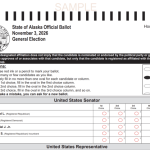
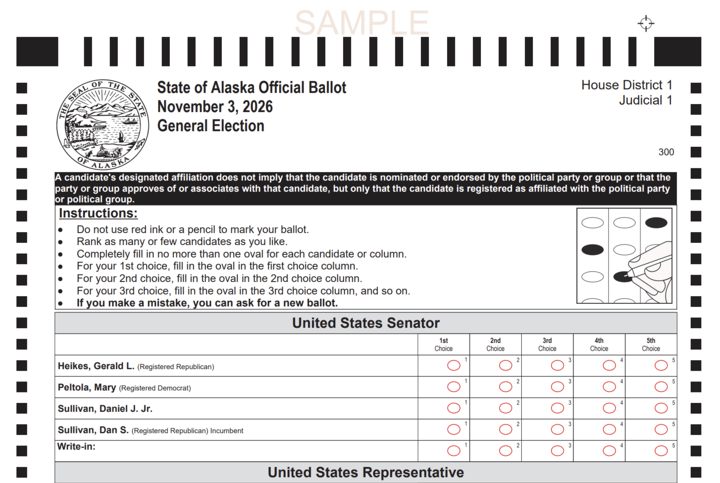
The state’s subsequent ballot design distinguishes the candidates. The incumbent appears as Dan S. Sullivan, is identified as a registered Republican, and carries an “incumbent” designation. The challenger appears as Daniel J. Sullivan Jr. without a party affiliation.
 100vw, 720px”><figcaption class=) Screenshot from Elections.Alaska.gov of Alaska’s Senate ballot.
The state’s earlier decision concerned whether he could qualify for the ballot, while the current DOJ lawsuit concerns whether the state may certify the election results if the outcome could have been affected by voter confusion.
ELECTION LAWSUITS TO WATCH ONE WEEK BEFORE THE MIDTERM ELECTIONS
What does this mean for the Senate race?
The investigation arrives at a politically sensitive moment, with Election Day approaching on Tuesday and early voting already underway. With a week to go, 58,168 Alaskans had cast early or absentee ballots.
The Senate contest is among the races that could determine control of the chamber. Polling averages show Peltola with a narrow advantage over Sullivan, while election forecasters have rated the race as a toss-up.


