







In the turbulent spring of 1793, the young United States confronted its first profound foreign policy crisis. Revolutionary France, having declared war on a coalition including Great Britain, looked to its 1778 treaty ally for support. The alliance had been crucial during America’s War of Independence, providing naval power under admirals such as de Grasse, troops at Yorktown, and loans that kept the Continental Army afloat. Thomas Jefferson, as secretary of state, passionately advocated honoring the treaty, viewing it as a debt of gratitude to a nation that shared republican ideals and had sacrificed much for American liberty. Treasury Secretary Alexander Hamilton argued forcefully against entanglement: The treaty bound America to the French monarchy, now guillotined amid the Reign of Terror. The radical republic that replaced it bore little resemblance to the partner of 1778, having descended into chaos, executions, and ideological extremism that threatened neighboring states.
After weeks of heated Cabinet debates, immortalized in part by the Broadway musical Hamilton, which wryly captures one resolution with the line, “It must be nice, it must be nice, To have Washington on your side,” President George Washington sided with Hamilton. On April 22, 1793, he issued the Proclamation of Neutrality, affirming that the U.S. would pursue “a conduct friendly and impartial toward the belligerent powers” and warning Americans against aiding either side. The decision shielded the fragile republic from a war it could ill afford, preserving sovereignty and allowing it to focus on internal growth. It also established a precedent for unilateral executive action in foreign affairs, sparking the Pacificus-Helvidius debates between Hamilton, writing as Pacificus, and James Madison, as Helvidius, which probed the boundaries of presidential power, the nature of treaty obligations, and the limits of congressional authority in foreign policy.
Washington’s choice prioritized American independence over European quarrels. Entanglement risked destruction by stronger powers or internal division along pro-French and pro-British lines. Neutrality allowed the nation to build strength, expand westward, and avoid the ideological contagions sweeping the continent. The young republic’s survival hinged on distancing itself from a Europe convulsed by revolution and war. Today, similar prudence animates concerns about NATO and broader trans-Atlantic ties in an era when Europe has undergone profound transformations through mass migration, supranational governance, demographic decline, and shifting cultural priorities.
The founding debate and its enduring lessons
The 1793 crisis laid bare fundamental tensions in American foreign policy: gratitude versus prudence, idealism versus realism, and perpetual obligation versus conditional alliance. Jefferson, who saw the French Revolution as an extension of America’s own struggle for liberty, urged active support of France to repay our revolutionary debts and to align with a kindred spirit fighting monarchy across Europe. Hamilton, wary of France’s descent into chaos and its aggressive wars, contended that treaties are contracts with specific regimes, not eternal bonds irrespective of change. The radical shifts in France — regicide, the Committee of Public Safety’s terror, and expansionist campaigns — dissolved the moral and practical basis for the alliance.

This historical episode offers timeless guidance. Treaties assume shared values, stable circumstances, and mutual benefit. When a partner transforms fundamentally, obligations may lapse without dishonor. Washington’s neutrality preserved the republic’s future, enabling economic expansion under the funding system Hamilton designed, territorial growth through the Louisiana Purchase and beyond, and eventual emergence as a great power capable of tipping global balances. Contemporary voices echo this caution with striking clarity.
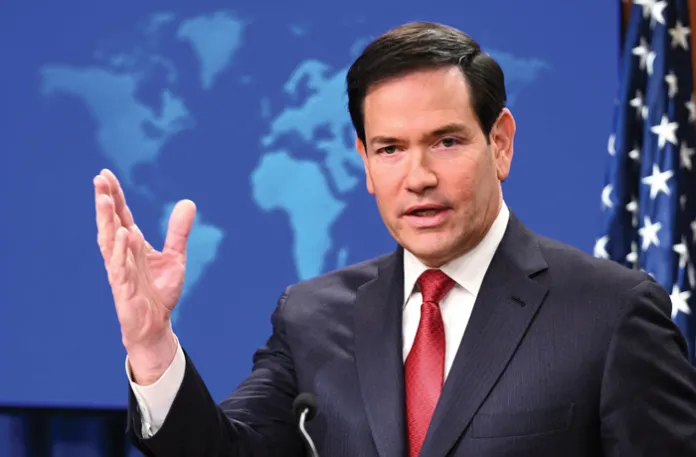
In his December 2025 press conference at the State Department, Secretary of State Marco Rubio articulated NATO’s foundational premise: Its enduring strength derives from “shared history, shared cultures, shared ideology, shared priorities, shared principles.” Yet he warned that unchecked mass migration threatens to erode those foundations, which could reduce the alliance to a mere “straight-up defense agreement” devoid of deeper commonality or civilizational purpose.
Rubio carefully distinguished controlled, merit-based immigration from “mass migration,” describing the latter as “a negative thing” because no society can successfully absorb “hundreds of thousands if not millions of people over a short period of time, especially if they come from halfway around the world” without severe strain. Cultural, linguistic, and value-based assimilation challenges arise, potentially altering national identities and eroding civilizational confidence. Eastern and Southern European leaders speak openly of these disruptions. Western counterparts often acknowledge them privately, even as public backlash from some European institutions and media figures ensued against Rubio’s candor.
The Trump administration‘s 2025 National Security Strategy amplifies these concerns in unprecedented detail, warning that mass migration, combined with persistently low birth rates, erosion of national identity, and increasing suppression of free speech, risks rendering significant parts of Europe “unrecognizable” within decades, with some NATO members possibly becoming majority non-European by mid-century. This “civilizational erasure,” according to the document, undermines the West’s shared heritage, rooted in Greco-Roman law, Judeo-Christian ethics, Enlightenment values, and individual liberty, that animated NATO‘s founding in 1949 as a bulwark against Soviet totalitarianism. The strategy further pledges to “cultivate resistance” within Europe to reverse these trends, expressing guarded optimism about the rise of patriotic parties that prioritize border security, cultural preservation, and national sovereignty over supranational mandates.
Deepening fractures over Ukraine
The war in Ukraine exposes these trans-Atlantic strains most acutely. Russia’s full-scale invasion in February 2022 prompted unified Western sanctions, massive military aid, and rhetorical solidarity, but by late 2025, strategic divergences had widened amid battlefield stalemates, economic fatigue, and diplomatic initiatives. The Trump administration prioritized rapid de-escalation to prevent further escalation and redirect resources, circulating multiple draft frameworks emphasizing practical resolutions: multilateral security guarantees for Ukraine; accelerated EU membership pathways possibly by 2027; demilitarized zones along contact lines; territorial adjustments addressing Russian security claims; caps on military deployments, adjusted in revisions to accommodate Ukrainian needs; and mechanisms for releasing frozen Russian assets toward reconstruction.
European and Ukrainian reactions ranged from cautious engagement to outright skepticism. Officials in Brussels, Berlin, and Paris viewed early proposals as overly concessive to Moscow, insufficiently safeguarding Ukrainian sovereignty and territorial integrity — particularly regarding Donbas, Crimea, and possible concessions beyond current lines of control. Diplomatic exchanges in Geneva; Berlin; Palm Beach, Florida; Riyadh, Saudia Arabia; and other venues produced partial alignments on ending bloodshed, postwar reconstruction, and long-term European stability, yet persistent doubts reflected proximity-driven anxieties: Europe’s front-line exposure to Russian power demands robust deterrence and ironclad commitments, while Washington’s perspective emphasizes halting further loss of life, avoiding nuclear risks, and redirecting global resources toward domestic renewal and Indo-Pacific priorities.
Ukrainian counterproposals demanded NATO-equivalent protections, no permanent territorial losses, full reparations, and direct European involvement in any settlement. As negotiations evolved through at least five iterative documents, the episode underscores how shared threats that once forged reflexive unity now require arduous reconciliation amid differing risk assessments, domestic political pressures, and war fatigue after nearly four years of grinding conflict. European leaders coordinated joint responses, insisting any deal respect Kyiv’s red lines, while the administration stressed pragmatic compromises to secure lasting peace.
Economic strains and regulatory overreach
Trade and technology further illuminate the growing rift. The heralded U.S.-U.K. Tech Prosperity Deal, announced with great fanfare during President Donald Trump‘s September 2025 state visit to London, with promises of billions in new investments, including $30 billion from Microsoft and $6.8 billion from Google, stalled dramatically by December. Washington paused implementation, citing London‘s insufficient progress on lowering nontariff barriers, eliminating persistent digital services taxes that disproportionately target American firms, easing stringent food safety and chlorination rules blocking U.S. agricultural exports, and resolving lingering irritants from the broader May 2025 Economic Prosperity Deal framework.

British officials downplayed the pause as temporary, insisting momentum would resume amid complex negotiations, but the impasse signals broader frustrations with Europe’s regulatory posture toward American innovation, market access, and economic sovereignty. The broader U.S.-U.K. framework, initially framed as historic for slashing remaining tariffs and boosting sectors including automobiles, steel, financial services, and critical minerals, faced repeated delays over alignment on regulatory standards and digital taxation.
Across the English Channel, the European Union‘s Dec. 5 imposition of a $140 million fine on X for alleged Digital Services Act violations, citing misleading blue checkmark design after paid verification changes, inadequate advertising transparency, and restricted data access for approved researchers, drew immediate and sharp rebukes from American officials. Vice President JD Vance, anticipating the penalty in a Dec. 4 post, criticized it as effectively punishing the platform for “not engaging in censorship,” urging the EU to champion free speech rather than penalize leading American companies. The action, critics argue, exemplifies Brussels’s increasingly assertive regulatory oversight, clashing with U.S. views on platform governance, freedom of expression, and innovation sovereignty. Administration officials framed the fine as part of a broader pattern of weaponized regulation aimed at curbing U.S. tech dominance.
Migration, identity, and the future of the West
At the heart of these tensions lies Europe’s protracted migration challenge. Over the past decade and a half, millions from the Middle East, North Africa, sub-Saharan Africa, and South Asia arrived amid successive crises in Syria, Libya, Afghanistan, and beyond. Well-intentioned policies emphasizing humanitarian intake and asylum rights often outpaced integration capacity. Parallel societies in certain urban areas and rising violent crime statistics linked to some migrant cohorts in countries such as Sweden and Germany led to the dramatic rise of populist and patriotic parties across the continent, from France to Italy to the Netherlands.
The 2025 National Security Strategy frames this transformation bluntly: Mass migration fundamentally alters demographics and generates social strife alongside cratering native birth rates and accelerating identity erosion. Long-term projections suggest demographic tipping points in major cities and even nations, altering cultural landscapes and potentially alliance dynamics. Rubio’s warnings amplify this concern: Disruptive inflows challenge assimilation efforts, risking dilution or displacement of the Western values — liberty, rule of law, separation of church and state, equality under law, and democratic self-governance — that NATO was originally built upon.
The administration has quietly directed diplomats to press allies on restricting inflows, enhancing deportation mechanisms, and ending policies perceived as favoring migrants over citizens. European responses remain mixed: Some leaders continue to defend open policies as moral imperatives aligned with postwar human rights frameworks, while others, particularly in Central and Eastern Europe, echo U.S. concerns privately while navigating EU constraints. Public opinion across the continent increasingly ranks immigration and cultural preservation among top issues, fueling electoral gains for parties the U.S. strategy views optimistically as possible correctives to supranational overreach and cultural drift.
These shifts extend beyond demographics to governance itself. The EU’s expanding regulatory framework, from the Digital Services Act to Green Deal mandates and migration pacts, increasingly asserts supranational authority in ways that American officials see as infringing national sovereignty, stifling innovation, and imposing costs without democratic accountability. Combined with persistent defense spending shortfalls in many NATO members despite repeated pledges, these trends raise fundamental questions about burden-sharing, mutual reliability, and the alliance’s long-term viability.
Toward America’s sestercentennial
In 2026, the year in which we’ll celebrate the U.S.’s 250th anniversary, the parallels to 1793 sharpen with remarkable clarity. A nascent republic then chose sovereignty over entanglement with a revolutionized Europe veering toward radicalism, terror, and self-destruction. Today, with the continent reshaped by uncontrolled migration, supranational integration, severe demographic decline, and policy drifts on speech, security, and identity, we’re once again compelled to confront whether commitments to the continent that we forged in an earlier era are still mutually beneficial or strategically sound.
WORLD LEADERS REACT TO US ATTACK IN VENEZUELA
Washington’s neutrality safeguarded our nation’s first quarter-millennium, enabling our ascent to superpower status and the preservation of liberty at home. Prudent recalibration now could secure our next 250 years. By insisting on genuine shared burdens — robust defense spending targeting 5% of GDP by 2035, cultural cohesion through secure borders and assimilation priorities, and resistance to civilizational erosion — the Trump administration seeks not rupture but revitalization of the trans-Atlantic bond. Resisting Europe’s current trajectories through supporting patriotic European movements aims to restore civilizational confidence and true alliance vitality.
How we navigate this pivotal question — should we honor an alliance that’s been transformed beyond recognition, or should we reaffirm our sovereignty as Washington once did? — will shape not merely our ties with Europe but the West’s resilience in an increasingly multipolar and dangerous world. The choices ahead may define the character of American foreign policy for generations to come, just as Washington’s fateful decision did in the republic’s earliest days.
Daniel Ross Goodman is a Washington Examiner contributing writer and the Allen and Joan Bildner Visiting Scholar at Rutgers University. Find him on X @DanRossGoodman.


