







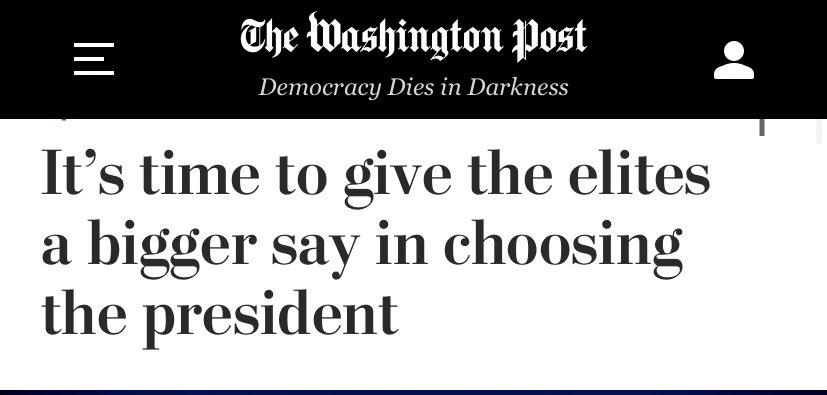
The Washington Post is taking criticism for an op-ed published Tuesday by Marquette University political science professor Julia Azari, titled: “It’s time to give the elites a bigger say in choosing the president.”
Citing the “rocky start” to the Democratic Party’s presidential primary, Azari suggests that the process of choosing the nominee be taken from the people and returned to the politicians:
The current process is clearly flawed, but what would be better? … A better primary system would empower elites to bargain and make decisions, instructed by voters.
One lesson from the 2020 and 2016 election cycles is that a lot of candidates, many of whom are highly qualified and attract substantial followings, will inevitably enter the race. The system as it works now — with a long informal primary, lots of attention to early contests and sequential primary season that unfolds over several months — is great at testing candidates to see whether they have the skills to run for president. What it’s not great at is choosing among the many candidates who clear that bar, or bringing their different ideological factions together, or reconciling competing priorities. A process in which intermediate representatives — elected delegates who understand the priorities of their constituents — can bargain without being bound to specific candidates might actually produce nominees that better reflect what voters want.
Repeat offender with lengthy rap sheet accused of gunning down Kentucky trooper during traffic stop
Eric Schmitt defends perjury trap airball at Jack Smith hearing: ‘Not a mistake’
Fox News Hires Former Top Andrew Cuomo Aide Who Helped Run Major Cover-Up
Woman on Death Row for Satanic Murder Says She Feels ‘a Kinship’ with Lindsay Clancy
Boeing lands $20B-plus Navy deal for sixth-generation fighter to deliver ‘absolute air superiority’
Watch: Broncos Stars Team Up to Give ‘All Glory to God’ on Live TV After Wild Comeback Win
‘F— her’: Jasmine Crockett torched by ex-Dem colleague over who she left off endorsement list
Suspect accused of killing Pittsburgh pediatrician sexually assaulted woman hours earlier: police
Watch: NFL Sparks Controversy Again as Mariachi Band Plays Nat’l Anthem on Monday Night Football
Bears QB Caleb Williams Accused of ‘Disrespecting the Flag’ During National Anthem
Unearthed audit exposes vulnerable Dem’s handling of COVID relief funds: ‘Gross oversight’
Woke, Anti-Trump Classic Rocker Todd Rundgren Nukes Taylor Swift: ‘Apotheosis of Mediocrity’
Trump Sets the Record Straight After ‘Hoax’ Report on What He Offered Iran
NYC judge orders Mamdani to redo second-home tax rollout
Law Enforcement Investigating New Nancy Guthrie Ransom Note
Azari suggests that the parties should use what she calls “preference primaries,” which would “allow voters to rank their choices among candidates, as well as to register opinions about their issue priorities.”
After a perfunctory voting process, wlites would be able to choose a nominee based on information about what the voters want.
She acknowledges that the idea is “labor-intensive and a little risky.”
The Post is owned by Jeff Bezos, the founder of Amazon, who is the world’s richest man. The paper’s slogan, adopted as an intended rebuke to President Donald Trump, is “Democracy dies in darkness.”
That phrase was trending on Twitter on Wednesday morning as readers reacted ironically to the op-ed.
The headline right below “democracy dies in darkness” is some A+ work
— Greg (@gwiss) February 19, 2020
>"Democracy dies in darkness"
>"Do people actually want more Democracy in their lives" pic.twitter.com/p7fPf5dFVX
— sal🌹🏴🏴☠️ (@ProjektVayo) February 19, 2020
Repeat offender with lengthy rap sheet accused of gunning down Kentucky trooper during traffic stop
Eric Schmitt defends perjury trap airball at Jack Smith hearing: ‘Not a mistake’
Fox News Hires Former Top Andrew Cuomo Aide Who Helped Run Major Cover-Up
Woman on Death Row for Satanic Murder Says She Feels ‘a Kinship’ with Lindsay Clancy
Boeing lands $20B-plus Navy deal for sixth-generation fighter to deliver ‘absolute air superiority’
Watch: Broncos Stars Team Up to Give ‘All Glory to God’ on Live TV After Wild Comeback Win
‘F— her’: Jasmine Crockett torched by ex-Dem colleague over who she left off endorsement list
Suspect accused of killing Pittsburgh pediatrician sexually assaulted woman hours earlier: police
Watch: NFL Sparks Controversy Again as Mariachi Band Plays Nat’l Anthem on Monday Night Football
Bears QB Caleb Williams Accused of ‘Disrespecting the Flag’ During National Anthem
Unearthed audit exposes vulnerable Dem’s handling of COVID relief funds: ‘Gross oversight’
Woke, Anti-Trump Classic Rocker Todd Rundgren Nukes Taylor Swift: ‘Apotheosis of Mediocrity’
Trump Sets the Record Straight After ‘Hoax’ Report on What He Offered Iran
NYC judge orders Mamdani to redo second-home tax rollout
Law Enforcement Investigating New Nancy Guthrie Ransom Note
File this under: “Democracy dies in Darkness” https://t.co/VbD9kvJgWl
— Oliver Hidalgo-Wohlleben (@OliverHidWoh) February 19, 2020
Azari’s article appears to anticipate the possibility of a “brokered convention” among Democrats this summer. Currently, no candidate is projected to win a majority of delegates before they gather in Milwaukee, Wisconsin — near Professor Azari’s university — at the Democratic National Convention.
Average projected delegates through Super Tuesday:
Sanders 608 (41% of delegates thru March 3)
Bloomberg 273 (18%)
Biden 270 (18%)
Buttigieg 157 (10%)
Warren 127 (8%)
Klobuchar 55 (4%)https://t.co/JDz2dZ8bqR— Nate Silver (@NateSilver538) February 18, 2020
Repeat offender with lengthy rap sheet accused of gunning down Kentucky trooper during traffic stop
Eric Schmitt defends perjury trap airball at Jack Smith hearing: ‘Not a mistake’
Fox News Hires Former Top Andrew Cuomo Aide Who Helped Run Major Cover-Up
Woman on Death Row for Satanic Murder Says She Feels ‘a Kinship’ with Lindsay Clancy
Boeing lands $20B-plus Navy deal for sixth-generation fighter to deliver ‘absolute air superiority’
Watch: Broncos Stars Team Up to Give ‘All Glory to God’ on Live TV After Wild Comeback Win
‘F— her’: Jasmine Crockett torched by ex-Dem colleague over who she left off endorsement list
Suspect accused of killing Pittsburgh pediatrician sexually assaulted woman hours earlier: police
Watch: NFL Sparks Controversy Again as Mariachi Band Plays Nat’l Anthem on Monday Night Football
Bears QB Caleb Williams Accused of ‘Disrespecting the Flag’ During National Anthem
Unearthed audit exposes vulnerable Dem’s handling of COVID relief funds: ‘Gross oversight’
Woke, Anti-Trump Classic Rocker Todd Rundgren Nukes Taylor Swift: ‘Apotheosis of Mediocrity’
Trump Sets the Record Straight After ‘Hoax’ Report on What He Offered Iran
NYC judge orders Mamdani to redo second-home tax rollout
Law Enforcement Investigating New Nancy Guthrie Ransom Note
If no candidate wins on the first ballot, there will be a second — at which point committed delegates will be free to choose other candidates, and the party elites, known as “superdelegates,” will be able to vote.
Also on Tuesday, billionaire oligarch Mike Bloomberg, who once changed the rules to run for a third term as mayor of New York City, qualified for the Democrat debate in Nevada on Wednesday evening.
Story cited here.


