







Early voting is underway in Virginia on a closely watched redistricting referendum that is shaping up to be a razor-thin race, with both parties increasingly treating the April 21 vote as a pivotal and unpredictable fight for control of the House.
The ballot measure would temporarily return map-drawing authority to the Democratic-controlled legislature, which has already passed a new congressional map to be used for 2026, 2028, and 2030, pending legal challenge. The new map shifts Virginia’s 6-5 Democratic majority to 10-1 in favor of Democrats.
The outcome carries implications far beyond Virginia. Both parties see the referendum as part of a broader national battle over congressional maps, as Republicans move to redraw districts in several states and Democrats weigh how aggressively to respond.
But what once looked like a clear advantage for supporters has tightened into a competitive contest, with early voting patterns, polling, and on-the-ground organizing all pointing to a dead heat in the final stretch.
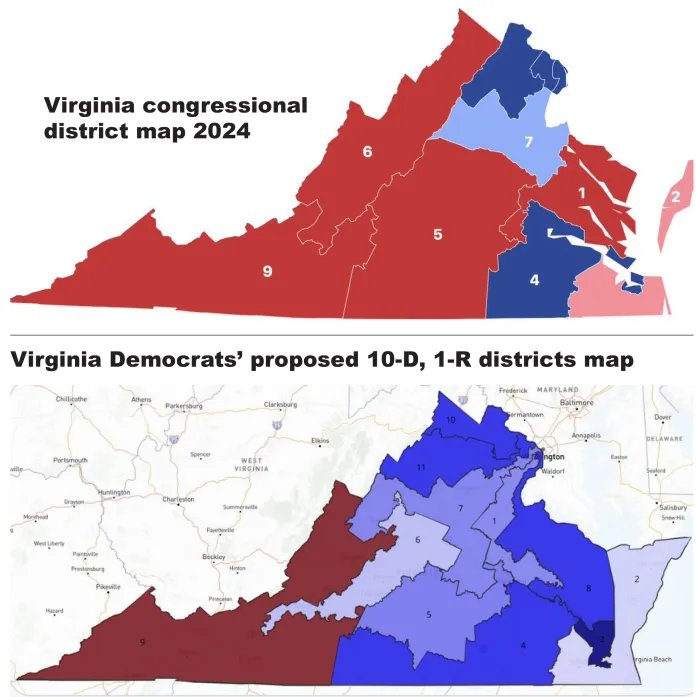
Just weeks ago, Virginia Republicans saw the measure as all but decided against them. Things changed, however, when the early votes started to roll in.
At first, said Virginia-based Republican strategist Brian Kirwin, “it felt pretty defeatist.” Democrats dominated early advertising, he noted, but Republican engagement has surged in recent weeks as awareness of the measure has grown. Now, he said, “It looks like it might be neck and neck,” a sharp change from expectations a month ago.
Kirwin said GOP voters increasingly view the proposal as a power grab, arguing it would shift representation heavily toward northern Virginia and dilute the influence of more rural regions.
“They think this is about going from six-five to ten-one,” he said. “That’s not about fairness. That’s about power.”
Early voting data underscore the uncertainty. More than 1 million early ballots had been cast as of mid-April, roughly in line with turnout at a comparable point in the previous cycle, according to data from the Virginia Public Access Project.
The geographic split has been notable. Republican-leaning districts are posting some of the highest raw turnout totals, while the largest share of ballots is still coming from population centers, particularly northern Virginia, where participation has surged and now accounts for a majority of votes cast statewide.
The competing trends underscore how difficult it is to draw firm conclusions about which party has the advantage heading into election day.
Polling reflects a similarly mixed picture. A new Washington Post-George Mason University Schar School survey suggests Republicans currently hold an enthusiasm edge, with GOP voters more likely than Democrats to say they are certain to cast a ballot. Despite that gap in motivation, the survey still shows the redistricting amendment ahead among likely voters, holding a narrow lead overall.
That split has shaped both parties’ closing strategies. Democrats are banking on expanded early voting access and strong turnout in suburban regions, while Republicans are counting on a traditional election day surge.
“There’s no history of who shows up in April for a referendum,” Kirwin said, describing the electorate as largely unpredictable. “Everybody is basically making educated guesses.”
Democratic strategists argue the numbers are moving in their favor as more early voting sites open in heavily populated areas.
Jared Leopold, a Virginia Democratic strategist, pointed to increased participation in Northern Virginia, Richmond, and Hampton Roads as a sign that turnout is broadening beyond initial rural spikes.
“I think it is very encouraging,” Leopold said. “If Democrats turn out, we’ve got the numbers on our side.”
Leopold and other Democrats also see the referendum as part of a broader political moment, with voters using the election to respond to President Donald Trump and Republican-led redistricting efforts elsewhere.
“It would send a clear message that Democrats are not going to allow Donald Trump to gerrymander the maps nationally,” Leopold said.
Former President Barack Obama stepped into the fight to boost the “yes” campaign, appearing in statewide television and digital ads in March. GOP-aligned groups quickly responded with targeted outreach to black voters, citing his past opposition to gerrymandering and warning the proposed maps could weaken their influence.
Democrats have publicly brushed off those attacks, but the exchange has added to the increasingly sharp tone of the campaign. Some party operatives privately point to potential warning signs, including Gov. Abigail Spanberger’s approval rating slipping below 50% as the debate over the maps intensifies.
Ben Tribbett, another Virginia Democratic strategist, framed the effort as a pragmatic response to national trends, arguing that Democrats can no longer afford to unilaterally adhere to redistricting reforms while Republicans redraw maps in their favor.
“The base needs to see that we’re willing to fight,” Tribbett said, adding that failing to act could depress turnout and cost Democrats elections.
Still, opposition to the measure is not limited to Republicans. Brian Cannon, a Democrat and advisory council member for the anti-gerrymandering group No Gerrymandering Virginia, said the proposal violates core democratic principles regardless of which party benefits.
“Gerrymandering is cheating,” Cannon said. “It’s picking winners ahead of elections. As a Democrat, I would love to see Democrats win more seats, but not by undermining free and fair elections.”
Cannon also warned the measure could set a dangerous precedent, encouraging both parties to redraw maps whenever they gain power.
“This is opening a Pandora’s box,” he said. “The people who lose in that are the voters.”
Political observers say the fight reflects a broader shift in how redistricting battles are playing out across the country. Karen Hult, a political science professor at Virginia Tech, said the referendum has become nationalized in a way that blurs the line between state and federal politics.
“Voters are being asked to decide not just who represents them, but whether they want to influence control of the U.S. House,” she said.
That framing could cut both ways. Hult noted that tying the measure too closely to national partisan battles may already be backfiring with some voters who supported Virginia’s independent redistricting commission in 2020.
“There’s a sense of confusion and concern,” she said, particularly among voters wary of reversing a reform they recently approved.
Adding to the uncertainty, the Virginia Supreme Court is expected to weigh in on the measure’s legality after the election, raising the possibility that the outcome could ultimately be decided in court.
With control of the House hanging in the balance, both parties are watching Virginia closely for signals about the political environment heading into the midterm elections.
Kirwin argued that even a close result could signal vulnerability for Democrats in a state they control, while Leopold cautioned against overinterpreting the outcome of an unusual spring election.
“This is a really unique election,” Leopold said. “I wouldn’t read too much into what it means for November.”
SPANBERGER AND DEMOCRATS SPEND BIG ON ‘NAKED QUEST FOR POWER’ IN VIRGINIA REDISTRICTING
What is clear is that turnout is likely to decide the race.
“This is all about who shows up,” Tribbett said.


