






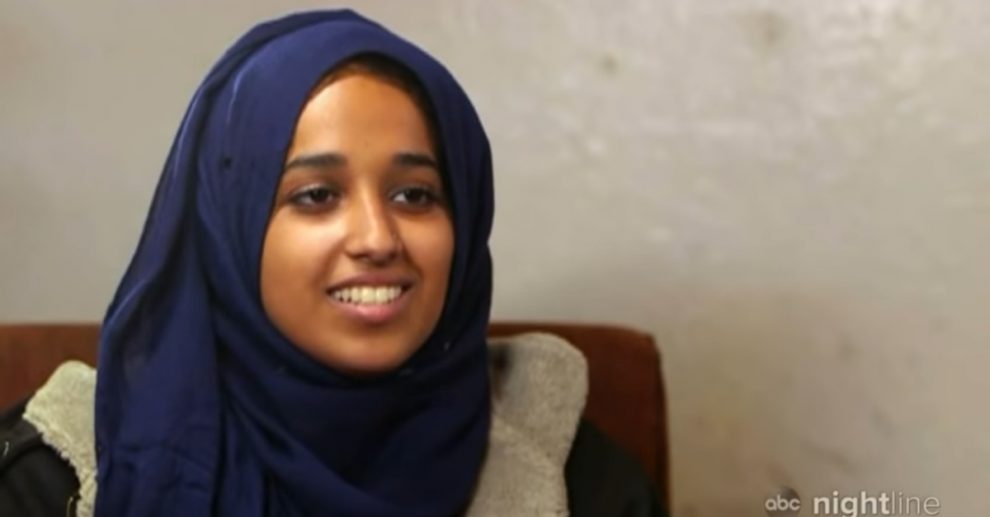
A woman born in New Jersey, who fled the United States to join the Islamic State five years ago, isn’t an American citizen and won’t be leaving the Syrian refugee camp where she resides, a federal judge ruled.
Hoda Muthana, the so-called ISIS bride, “doesn’t have a constitutional right to return to the United States because she is not a U.S. citizen,” Judge Reggie Walton of the District of Columbia District Court ruled Thursday.
Muthana, 25, left her family home in Alabama and dropped out of school in 2014 after making contact with ISIS fighters through social media. She was born to a Yemeni diplomat in 1994 and was issued an American passport despite eventual confusion about when her father’s diplomatic post officially came to an end.
Muthana burned her U.S. passport in 2014 and declared herself to be a part of the caliphate, using social media to encourage others to join too. She married an Australian-born ISIS fighter who was killed in 2015 and then married a Tunisian-born fighter who was also killed, but with whom she had a son. Muthana also married and divorced another fighter.
During the brief hearing Thursday afternoon, the judge heard arguments from Christina Jump, who was representing Hoda Muthana’s father Mohammed Ali Muthana, and from DOJ attorney Scott Stewart, who was appearing on behalf of the State Department and the U.S. government. Walton’s surprise ruling came after a 15-minute recess. The judge’s quick decision may have been based on the recent shifting and uncertain conditions in Syria he referenced in his opening remarks. Walton said he’d issue a written opinion within 30 days.
As Feds Probe Her Foreign Ties, Omar Surfaces to Share Stage with ‘Dangerous’ Known Terror Supporter
Inside the Somali mall safe haven where Ilhan Omar reappeared after feds raided her DC home
Trump supporters confront Iran, affordability concerns with a message for critics: ‘Give him time’
Feds crack down on stolen car pipeline to Mexican cartels as 13 charged in border scheme
Florida mom arrested after Vegas trip left 4 kids without overnight supervision: deputies
Middle school teacher arrested in alleged prostitution scheme at casino hotel
Stranded hikers cling to steep California mountain ridge as helicopter crew swoops in
Longtime Serbian leader Vucic’s defeat at the hands of student movement leaves Washington in awkward position
Watch: El-Sayed Staffer Lets His True Feelings About Americans and the Muslim Brotherhood Slip in Devastating Undercover Video
DHS suspends visa-free travel program for Chinese nationals amid birth tourism, security concerns
Germans Furious After Audi CEO Teams with Trump to Announce New Georgia Plant
The Hitchhiker’s Guide to why removing Ilhan Omar from Congress could be harder than Trump expects
Billionaire with Epstein ties emerges as top Dem donor bankrolling ads weaponizing disgraced financier’s files
Utterly Incompetent WNBA Faces Potential Championship Game Disaster – Was it Because DEI Staff Failed to Book Stadium?
Powerful: Video Shows Grieving Mom Offer Illegal Alien Trucker Forgiveness Over Son’s Death: ‘I Pray for You’
The debate hinged on a clause in Article 43 of the Vienna Convention about when an ambassador’s diplomatic immunity ends. Muthana’s attorney says her father was terminated as a diplomat in June 1994 and that his diplomatic posting officially ended on Sept. 1, 1994. Muthana was born on Oct. 28 that year. It was only in February 1995 that documentation suggests the United Nations and the U.S. were notified of her father’s termination, however, and the judge agreed with the Trump administration that it was the notification date that was key.
“Citizenship can’t be revoked just based on second thoughts,” the Muthanas’ lawyer said.
Stewart countered that the February 1995 date on the notification documents was “enough” to rule in their favor, and that Muthana was not a native-born citizen in October 1994 because her father still had diplomatic immunity in early 1995, which means “she could not have obtained citizenship at birth.”
“I am constrained to rule that at the time of her birth, she was still under the protection afforded to diplomats and that when she was born she was not born a U.S. citizen,” Walton said in siding with the Trump administration.
Walton also said Muthana’s father would not be able to send any money over to Muthana or her son, presumably because it could run afoul of laws prohibiting financial support for terrorist groups.
As the ISIS physical caliphate in Syria was crushed, Muthana handed herself over to coalition forces in January, saying she regretted joining ISIS and wanted to come home. But Secretary of State Mike Pompeo, through the instruction of President Trump, publicly denied re-entry to Muthana and her 2-year-old son, saying she was not a citizen.
“She’s a terrorist,” Pompeo said.
As Feds Probe Her Foreign Ties, Omar Surfaces to Share Stage with ‘Dangerous’ Known Terror Supporter
Inside the Somali mall safe haven where Ilhan Omar reappeared after feds raided her DC home
Trump supporters confront Iran, affordability concerns with a message for critics: ‘Give him time’
Feds crack down on stolen car pipeline to Mexican cartels as 13 charged in border scheme
Florida mom arrested after Vegas trip left 4 kids without overnight supervision: deputies
Middle school teacher arrested in alleged prostitution scheme at casino hotel
Stranded hikers cling to steep California mountain ridge as helicopter crew swoops in
Longtime Serbian leader Vucic’s defeat at the hands of student movement leaves Washington in awkward position
Watch: El-Sayed Staffer Lets His True Feelings About Americans and the Muslim Brotherhood Slip in Devastating Undercover Video
DHS suspends visa-free travel program for Chinese nationals amid birth tourism, security concerns
Germans Furious After Audi CEO Teams with Trump to Announce New Georgia Plant
The Hitchhiker’s Guide to why removing Ilhan Omar from Congress could be harder than Trump expects
Billionaire with Epstein ties emerges as top Dem donor bankrolling ads weaponizing disgraced financier’s files
Utterly Incompetent WNBA Faces Potential Championship Game Disaster – Was it Because DEI Staff Failed to Book Stadium?
Powerful: Video Shows Grieving Mom Offer Illegal Alien Trucker Forgiveness Over Son’s Death: ‘I Pray for You’
Muthana “wants to come home and is willing to submit to any charges against her — though, to be clear, at the moment there are none,” Jump said, and Muthana wants to bring her son to the U.S.
Muthana’s decision to join ISIS and use social media to recruit and encourage terrorist attacks could have opened her up to a slew of terrorism charges.
But there was “serious doubt as to whether she fully understands what she would face if she returns to the U.S,” Stewart said, referring to recent interviews where Muthana expressed an interest in returning to the U.S. to drive a car and go back to school.
The judge said this case “weighs on a judge, because President Trump laid in on this issue” and his office had received 6,000 letters since then, most of them angry and some of them threatening.
“The hate that exists in this country is just sad,” Walton said. “There were warnings that if I ruled in the father’s favor, there would be consequences.”
But the judge said he couldn’t let his personal perspectives — or those threats — influence his ruling.
The Trump administration followed in the footsteps of the Obama administration, which argued in January 2016 that Muthana had never been a U.S. citizen and delivered a letter to her family’s home in Alabama informing them of that.
This ruling comes as the Trump administration continues to demand that European countries take responsibility for their own hundreds of foreign fighters held in Syria.
Story cited here.


