





An Italian expert credentialed by the United Nations and living in Tunisia is at the center of a highly unusual First Amendment lawsuit, despite not being a citizen and the speech in question taking place overseas.
U.N. Special Rapporteur on the Occupied Palestinian Territories Francesca Albanese has been placed back on the sanctions list after the U.S. Court of Appeals for the District of Columbia Circuit issued a stay this week against a lower court’s previous injunction.
Albanese — an advocate against the Israeli government who has drawn international condemnation for her rhetoric — is hoping a residence she owns in the United States and her daughter’s American citizenship will be enough to convince the legal system she cannot be punished for her speech.
</p>
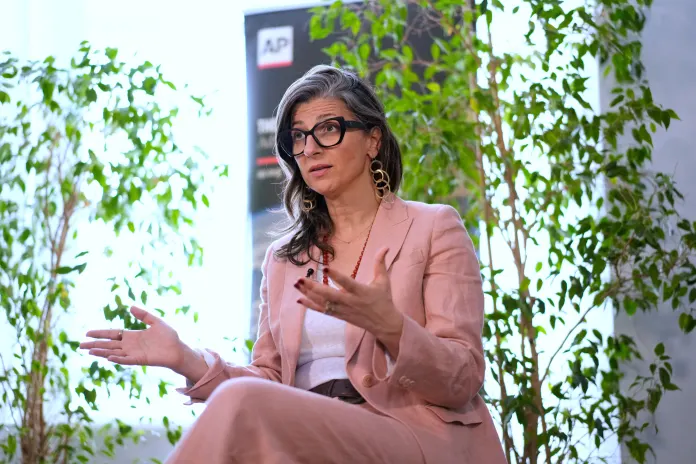
<p> ” data-large-file=”https://www.washingtonexaminer.com/wp-content/uploads/2026/06/AP26057570351184-e1781830223197.jpg?w=696″ src=”https://conservativemodern.com/wp-content/uploads/2026/06/uns-albanese-faces-uphill-battle-with-first-amendment-case-seeking-to-end-sanctions-against-her.webp” alt=”Albanese” class=”wp-image-4615644″><figcaption class=) Francesca Albanese, the U.N. special rapporteur for the West Bank and Gaza, is interviewed by the Associated Press in Rome, July 29, 2025. (AP Photo/Gregorio Borgia, file)
Francesca Albanese, the U.N. special rapporteur for the West Bank and Gaza, is interviewed by the Associated Press in Rome, July 29, 2025. (AP Photo/Gregorio Borgia, file)Albanese was slapped with sanctions by the State Department in July 2025 as the Trump administration hit the International Criminal Court, an organization it claimed “engaged in illegitimate and baseless actions targeting America and our close ally Israel.”
The rapporteur ended up in the administration’s crosshairs due to her history of lobbying for the ICC to issue an arrest warrant for Israeli leaders, including Prime Minister Benjamin Netanyahu, on the basis of war crimes in Gaza. The court ultimately issued warrants in late 2024, though they have never been carried out.
Secretary of State Marco Rubio asserted at the time that Albanese “directly engaged with the International Criminal Court in efforts to investigate, arrest, detain, or prosecute nationals of the United States or Israel, without the consent of those two countries.” He further accused her of “unabashed antisemitism, expressed support for terrorism, and open contempt for the United States, Israel, and the West.”
Albanese claims these punitive measures had a catastrophic effect on her family — freezing them out of banking systems, restricting travel, and complicating her ability to even pay normal bills. Her husband, Massimiliano Cali, appealed the decision on behalf of their minor daughter, who was born in the U.S. and is therefore an American citizen.
Last month, U.S. District Judge Richard Leon ruled in favor of the Albanese family’s request for an injunction and ordered the State Department to remove her from their sanctions list as the case moved to the U.S. Court of Appeals for the D.C. Circuit.
The U.S. Court of Appeals for the D.C. Circuit has since overturned Leon’s injunction and allowed the U.S. government to reinstate the sanctions throughout the litigation process, and the opinions issued by the court signal they might not see the First Amendment argument as valid.
David Keating, president of the Washington, D.C.-based Institute for Free Speech, told the Washington Examiner: “The courts, generally speaking, are often quite deferential to the president when it comes to foreign policy and national security. So just generally, as a rule, when you’re trying to get a court to address a First Amendment issue in that context, it’s much more difficult.”
He said it’s among the most “unusual” First Amendment cases he has observed.
“It’s pretty unusual set of facts. I mean, they’ve got a U.S. citizen daughter, but they’re not living in the United States. The speech was outside the United States. It’s a tough case with some difficult questions, but I think on balance the odds are probably against her succeeding,” Keating said.
Albanese believes the occupation of the Palestinian territories amounts to genocide on par with the Holocaust and has previously stated that the “Palestinians have no other room for dissent than violence.”
Her notoriety is largely derived from her U.N. associations. Rapporteurs are independent experts appointed by the body with the authority to investigate, monitor, and report back on issues within their purview. They top their documents with the U.N. letterhead and maintain authority to intervene in human rights controversies.
But they are not employees of the international body. They receive no salary and never need to answer to the U.N. command structure.
Hillel Neuer, executive director of the nonprofit organization U.N. Watch in Switzerland, has made it his mission to call attention to Albanese and oust her. He claims she has abused the position by turning it into a vehicle of celebrity and hysteria.
“Historically, [rapporteurs] would write two reports a year, maybe issue a few press releases, and it was kind of a quiet job,” Neuer told the Washington Examiner, explaining that the age of social media “changed everything” about the position. “She’s tweeting every five minutes, every Hamas lie about Israel … she just repeats it. And so she’s hyperactive, doing all this stuff in the name of the U.N.”
“From her standpoint, she benefits from the incredible imprimatur to be a U.N. expert,” Neuer continued. “She can tell the world that she is the U.N. special rapporteur in Palestine. She suddenly benefits from immunity. She gets various U.N. documents that won’t call her an employee, but basically call her some kind of an official. … She gets to issue press releases on the U.N. stationery and issue U.N. reports.”
In February, the chorus calling for her dismissal grew to deafening proportions after a speech at the Al Jazeera Forum.
“The fact that instead of stopping Israel, most of the world has armed, given Israel political excuses, political sheltering, economic and financial support. … We who do not control large amounts of financial capitals, algorithms, and weapons, we now see that we as a humanity have a common enemy, and freedoms, the respect of fundamental freedoms is the last peaceful avenue, the last peaceful toolbox that we have to regain our freedom,” she said.
There was immediate backlash against characterizing Israel as the “common enemy” of humanity. Albanese later clarified on social media that the “common enemy” she referenced was “THE SYSTEM that has enabled the genocide in Palestine,” but multiple world leaders condemned the rapporteur for the comments.
UN SAYS VIOLENCE IN SOUTHERN LEBANON HAS ‘SIGNIFICANTLY REDUCED’ SINCE PEACE DEAL
Albanese began her second term as special rapporteur in May 2025 despite concerted efforts to flag her for reconsideration and removal — including a letter from the U.S. Mission to the U.N.
She will be in the position until 2028, barring intervention by the Human Rights Council.


