







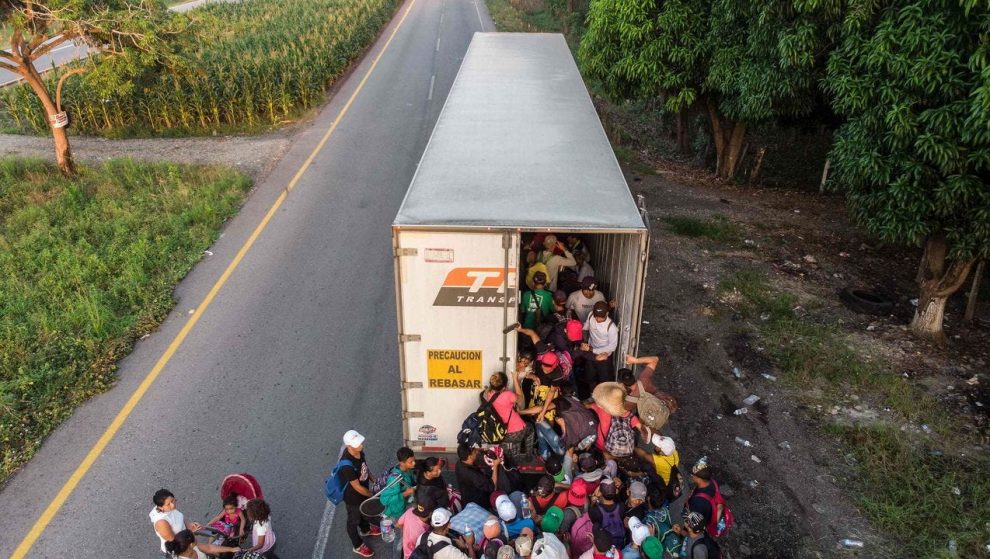
U.S.-bound asylum seekers will be sent back to at least two additional Mexican border cities later this week to wait for their claims to be processed, officials said, with one of the cities in a region that is among Mexico’s most chaotic and violent.
The policy known as the Migrant Protection Protocols (MPP), or Remain in Mexico, will be implemented later this week in Nuevo Laredo in the northern state of Tamaulipas, which borders Texas, said two Mexican officials with knowledge of the matter, who declined to be identified.
Tamaulipas is home to the Gulf and Zeta cartels that include people-smuggling and kidnapping among their criminal activities.
One of the Mexican officials said the policy would also be expanded to San Luis Rio Colorado in the northern state of Sonora, which borders Arizona. Mexican newspaper Reforma reported immigration official Julio César Navarro Contreras as saying San Luis Rio Colorado was on the list.
The latest expansion follows high-stakes negotiations to fend off trade tariffs.
Smithsonian screening dispute puts museum’s commitment to diverse views on trial: ‘Right kind of Black?’
Reporter’s Notebook: Senate sneaks in one last political play before voters have their say
Court Set to Deliver Big Win to 70 Churches Seeking to Leave United Methodist Denomination
How a foreign government helped accused Saudi spy’s family flee US after OpenAI bug scandal
Violent far-left riots in France are ‘chilling warning’ for Americans at home, Mike Johnson says
WJ Straw Poll: Rubio Nears 50 Percent as Massie Loses More Ground
Trump aides fire back at press over Zacharia firing as they seek to limit damage
Convicted serial rapist originally sentenced to 124 years walks free after 20, sparking outrage
Blue State Schools Forced Christians to Keep Bibles in Envelopes So Other Students Wouldn’t Be ‘Exposed to Them’
Elon Musk Announces Plan to Distribute a Financial Gift to ‘Every Kid in America’
Trump heads to unlikely battleground as GOP fights to hold Senate and more top headlines
State Trooper Dishonorably Discharged for Using ‘Offensive Language’
It took 3 months to get inside this massive Texas data center — here’s what we saw
What’s next for Skydance after the Paramount-Warner Bros. merger?
National Guard member shot in DC, police chief says
U.S. President Donald Trump had threatened the tariffs to push Mexico to do more to stop migrants from Central America and beyond from reaching U.S. soil, after a sharp spike in numbers this year.
As part of the deal struck earlier this month to remove the tariff threat, Mexico agreed for MPP to apply to the whole length of the border, but capacity issues on both sides have slowed implementation.
Under the deal, Mexico has also deployed a new militarized National Guard police force to detain migrants near the country’s northern and southern borders.
MPP started in January and is already functioning in Mexicali and Tijuana in Baja California, which borders California, and Ciudad Juarez in Chihuahua, which borders New Mexico and Texas.
Smithsonian screening dispute puts museum’s commitment to diverse views on trial: ‘Right kind of Black?’
Reporter’s Notebook: Senate sneaks in one last political play before voters have their say
Court Set to Deliver Big Win to 70 Churches Seeking to Leave United Methodist Denomination
How a foreign government helped accused Saudi spy’s family flee US after OpenAI bug scandal
Violent far-left riots in France are ‘chilling warning’ for Americans at home, Mike Johnson says
WJ Straw Poll: Rubio Nears 50 Percent as Massie Loses More Ground
Trump aides fire back at press over Zacharia firing as they seek to limit damage
Convicted serial rapist originally sentenced to 124 years walks free after 20, sparking outrage
Blue State Schools Forced Christians to Keep Bibles in Envelopes So Other Students Wouldn’t Be ‘Exposed to Them’
Elon Musk Announces Plan to Distribute a Financial Gift to ‘Every Kid in America’
Trump heads to unlikely battleground as GOP fights to hold Senate and more top headlines
State Trooper Dishonorably Discharged for Using ‘Offensive Language’
It took 3 months to get inside this massive Texas data center — here’s what we saw
What’s next for Skydance after the Paramount-Warner Bros. merger?
National Guard member shot in DC, police chief says
Since the tariff deal, MPP has been applied to more nationalities, including Cubans, and the number of people being returned has been increased to 500 from 100 a day in Juarez.
A representative for Mexico’s national institute for migration said it had received no official confirmation for when and how the policy would be further expanded.
A U.S. Department of Homeland Security official said the department “was not in a position to confirm new locations.”
Rights groups have sued the Trump administration over the policy, which they argue leaves vulnerable people facing dangers in Mexican border towns similar to those they fled in their home countries.
In April, a federal judge in California ruled MPP likely violated U.S. immigration law. In May, however, the 9th U.S. Circuit Court of Appeals allowed the program to continue while the legal challenge proceeds.
VIOLENCE
Tamaulipas suffers from high levels of killings and kidnapping, as powerful gangs battle over drug and people-smuggling routes.
The eastern part of the state, bordering the Texas cities of McAllen and Brownsville, is the busiest crossing for families and individuals from Guatemala, Honduras and El Salvador and is also considered the most dangerous.
Nuevo Laredo, however, sees relatively low traffic of families seeking asylum, U.S. Customs and Border Protection figures show.
Smithsonian screening dispute puts museum’s commitment to diverse views on trial: ‘Right kind of Black?’
Reporter’s Notebook: Senate sneaks in one last political play before voters have their say
Court Set to Deliver Big Win to 70 Churches Seeking to Leave United Methodist Denomination
How a foreign government helped accused Saudi spy’s family flee US after OpenAI bug scandal
Violent far-left riots in France are ‘chilling warning’ for Americans at home, Mike Johnson says
WJ Straw Poll: Rubio Nears 50 Percent as Massie Loses More Ground
Trump aides fire back at press over Zacharia firing as they seek to limit damage
Convicted serial rapist originally sentenced to 124 years walks free after 20, sparking outrage
Blue State Schools Forced Christians to Keep Bibles in Envelopes So Other Students Wouldn’t Be ‘Exposed to Them’
Elon Musk Announces Plan to Distribute a Financial Gift to ‘Every Kid in America’
Trump heads to unlikely battleground as GOP fights to hold Senate and more top headlines
State Trooper Dishonorably Discharged for Using ‘Offensive Language’
It took 3 months to get inside this massive Texas data center — here’s what we saw
What’s next for Skydance after the Paramount-Warner Bros. merger?
National Guard member shot in DC, police chief says
Other officials with knowledge of the talks between Mexico and the United States say the towns of Nogales and Brownsville-Matamoros have been mentioned in discussions.
Remain in Mexico is aimed at dissuading asylum seekers from applying for refuge in the United States. The Trump administration says many claims are false, and that claimants will desist once they realize they must stay in Mexico for extended periods.
Since it was implemented, nearly 14,000 asylum seekers have been sent to Mexico under the program.
Reporting by Lizbeth Diaz in Mexico City; Additional reporting by Kristina Cooke in San Francisco, Jose Luis Cabezas in Rio Bravo and Dave Graham in Mexico City; Writing by Stefanie Eschenbacher; Editing by Frank Jack Daniel and Phil Berlowitz.
Story cited here.


