







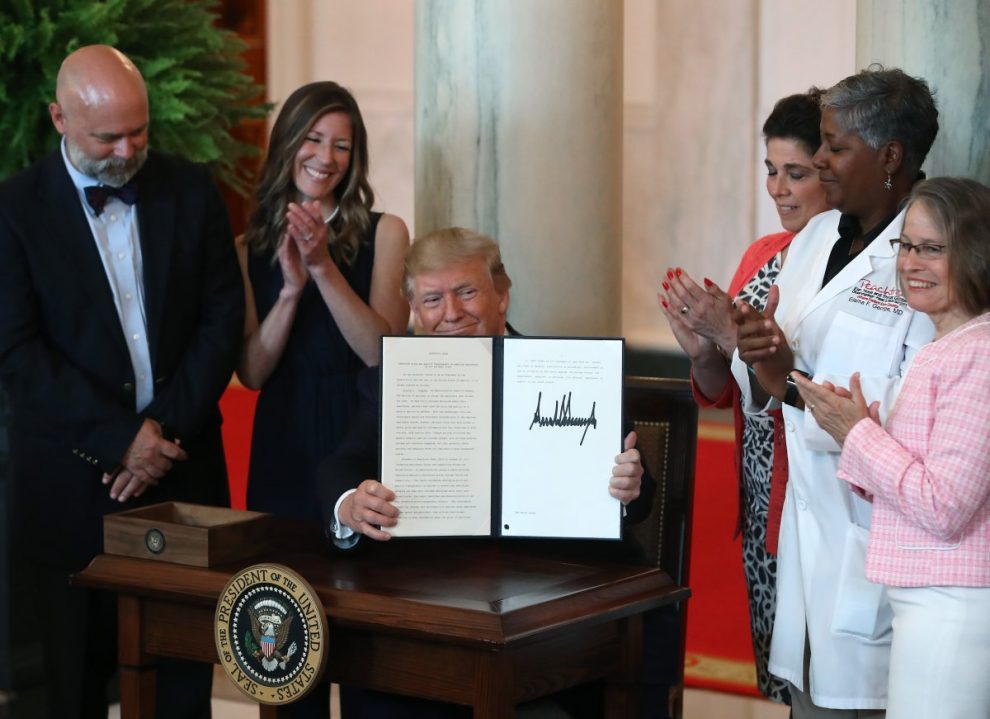
President Trump on Monday signed an executive order demanding the upfront disclosure by hospitals of the actual prices for common tests and procedures.
Trump’s order also requires that patients be told ahead of time what their out-of-pocket costs like deductibles and copays will be for many procedures.
“This landmark initiative continues our work to put American patients first,” Trump said during remarks at the White House before signing the order. “We are fundamentally changing the nature of the health care marketplace.”
Health and Human Services Secretary Alex Azar told reporters before Trump’s remarks that the idea is to give patients practical information that they can use to help save money. For example, if a hospital charges your insurer $3,500 for a type of echocardiogram and the same test costs $550 in a doctor’s office, you might go for the lower-price procedure to save on copays.
The executive order calls for a rule-making process by federal agencies, which typically takes months or even years. The details of what information will have to be disclosed and how it will be made available to patients must be worked out as part of writing the regulations. That will involve a complex give-and-take with hospitals, insurers and others affected. Consumers will have to wait to see whether the results live up to the administration’s promises.
90 Percent of Largest United Methodist Church Congregation Votes to Leave Denomination – But It Won’t Be Easy
Hundreds of staged armed robberies helped thousands pose as crime victims in US immigration scam: DOJ
The Thing That Never Happens: DOJ Says Hundreds of Foreigners Voted in Multiple US Elections
House report says NYC prosecutors tailored plea deals to shield illegal immigrants from deportation
Multi-state manhunt underway as murder victim’s close friend fears escaped killer could strike again
FBI raids Beverly Hills mansion as part of Eric Swalwell investigation
WNBA Players Run Off the Court Again Before National Anthem Ahead of Monday Finals Game
Ilhan Omar Tells Hasan Piker She Is Being Targeted Because She’s Good-Looking
Fox News Power Rankings: As Iran looms large, can the GOP keep the faithful?
Netanyahu warns of high turnout in Israeli election: ‘Emergency hour’
Many of Annie Andrews’s supposed Republican backers have history of supporting Democrats
Trump takes campaign blitz to Texas with one week until midterms and more top headlines
As Feds Probe Her Foreign Ties, Omar Surfaces to Share Stage with ‘Dangerous’ Known Terror Supporter
Inside the Somali mall safe haven where Ilhan Omar reappeared after feds raided her DC home
Trump supporters confront Iran, affordability concerns with a message for critics: ‘Give him time’
Lack of information on health care prices is a widespread problem . It’s confusing for patients, and experts say it’s also one of the major factors that push up U.S. costs. The same test or procedure, in the same city, can cost widely different amounts depending on who is performing it and who is paying the bill. Hospital list prices, which are available, don’t reflect what they actually get paid by insurers and government programs.
The health insurance industry said disclosing negotiated prices will only encourage hospitals that are now providing deeper discounts to try to raise their rates to match the top-tier facilities. “Publicly disclosing competitively negotiated proprietary rates will reduce competition and push prices higher — not lower — for consumers, patients, and taxpayers,” Matt Eyles, head of the industry group America’s Health Insurance Plans, said in a statement.
While the prices Medicare pays are publicly available, private insurers’ negotiated rates generally are not. Industry officials say such contractual information is tantamount to trade secrets and should remain private.
Azar pushed back against that argument, saying insurers do ultimately disclose their payment rates when they send individual patients an “explanation of benefits.” That’s the technical term for the form that patients get after they’ve had a procedure or seen the doctor.
90 Percent of Largest United Methodist Church Congregation Votes to Leave Denomination – But It Won’t Be Easy
Hundreds of staged armed robberies helped thousands pose as crime victims in US immigration scam: DOJ
The Thing That Never Happens: DOJ Says Hundreds of Foreigners Voted in Multiple US Elections
House report says NYC prosecutors tailored plea deals to shield illegal immigrants from deportation
Multi-state manhunt underway as murder victim’s close friend fears escaped killer could strike again
FBI raids Beverly Hills mansion as part of Eric Swalwell investigation
WNBA Players Run Off the Court Again Before National Anthem Ahead of Monday Finals Game
Ilhan Omar Tells Hasan Piker She Is Being Targeted Because She’s Good-Looking
Fox News Power Rankings: As Iran looms large, can the GOP keep the faithful?
Netanyahu warns of high turnout in Israeli election: ‘Emergency hour’
Many of Annie Andrews’s supposed Republican backers have history of supporting Democrats
Trump takes campaign blitz to Texas with one week until midterms and more top headlines
As Feds Probe Her Foreign Ties, Omar Surfaces to Share Stage with ‘Dangerous’ Known Terror Supporter
Inside the Somali mall safe haven where Ilhan Omar reappeared after feds raided her DC home
Trump supporters confront Iran, affordability concerns with a message for critics: ‘Give him time’
The president used his remarks to also take shots at former President Barack Obama’s Affordable Care Act as well as 2020 presidential hopeful Bernie Sanders and his “Medicare for all” plan. Sanders’ plan would replace job-based and individual private health insurance with a government-run plan that guarantees coverage for all with no premiums, deductibles and minimal copays for certain services.
“Democrats in Congress support Bernie Sanders’ socialist takedown of American health care,” Trump said. “Under my administration, we will not let that happen.”
Story cited here.


