


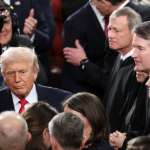


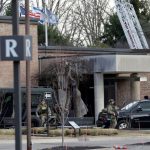

President Donald Trump on Saturday afternoon declared that Iranian Ayatollah Ali Khamenei, a man he described as “one of the most evil people in history,” is dead, following joint U.S.-Israeli strikes against Tehran.
“This is not only Justice for the people of Iran, but for all Great Americans, and those people from many Countries throughout the World, that have been killed or mutilated by Khamenei and his gang of bloodthirsty THUGS,” the president said in a post to Truth Social. “This is the single greatest chance for the Iranian people to take back their Country.”
A photo of the supreme leader’s body was shown to Israeli Prime Minister Benjamin Netanyahu, an Israeli official told the New York Post.
Hours later, Iranian state media confirmed Khamenei’s death.
“We hereby inform the devoted, martyr-loving people of Iran that His Eminence Ayatollah al-Uzma Khamenei, the Supreme Leader of the Islamic Revolution, was martyred in a joint attack by the criminal America and the Zionist regime on the morning of Monday, the ninth of Esfand,” Tasnim News Agency reported on Saturday night.
The development marks a critical and extraordinary moment for Iran, as Netanyahu and Trump have urged those who have participated in mass uprisings against the ayatollah’s government to take over the country.
THE US AND ISRAEL ATTACKED IRAN: WHAT WE KNOW
In his press conference, Netanyahu urged the Iranian people to overthrow Khamenei’s theocratic government, similar to President Donald Trump’s calls.
The strikes offer protestors an opportunity to “unshackle themselves from tyranny,” the Israeli leader said, calling the moment a “once in a generation chance” to overthrow the Iranian regime.
Exiled crown prince Reza Pahlavi, seen by some as a potential leader in a post Khamenei world, urged the Iranian people to shape their future. “My dear compatriots, Moments of destiny lie ahead of us,” he said early Saturday.
What happened?
The Trump administration has for months engaged in diplomatic talks with the Iranian regime, aimed at averting military intervention, due largely to concerns about the country’s nuclear weapons ambitions and the terrorism it promotes internationally.
With no clear breakthrough in sight, the White House and Israel targeted Iran with strikes over the weekend. In an eight-minute video message posted to Truth Social, Trump said the objective of “Operation Epic Fury” is “to prevent this very wicked, radical dictatorship from threatening America and our core national security interests.” He described Iran as the world’s number 1 state sponsor of terror, and called on its citizens to overthrow the Ayatollah. That was before confirmation of Khamenei’s death.
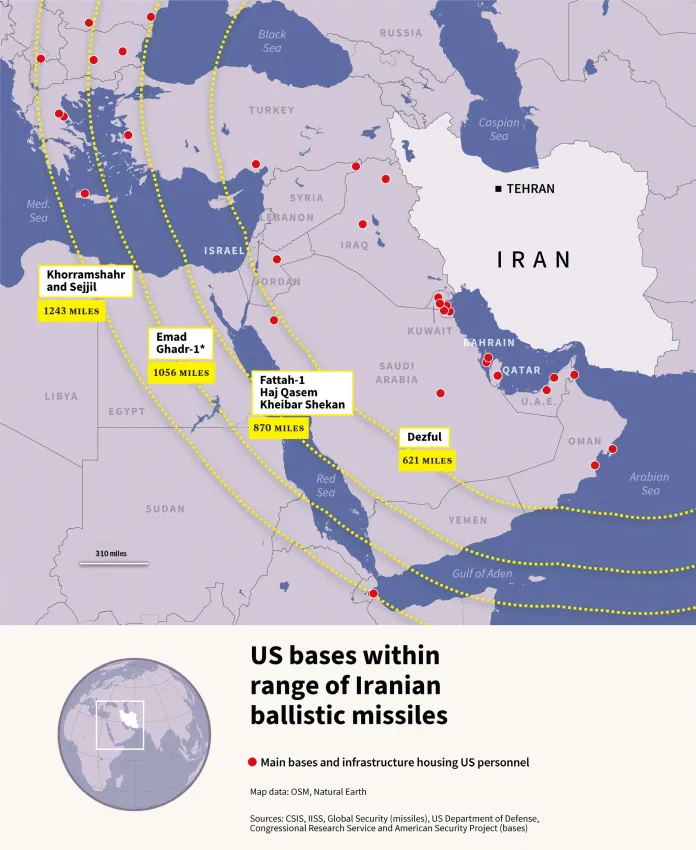
U.S. intelligence indicating Iran intended to use conventional missiles, potentially preemptively, against U.S. troops in the Middle East, was also a key part of the rationale for why Trump signed off on the strikes, senior officials said during a Saturday briefing, according to BBC.
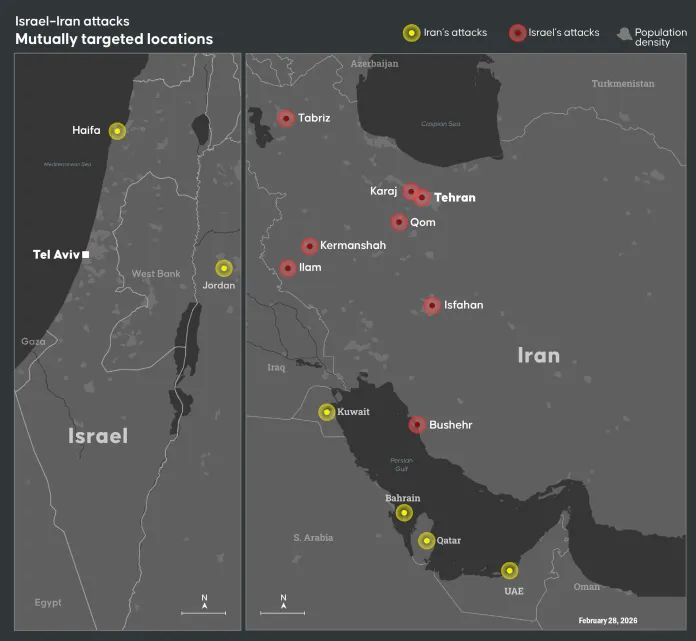
The strikes targeted several sites where the Ayatollah and other senior military leaders gathered in Iran. U.S. officials told NBC News that Israel had targeted Iranian leaders while the U.S.went after Iran’s ballistic missile and nuclear programs.
The Pentagon confirmed there were no U.S. casualties in the first 12 hours of the operation.
The U.S. military used sea and air-based platforms to launch massive strikes across Iran overnight, a U.S. official told the Wall Street Journal. American destroyers launched Tomahawk missiles from the waters in the Middle East and Eastern Mediterranean Sea, while U.S. jet fighters fired missiles, the official said.
How long will the operation last?
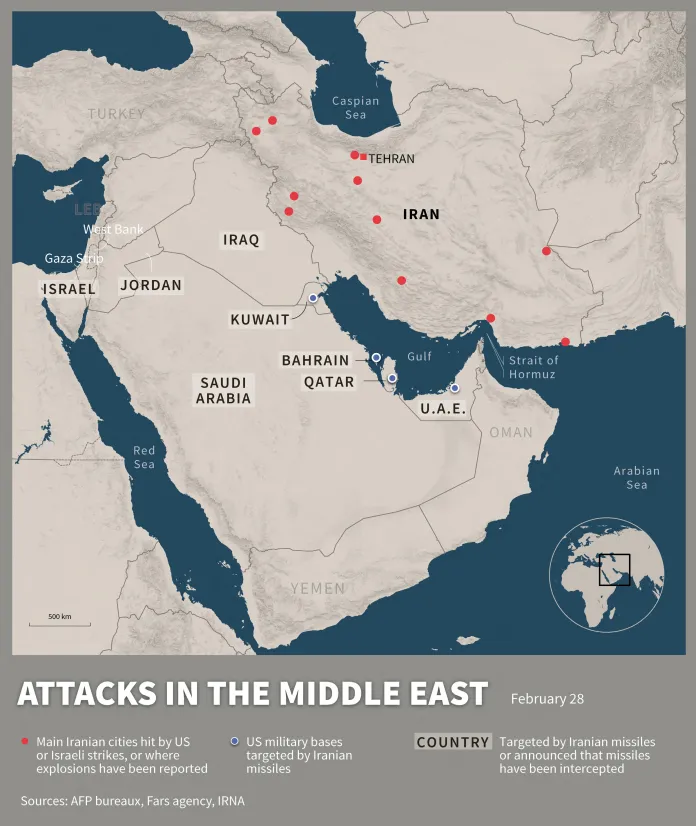
Trump has described attacks as a “combat” operation that is “massive and ongoing.” A U.S. official said the “multiday” operation against Iran began at about 1 a.m. Eastern time with a salvo of ship-launched Tomahawk cruise missiles and air-launched munitions from U.S. Air Force and Navy jets, in comments to the Washington Post.
TIANA LOWE DOESCHER: TRUMP’S ATTACK ON IRAN IS AN ATTACK ON CHINA’S ECONOMIC SUPERIORITY
The president noted on Saturday the potential cost to American lives.
“The Iranian regime seeks to kill. The lives of courageous American heroes may be lost and we may have casualties — that often happens in war — but we’re doing this not for now. We’re doing this for the future, and it is a noble mission,” Trump said.
Ahead of the operation, Vice President J.D. Vance promised Thursday that the U.S. would not be drawn into another long-term war in the Middle East, amid fears internvention in Iran could echo the conflicts in Afghanistan and Iraq.
“The idea that we’re going to be in a Middle Eastern war for years with no end in sight — there is no chance that will happen,” he said. “I do think we have to avoid repeating the mistakes of the past. I also think that we have to avoid overlearning the lessons of the past…just because one president screwed up a military conflict doesn’t mean we can never engage in military conflict again. We’ve got to be careful about it, but I think the president is being careful.”
Are the strikes legal?
The Constitution states that Congress shall have the power “to declare war.” Some lawmakers, such as Rep. Elissa Slotkin (D-MI), are suggesting that the operation in Iran amounts to a war, saying Trump violated the Constitution in not bringing the matter to Congress. Reps. Thomas Massie (R-KY) and Ro Khanna (D-CA) are among others arguing that Trump abused his presidential authority to authorize the strikes without congressional approval.
ISRAEL TOUTS ‘LARGEST EVER’ MILITARY FLYOVER IN IRAN ATTACK
Secretary of State Marco Rubio alerted a key group of congressional leaders known as the “Gang of Eight” before the operation. He was able to reach seven of the eight members, which includes the top party members of the House and Senate intelligence committees.
House Minority Leader Hakeem Jeffries (D-NY) wants to force a “war powers” vote seeking to restrict military action against Iran. Senate Minority Leader Chuck Schumer (D-NY) requested that the Trump administration brief Congress on the operation, and expressed concern that members were not alerted to the “critical details about the scope and immediacy” of the Iranian threat. Senate Majority Leader John Thune (R-LA) said he looks “forward to administration officials briefing all senators about these military operations.”
Why did the U.S. attack?
The U.S. has long expressed concern that Iran is enriching uranium in efforts to create nuclear weapons. The Trump administration carried out strikes targeting three Iranian nuclear facilities last June in hopes of obliterating its nuclear program, which is viewed by Israel and other allies as a critical threat. One of the three nuclear sites was mostly destroyed, but the two others were not as badly damaged and may have been degraded only to a point where nuclear enrichment could resume within months, according to reports.
The United Nations’s nuclear watchdog said Friday that Iran has not allowed it access to the nuclear facilities bombed by the U.S. The International Atomic Energy Agency said it “cannot verify whether Iran has suspended all enrichment-related activities,” or the “size of Iran’s uranium stockpile at the affected nuclear facilities,” according to the Associated Press.
The State Department has held rounds of talks on the matter, including earlier this week in Geneva, but they fell short of a deal. The U.S. team of negotiators, led by special envoy Steve Witkoff and Jared Kushner, requested that Iran destroy the three main nuclear sites at Fordow, Natanz, and Isfahan, and deliver all of its remaining enriched uranium to the U.S., demands that Iranian officials have objected to, according to the Wall Street Journal. Senior U.S. officials said Saturday afternoon that they believed the three facilities were being rebuilt, a violation of existing protocols.
TRUMP ANNOUNCES ‘MASSIVE AND ONGOING OPERATION’ AGAINST IRAN
Trump said Saturday that time had run out for Iran to make concessions. And he decried the regime’s actions to suppress uprisings against the government. The Ayatollah’s forces have reportedly killed up to tens of thousands of dissenters since massive protests began in December.
“They rejected every opportunity to renounce their nuclear ambitions, and we can’t take it anymore. Instead, they attempted to rebuild their nuclear program and to continue developing long-range missiles that can now threaten our very good friends and allies in Europe, our troops stationed overseas, and could soon reach the American homeland,” Trump said.


