



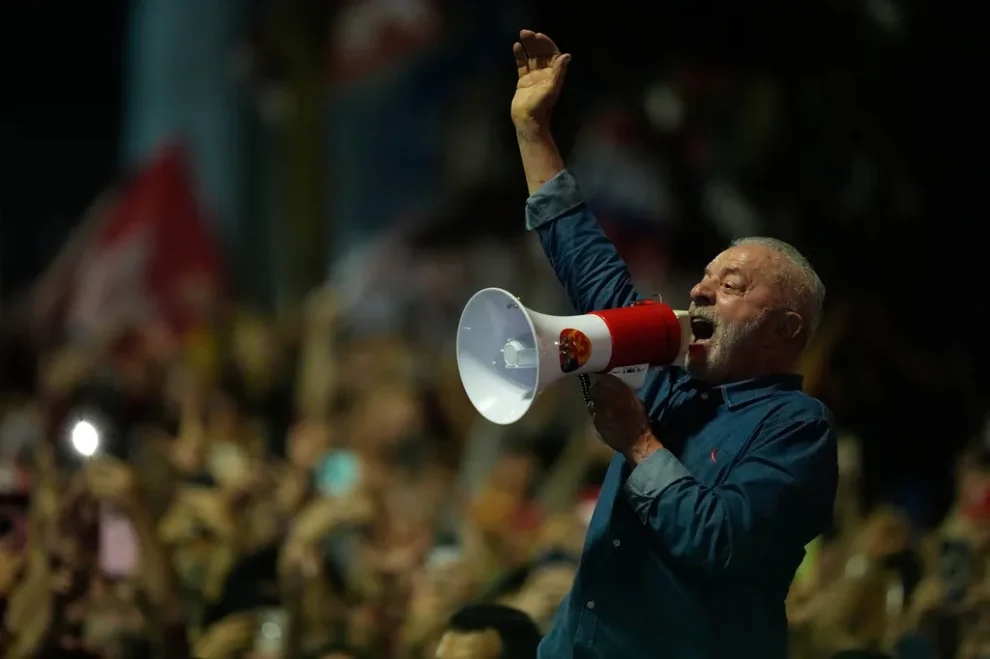
President Luiz Inacio Lula da Silva clinched victory out of thin air in Brazil’s weekend election, spurring his challenger to deny the results and the United States to demur from commenting on them.
Lula won reelection in the results published overnight Monday, claiming 51.7% of the vote against Flavio Bolsonaro’s 48.2% share. It was an unbelievable comeback given that Lula was trailing Bolsonaro by over 2 million votes in the first round of the election, which also included multiple other candidates running to the president’s right.
President Donald Trump, asked on Monday for his reaction to the results, said it “looked like another rigged election, frankly.”
</p>
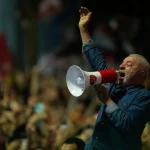
<p> ” data-large-file=”https://conservativemodern.com/wp-content/uploads/2026/10/trump-says-brazil-election-likely-rigged-as-bolsonaro-demands-lulas-victory-be-annulled.webp” src=”https://conservativemodern.com/wp-content/uploads/2026/10/trump-says-brazil-election-likely-rigged-as-bolsonaro-demands-lulas-victory-be-annulled.webp” alt=”Lula election victory” class=”wp-image-4780114″ srcset=”https://conservativemodern.com/wp-content/uploads/2026/10/trump-says-brazil-election-likely-rigged-as-bolsonaro-demands-lulas-victory-be-annulled.webp 1024w, https://conservativemodern.com/wp-content/uploads/2026/10/trump-says-brazil-election-likely-rigged-as-bolsonaro-demands-lulas-victory-be-annulled.webp?resize=300,200 300w, https://conservativemodern.com/wp-content/uploads/2026/10/trump-says-brazil-election-likely-rigged-as-bolsonaro-demands-lulas-victory-be-annulled.webp?resize=768,512 768w” sizes=”(max-width: 1024px) 100vw, 1024px”><figcaption class=) Brazilian President Luiz Inacio Lula da Silva addresses supporters during a victory rally after winning a fourth term in the presidential runoff on Paulista Avenue in Sao Paulo, Sunday, Oct. 25, 2026. (Natacha Pisarenko/AP Photo)
“Elections have to be indisputable — and it looked very bad to me,” Trump added.
The U.S. president repeatedly emphasized that he “didn’t take sides” in the election, having not issued an endorsement for either candidate. But Bolsonaro’s father, now in prison for a 2022 coup attempt against Lula to stay in power, is a high-profile ally of Trump.
It seemed all but guaranteed that Flavio Bolsonaro would waltz into high office and be empowered to pardon his father before working with Trump to align Brazil with the U.S.
“It was quite a surprise. This is the first time that we’ve had a reversal result between the first round and the runoff,” said Ricardo Sennes, nonresident senior fellow of the Atlantic Council’s Latin America Center.
Interpreting the unprecedented result as proof “Brazilian voters clearly reject Flavio more than they reject Lula,” Sennes pointed to exit polling data that suggests voter turnout surged between the first-round and runoff —firmly to Lula’s benefit. He also pointed to several key cities that appeared to flip in the president’s favor.
Dissecting the voter data and conclusively verifying how Lula made such a dramatic turnaround will likely take months, but a decision by the Supreme Court on the night of the election may further erode public faith in the courts.
Justice Cristiano Zanin, a judge appointed to the high court by Lula, approved the president’s request for a two-hour extension on voting due to reported public transportation issues in the states of Sao Paulo and Bahia. The order came just minutes before the end of voting, and with many polling locations already closed, the court hastily elaborated that it applied only to those locations still open.
Bolsonaro’s campaign had previously requested a time extension for several southern regions being affected by severe weather.
No such time extension has ever been implemented in modern Brazilian elections.
The right-wing candidate rejected the results on Monday, declaring that it is “impossible to recognize the results of the election in the context of these things that happened.”
It seems as though Bolsonaro has little momentum to question the results, however.
Kassio Nunes Marques, president of the Supreme Electoral Court, already announced that the extension did not have a large enough potential effect on voter turnout to swing the election and confirmed Lula as the victor. Marques was appointed by former President Jair Bolsonaro — Flavio Bolsonaro’s father.
Various world leaders have already issued statements congratulating Lula on his reelection, including French President Emmanuel Macron and Russian President Vladimir Putin.
The glaring exception is the United States.
“The White House’s hesitation is not surprising,” said Christopher Sabatini, director of the Latin America program at London-based think tank Chatham House. “It had been counting on the election of Bolsonaro to complete its bingo card of right-wing presidents in the Western Hemisphere, following a period of sustained electoral success for right-wing candidates stretching from Honduras to Argentina.”
</p>
<p> ” data-large-file=”https://conservativemodern.com/wp-content/uploads/2026/10/trump-says-brazil-election-likely-rigged-as-bolsonaro-demands-lulas-victory-be-annulled.jpg” src=”https://conservativemodern.com/wp-content/uploads/2026/10/trump-says-brazil-election-likely-rigged-as-bolsonaro-demands-lulas-victory-be-annulled.jpg” alt=”Flavio Bolsonaro” class=”wp-image-4780115″ srcset=”https://conservativemodern.com/wp-content/uploads/2026/10/trump-says-brazil-election-likely-rigged-as-bolsonaro-demands-lulas-victory-be-annulled-1.webp 1024w, https://conservativemodern.com/wp-content/uploads/2026/10/trump-says-brazil-election-likely-rigged-as-bolsonaro-demands-lulas-victory-be-annulled-1.webp?resize=300,200 300w, https://conservativemodern.com/wp-content/uploads/2026/10/trump-says-brazil-election-likely-rigged-as-bolsonaro-demands-lulas-victory-be-annulled-1.webp?resize=768,512 768w” sizes=”(max-width: 1024px) 100vw, 1024px”><figcaption class=) Opposition presidential candidate Sen. Flavio Bolsonaro arrives at his election night event after the presidential runoff in Brasilia, Brazil, Sunday, Oct. 25, 2026. (Eraldo Peres/AP Photo)
With the Supreme Electoral Court already on the record opposing his challenge of the results, Bolsonaro could follow in the footsteps of his father and court Trump for the political leverage he is lacking domestically.
“In the end, how far Flavio’s team decides to take its claims of fraud may depend on the White House and the U.S. State Department,” Sabatini said. “Both had a lot riding on a Bolsonaro victory. For Trump it would have been the crowning achievement for his support in the region, during this heavy year of presidential elections across the hemisphere.”
TRUMP’S NOVEL LEGAL STRATEGY PUMMELS ALLEGED ‘NARCO-TERRORISTS’ AND CARTEL MEMBERS
Latin America has experienced a continent-wide march to the right in the last half-decade, including several world leaders elected in the wake of Trump’s return.
The administration and its allies have tried to credit this upheaval to the president’s policies and foreign strategy, including the “Donroe Doctrine,” which asserts American hegemony in the Western Hemisphere, and the quashing of the U.S. Agency for International Development.


