







President Donald Trump is staring down another possible setback in the GOP-led Senate on a bipartisan measure to restrict further military operations against Venezuela without congressional approval.
The so-called war powers resolution advanced last week, but its ability to clear final passage as early as Wednesday hinges on whether Trump can personally sway the five Republicans who bucked him and voted with all Democrats.
Meanwhile, GOP leaders are weighing a procedural Hail Mary as a last-minute attempt to block the privileged measure that rank-and-file members used to force floor votes.
Senate Majority Whip John Barrasso (R-WY) floated to Republican colleagues on Tuesday during a closed-door meeting the idea of trying to table the resolution with a separate point-of-order vote, according to a source familiar with the matter and granted anonymity to discuss the private encounter. The Democratic majority under the Biden administration used a similar maneuver in 2024 to scuttle a GOP war powers resolution regarding U.S. military operations to build a pier in Gaza for humanitarian aid.
It’s one option under consideration, and no final decision has been made. Republicans would only seek that avenue if enough members flipped their votes, according to a second source.
“That’s a precedent if we want to use it, and if we have the votes to do it,” Sen. John Cornyn (R-TX) said.
But it remained unclear whether the war powers resolution, led by Sens. Tim Kaine (D-VA) and Rand Paul (R-KY) in response to the United States’s capture of former Venezuelan dictator Nicolás Maduro, could pass. It requires only a simple majority. And even if it does advance to the GOP-led House, where lawmakers are trying to pass a Venezuela war powers resolution of their own, Congress would be unable to override Trump’s veto.
Still, the saga would mark a rare but embarrassing rebuke from a Republican-controlled chamber of Congress that has so far offered Trump a wide berth on extending his executive authorities beyond that of past presidents. The resolution advanced 52-47 in the Senate last week with the help of five Republicans: Paul, Lisa Murkowski (R-AK), Susan Collins (R-ME), Todd Young (R-IN), and Josh Hawley (R-MO).
Trump and other administration officials, including War Secretary Marco Rubio, have spent recent days heavily lobbying the defectors with reassurances that U.S. troops will not be used on the ground to aid the South American country’s transition from the Maduro regime. They’ve especially tried to sway Hawley, a close Trump ally who indicated he was now undecided after the administration provided information he said was excluded from members of Congress during classified briefings.
“The outreach has all been on their part,” Hawley said of Trump and administration officials. “[They’ve] made a lot of effort here in the last few days.”
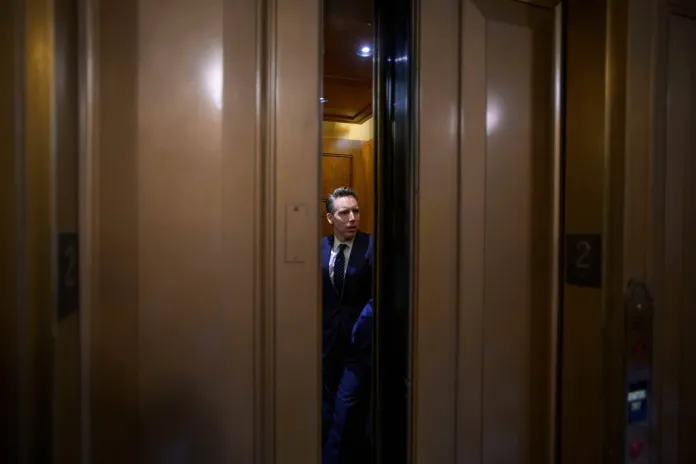
Murkowski confirmed that she remained unchanged and had spoken with the president after her initial vote. Trump lashed out on Truth Social against the five Republicans shortly after the resolution advanced, saying they “should never be elected to office again.” Collins faces a battleground reelection this fall.
The potential point of order objection from Republicans, if made, would be based on the notion that it’s unwarranted because no U.S. troops are in Venezuela. Most GOP lawmakers support the administration’s rationale that it had the legal authority to carry out targeted air strikes against suspected drug boats and remove Maduro from power because of the immediate threats posed to the United States.
“The question of whether or not there ought to be Congress telling the president that he can’t do something that he’s not doing and whether that ought to be accorded expedited consideration on the floor of the Senate, I think, is a valid question,” said Majority Leader John Thune (R-SD).
Kaine was optimistic that additional Republicans could buck Trump.
THE FIVE SENATE REPUBLICANS WHO BROKE RANK WITH TRUMP ON VENEZUELA WAR POWERS
“No one has ever regretted a vote that just said, ‘Mr. President, come to Congress before you send our sons and daughters into harm’s way,’” Kaine said. “That’s the point that I’d make to [Hawley] and my [Republican] colleagues.”
A final vote will be preceded by a debate and amendment process that could last several hours, depending on the number of votes held on proposed changes by Republicans. Kaine did not expect any votes on Democratic amendments.
Rachel Schilke contributed to this report.


