







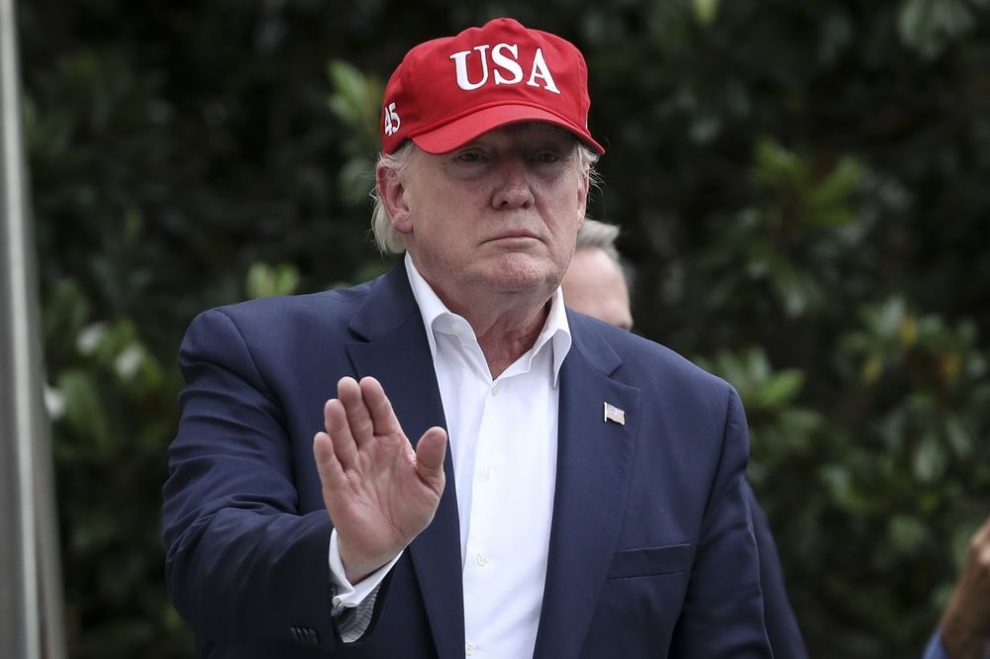
President Donald Trump has announced an immigration reform deal with the Mexican government which likely will allow border officials to end the catch-and-release of Central American migrants.
Ending catch-and-release is a huge win for Americans and Trump because it means border officials now have a legal alternative to the catch-and-release rules which allow migrants to legally enter the United States if they bring children and claim asylum.
Instead of catch-and-release, the migrants can be returned to Mexico until their asylum claims can be heard by a judge.
The “joint declaration” was outlined in a State Department message:
Watch: Outrageous Pro-El-Sayed Ad Blames Jewish State for Raising Price of Bananas, Eggs in Michigan
Haitian illegal immigrant charged in Walmart killing entered US via Biden parole program: DHS
Flavio Bolsonaro to be issued visa by State Department after fleeing Brazil
Right-Wing Presidential Candidate Flavio Bolsonaro Secretly Flees Brazil for US After Disputed Election: Report
Luxury real estate brothers sentenced to 30 years in prison for yearslong sex-trafficking scheme
Judge who apologized to accused would-be Trump assassin lights up DOJ in Hunter Biden FBI case
Jordanian Military Goes After Targets in Syria in Response to Terrorists Killing Christians
‘Beloved’ daredevils who scaled Empire State Building inching toward deal after proposal stunt: attorney
Judge slams federal prosecutors over new charges against ex-FBI officials
DHS Shuts Down Major Chinese Birth Tourism Loophole in US Pacific Territory
175 Democrats demand Trump admin stop Ilhan Omar investigation, warn it could hurt her re-election bid
Shouting match erupts at UN as Cuban foreign minister moves toward US ambassador’s podium: ‘Back up!’
Trump administration ‘monitoring’ leftist organizers ignoring new terrorism sanctions: State Department official
90 Percent of Largest United Methodist Church Congregation Votes to Leave Denomination – But It Won’t Be Easy
Hundreds of staged armed robberies helped thousands pose as crime victims in US immigration scam: DOJ
… those [migrants] crossing the U.S. Southern Border to seek asylum will be rapidly returned to Mexico where they may await the adjudication of their [US.] asylum claims.
In response, Mexico will authorize the entrance of all of those individuals for humanitarian reasons, in compliance with its international obligations, while they await the adjudication of their asylum claims. Mexico will also offer jobs, healthcare, and education according to its principles.
The United States commits to work to accelerate the adjudication of asylum claims and to conclude removal proceeding as expeditiously as possible.
…
Both parties also agree that, in the event the measure adopted do not have the expected results, they will take further actions.
Mexico’s agreement to offer jobs and healthcare to the migrants will weaken lawsuits by pro-migration U.S. groups that oppose the deal.
In exchange, the U.S will also work with Mexico to spur regional economic development.
Mexico also promised to step up police enforcement against the cartels’ labor trafficking from Central America into the United States:
Mexico will take unprecedented steps to increase enforcement to curb irregular migration, to include the deployment of its National Guard throughout Mexico, giving priority to its southern border.
Watch: Outrageous Pro-El-Sayed Ad Blames Jewish State for Raising Price of Bananas, Eggs in Michigan
Haitian illegal immigrant charged in Walmart killing entered US via Biden parole program: DHS
Flavio Bolsonaro to be issued visa by State Department after fleeing Brazil
Right-Wing Presidential Candidate Flavio Bolsonaro Secretly Flees Brazil for US After Disputed Election: Report
Luxury real estate brothers sentenced to 30 years in prison for yearslong sex-trafficking scheme
Judge who apologized to accused would-be Trump assassin lights up DOJ in Hunter Biden FBI case
Jordanian Military Goes After Targets in Syria in Response to Terrorists Killing Christians
‘Beloved’ daredevils who scaled Empire State Building inching toward deal after proposal stunt: attorney
Judge slams federal prosecutors over new charges against ex-FBI officials
DHS Shuts Down Major Chinese Birth Tourism Loophole in US Pacific Territory
175 Democrats demand Trump admin stop Ilhan Omar investigation, warn it could hurt her re-election bid
Shouting match erupts at UN as Cuban foreign minister moves toward US ambassador’s podium: ‘Back up!’
Trump administration ‘monitoring’ leftist organizers ignoring new terrorism sanctions: State Department official
90 Percent of Largest United Methodist Church Congregation Votes to Leave Denomination – But It Won’t Be Easy
Hundreds of staged armed robberies helped thousands pose as crime victims in US immigration scam: DOJ
The promise of extra enforcement is vague, and far less important to U.S. border security than the return of migrants to Mexico.
However, border officials face the practical problem of processing migrants for return to Mexico at a faster rate than the cartels can bus them up to the border. If the border agencies cannot keep pace with the cartels’ transport networks, they may be forced to release some migrants into the United States.
The compromise deal allows Mexico to dodge the escalating tariffs that Donald Trump promised, and it also means that Mexico does not have to formally declare itself a “safe third country.”
Trump and his deputies wanted Mexico to declare itself a safe third country because that would give U.S. border officials the permanent legal authority to reject migrants who cross through Mexico. But the Mexican government’s agreement to host the migrants before their U.S. court hearings provide similar legal authority to U.S. border agencies,
The deal means that border agencies will not have to release migrants into the United States prior to their asylum hearings.
The end of catch-and-release will likely wreck the cartels’ labor-trafficking business, which depends on migrants getting U.S. jobs to repay their smuggling debts. Few poor people in Honduras, El Salvador, or Guatemala will go into debt with the cartels, or mortgage their farms and homes to the cartels, once they know they will be forced to remain in Mexico prior to their asylum hearings.
The reduction of migration will also help stabilize the Central Americans countries, which is needed before foreign investors build farms or factories in those nations.
Watch: Outrageous Pro-El-Sayed Ad Blames Jewish State for Raising Price of Bananas, Eggs in Michigan
Haitian illegal immigrant charged in Walmart killing entered US via Biden parole program: DHS
Flavio Bolsonaro to be issued visa by State Department after fleeing Brazil
Right-Wing Presidential Candidate Flavio Bolsonaro Secretly Flees Brazil for US After Disputed Election: Report
Luxury real estate brothers sentenced to 30 years in prison for yearslong sex-trafficking scheme
Judge who apologized to accused would-be Trump assassin lights up DOJ in Hunter Biden FBI case
Jordanian Military Goes After Targets in Syria in Response to Terrorists Killing Christians
‘Beloved’ daredevils who scaled Empire State Building inching toward deal after proposal stunt: attorney
Judge slams federal prosecutors over new charges against ex-FBI officials
DHS Shuts Down Major Chinese Birth Tourism Loophole in US Pacific Territory
175 Democrats demand Trump admin stop Ilhan Omar investigation, warn it could hurt her re-election bid
Shouting match erupts at UN as Cuban foreign minister moves toward US ambassador’s podium: ‘Back up!’
Trump administration ‘monitoring’ leftist organizers ignoring new terrorism sanctions: State Department official
90 Percent of Largest United Methodist Church Congregation Votes to Leave Denomination – But It Won’t Be Easy
Hundreds of staged armed robberies helped thousands pose as crime victims in US immigration scam: DOJ
Under current rules, roughly one million Central Americans will walk through the border loopholes created and preserved by courts and Congress, and into Americans’ workplaces, neighborhoods, and schools during the 12 months prior to October.
Over the past 8 months, more than 500,000 Central Americans left the region. Guatemala saw largest absolute numbers but Honduras had the highest migration rate. (Acc to @sarahspalding & my @lawfareblog model, updated thru May for US #s and April for MX #s) https://t.co/CqjmA9prsM pic.twitter.com/kblXrWlc4d
— Stephanie Leutert (@Sleutert) June 7, 2019
Politically, a good deal for Trump is a bad deal for Democrats, who have campaigned during the last few days to prevent a deal that would slow the inflow of migrants.
Democrats oppose a deal, in part, because it reduces their bargaining power in the domestic fight against Trump to win amnesty for millions of illegals.
Story cited here.


