






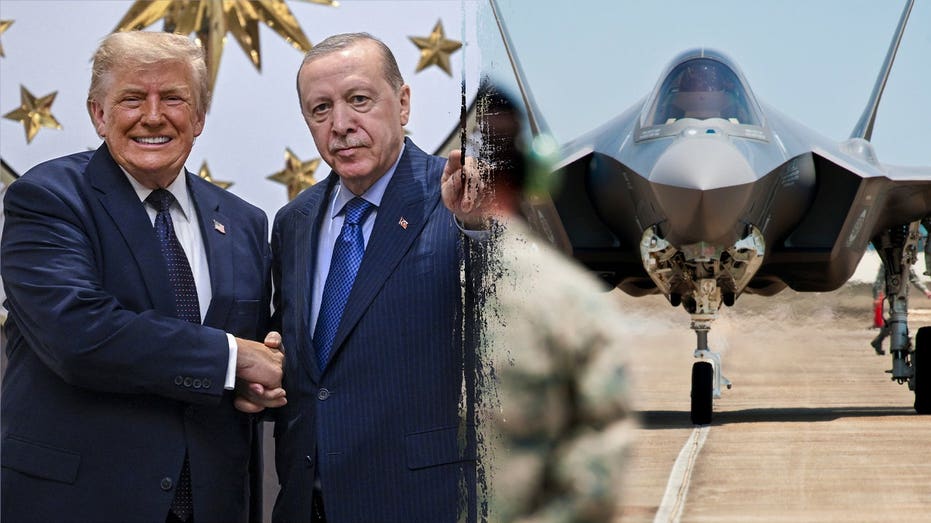
President Donald Trump said Tuesday he plans to lift U.S. sanctions on Turkey and signaled he is prepared to move forward with the long-stalled sale of F-35 stealth fighter jets, marking a dramatic reversal in U.S. policy toward the NATO ally years after Ankara was expelled from the program for its purchase of a Russian missile defense system.
Speaking alongside Turkish President Recep Tayyip Erdoğan during a bilateral meeting at the NATO summit in Ankara, Turkey, Tuesday, Trump said his administration would remove sanctions imposed on Turkey’s defense sector.
“I can tell you we’re going to be taking the sanctions off, OK?” Trump said. “I don’t want him to waste his time answering that question. It’s time. We don’t sanction friends.”
TRUMP BETS ON FORMER NATO TROUBLEMAKER AS TURKEY’S STRATEGIC VALUE SURGES
Asked whether he would sell F-35 fighter jets to Turkey despite existing legal restrictions tied to Ankara’s purchase of the Russian-made S-400 air defense system, Trump indicated he was open to doing so.
“Many people, including the people sitting right here think why wouldn’t we do that?” Trump said. “Turkey has been in many ways much more loyal than other countries that we think would be loyal.”
Pressed on concerns about Turkey’s continued possession of the S-400, Trump dismissed them.
“I have no concerns about anything.”
The remarks represent Trump’s clearest indication yet that he intends to restore defense ties with Turkey, building on months of efforts to revive military cooperation with one of NATO’s largest armed forces after years of strained relations.
Turkey was removed from the multinational F-35 program in 2019 after taking delivery of the Russian-made S-400 air defense system, prompting Washington to argue that operating the Kremlin-built system alongside America’s most advanced stealth fighter could expose sensitive U.S. technology. Congress subsequently imposed sanctions under the Countering America’s Adversaries Through Sanctions Act, or CAATSA.
Congress long has been one of the biggest obstacles to restoring Turkey’s access to the F-35, with bipartisan lawmakers arguing that Ankara should not receive America’s most advanced fighter aircraft while it continues to possess the Russian-made S-400 air defense system and pursues policies they say run counter to U.S. interests.
Beyond political opposition, the Trump administration also faces legal hurdles.
While the president has authority over sanctions policy, Congress enacted additional restrictions after Turkey’s purchase of the S-400. Section 1245 of the fiscal year 2020 National Defense Authorization Act bars the transfer of F-35 aircraft to Turkey unless the executive branch certifies that Ankara has met statutory requirements related to the Russian missile system.
In recent days, a bipartisan group of House lawmakers urged Trump not to move forward with an F-35 sale, arguing that doing so without satisfying those legal requirements would violate U.S. law and undermine national security.
Lawmakers also have warned that Turkey’s continued possession of the S-400, support for Hamas and tensions with fellow NATO allies Greece and Cyprus raise broader concerns about restoring Ankara’s access to the stealth fighter.
The Pentagon has maintained that the S-400’s sophisticated radar could collect data on the F-35’s radar signature and electronic profile during routine operations, potentially allowing Russia to better detect and defeat the aircraft in a future conflict if that information were shared with Moscow.
When the Trump administration removed Turkey from the F-35 program in 2019, the White House said “the F-35 cannot coexist with a Russian intelligence collection platform that will be used to learn about its advanced capabilities.”
Pentagon acquisition chief Ellen Lord similarly warned at the time that allowing Turkey to operate both systems would jeopardize the long-term security of the F-35 program because “much of the F-35’s strength lies in its stealth capabilities.”


